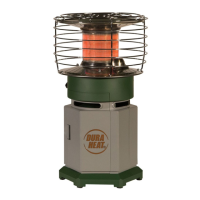
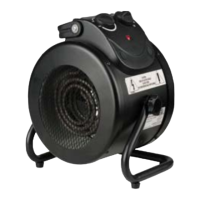
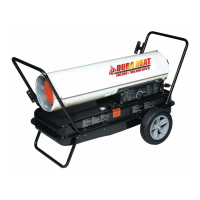
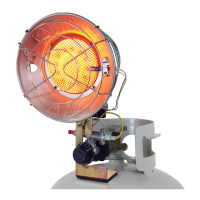
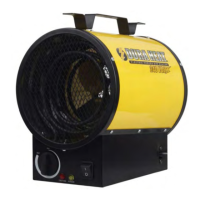
This document is a user's installation, operation, and maintenance manual for Dura Heat Propane Construction Heaters. It covers models LPC25, LPC80, and LPC200, which are designed for temporary heating in construction environments.
Function Description
These heaters are direct-fired propane convection heaters. Their primary purpose is to provide temporary heating for buildings under construction, alteration, or repair. They operate by burning propane gas and venting the products of combustion directly into the heated area. The heaters are designed to be used in accordance with ANSI Z83.7, CSA 2.14, and other relevant standards for fuel gases and heating products. Proper ventilation is crucial for safe operation, as the heaters produce carbon monoxide (CO), carbon dioxide (CO2), and nitrogen dioxide (NO2).
Important Technical Specifications
The manual provides detailed specifications for each model:
Fuel Type: Propane Vapor Only
Ignition Type: Piezo ignition (LPC25/LPC80/LPC200)
Minimum Operating Temperature: -20°F (-29°C) Surrounding Air
LPC25 Series:
- Rating (BTU/hr.): High: 25,000; Low: 15,000
- Fuel Consumption (lb/h): Minimum: 0.7 (0.32 kg/h); Maximum: 1.16 (0.53 kg/h)
- Supply Pressure: Minimum: Bottle pressure; Maximum: 5psi
- Manifold Pressure: High: 11.0" w.c.
- Ignitor Gap (Inch): .196 (4.98 mm)
- Size (Inch): 11.7 x 12.87 (29.69 x 32.79 cm)
LPC80 Series:
- Rating (BTU/hr.): High: 80,000; Low: 50,000
- Fuel Consumption (lb/h): Minimum: 2.32 (1.05 kg/h); Maximum: 3.71 (1.68 kg/h)
- Supply Pressure: Minimum: Bottle pressure; Maximum: 5psi
- Manifold Pressure: High: 11.0" w.c.
- Ignitor Gap (Inch): .196 (4.98 mm)
- Size (Inch): 15.9 x 18.3 (40.41 x 46.99 cm)
LPC200 Series:
- Rating (BTU/hr.): High: 200,000; Low: 50,000
- Fuel Consumption (lb/h): Minimum: 2.32 (1.05 kg/h); Maximum: 9.28 (4.21 kg/h)
- Supply Pressure: Minimum: Bottle pressure; Maximum: 12psi
- Manifold Pressure: High: 10psi
- Ignitor Gap (Inch): .196 (4.98 mm)
- Size (Inch): 15.9 x 26.2 (40.41 x 66.49 cm)
Clearance to Combustibles:
- RMC-LPC25: Sides: 2 ft. (60 cm); Top: 4 ft. (1.22 m)
- RMC-LPC80: Sides: 2 ft. (60 cm); Top: 5 ft. (1.52 m)
- RMC-LPC200: Sides: 3 ft. (91 cm); Top: 6 ft. (1.82 m)
Ventilation Requirements (Fresh Outside Air Opening):
- LPC25/LPC80: At least a 2½ square feet (.23 square meters) opening.
- RMC-LPC200: At least a 6 square feet (.56 square meters) opening.
Usage Features
Safety Information:
- Not for use in occupied dwellings, living, or sleeping quarters.
- Not for use in basements or below ground level due to propane gas being heavier than air.
- Keep appliance area clear of combustibles, gasoline, paint thinner, and other flammable vapors/liquids.
- Do not use in areas with high dust content.
- Heater must be located at least 6 ft. (1.83 m) in the U.S. or 10 ft. (3 m) in Canada from any propane gas container.
- Propane tank(s) must be kept below 100°F (37.8 °C).
- Check for damage before each use; do not use a damaged heater.
- Use only the hose and factory preset regulator provided.
- Check hose before each use; replace if highly worn or cut.
- Do not alter the heater.
- Locate heater on a stable and level surface.
- Not intended for use on finished floors.
- Never block air inlet (bottom of shell) or air outlet (around top of shell).
- Do not leave heater unattended.
- Keep children and animals away.
- Never move, handle, or service a hot or operating heater. Wait 15 minutes after turning off.
- Wear gloves when handling.
- Turn off propane supply when not in use.
- Use only original replacement parts.
- Installation at altitudes above 2000 ft. (610 m) must comply with local codes or relevant national standards (ANSI Z223.1 / NFPA 54, CSA B149.1).
Assembly:
- Assembly time is approximately 10 minutes.
- Tools required: Adjustable wrench (all models), Phillips head screwdriver (LPC80 and LPC200 Series).
- Involves removing packing materials, sliding the upper shell, attaching the regulator hose assembly to the propane tank(s), and connecting the hose to the heater's connector inlet.
- Important: Tighten regulator with the vent pointing down to protect it from weather damage.
Operation (LPC25/LPC80 Series):
- Turn control knob clockwise to "OFF" (O) position.
- Turn propane supply valve on by turning tank valve counterclockwise.
- Depress control knob and turn counterclockwise to "LOW/IGN" position to light burner.
- If burner doesn't light, turn knob to "OFF" (O), repeat step 4, holding the control knob depressed for 10-15 seconds.
- If flame goes out, wait 5 minutes, then repeat steps 4 and 5.
- Once operating, turn control knob counterclockwise to desired heating level between "LOW" and "HIGH."
- To turn off, turn control knob clockwise to "OFF" position, then turn propane supply valve off fully clockwise.
- Note: A small amount of air may be trapped in the gas line initially, requiring a few minutes to purge before the pilot and burner light normally.
Operation (LPC200 Series):
- Fully open the valve on the propane cylinder counterclockwise and wait 15 seconds.
- Depress the red button on the safety pilot valve, admitting gas to the pilot. Push and release the ignition button until the pilot lights.
- Hold the button depressed for 30 seconds after the pilot lights, then release.
- If the pilot goes out, wait 5 minutes and repeat the lighting procedure.
- Once the pilot remains lit, open the main burner valve to operate the heater. Partially close the valve to regulate heat output.
- To turn off, securely close the valve on the propane cylinder, then close the main burner valve.
- To restart after a safety shutdown, securely close the valve at the propane cylinder, wait 5 minutes, then follow the "Start" procedure.
Maintenance Features
General Maintenance:
- Keep the heater clean.
- Inspect the heater before each use. Check connections for leaks by applying a mixture of liquid soap and water; bubbles indicate a leak that must be corrected.
- Inspect the regulator hose assembly before each use. Replace if highly worn or cut.
- Have the heater inspected yearly by a qualified service person.
Storage:
- Disconnect the heater from the propane supply tank(s).
- Store propane tank(s) safely, referring to Chapter 5 of ANSI/NFPA 58 and CSA B149.1. Always store propane tanks outdoors.
- Place plastic cover caps over brass fittings on the connector inlet and regulator hose assembly.
- Store the heater in a dry, clean, and safe place.
Troubleshooting:
The manual includes a troubleshooting guide for common issues:
- Burner fails to light: Possible causes include closed propane supply valve, closed excess-flow check valve, blockage in burner nozzle, or faulty piezo ignition. Remedies involve opening valves, replacing the nozzle, or checking the ignitor electrode gap and wire lead.
- Burner lights but goes out when automatic control valve button is released: Possible causes include insufficient warm-up time, low gas pressure, loose/faulty thermocouple, or faulty automatic control valve. Remedies include relighting and holding the button longer, checking gas supply, tightening/replacing the thermocouple, or replacing the control valve.
- Burn rate is low: Possible causes include main burner valve not fully open, plugged gas orifices, low gas pressure, or low fuel supply. Remedies include fully opening the main burner valve, replacing gas orifices, checking gas supply/regulator output, or consulting the propane gas supplier.
Replacement Parts:
- The manual emphasizes using only original replacement parts, as design-specific parts are crucial for safety and warranty coverage.
- Detailed diagrams and lists of replacement parts are provided for each model (LPC25, LPC80, LPC200), including part numbers and quantities.
- Contact information for World Marketing of America, Inc. is provided for obtaining replacement parts or warranty service. When calling, users should have their name, address, description of malfunction, serial number, model number, and replacement part number ready.

 Need help?

 To Next Page
 General