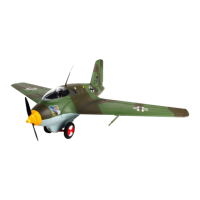
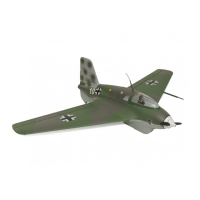
The Durafly Me-163 V2 Messerschmitt Me-163B "White 10" is an interceptor fighter model designed for intermediate to advanced pilots, offering a blend of scale realism and high-performance flight. This "Plug N Fly" model comes with a pre-installed motor, ESC, and servos, requiring only a few additional components to get it flight-ready.
Function Description
The Me-163 V2 is a radio-controlled flying model capable of blistering performance and incredible handling. Its primary function is to provide an exciting and authentic flying experience, replicating the Messerschmitt Me-163B "White 10" interceptor fighter. The model is designed for unlimited vertical performance, fast passes, and a wide range of aerobatic maneuvers, including huge loops and vertical rolls. Despite its speed and agility, it also boasts stable slow-speed handling and an impressive glide rate, making landings smooth and manageable.
A unique feature of this V2 version is its gravity-release scale "dolly" style undercarriage. This system simplifies the take-off procedure and reduces overall weight. The dolly is designed to fall away easily once the model lifts into a climb, simulating the original aircraft's take-off mechanism. For those flying from bumpy strips, an optional magnetic gear release system is also available, offering an alternative method for dolly detachment.
The model is powered by a brushless outrunner motor and an electronic speed controller (ESC), pre-installed for convenience. It is designed to operate with a 4S LiPo battery, providing ample power for extended flight times, typically 5-6 minutes with mixed throttle use. However, the power system is versatile enough to allow for 3S battery operation without any modifications.
Beyond its standard flight capabilities, the Me-163 V2 is also designed to accommodate a standard 18mm class model rocket engine. This optional feature allows for an incredibly scale-looking climb-out, adding an extra layer of realism and excitement for experienced users. An RC switch, rated for the appropriate voltage and amperage, is required to ignite the rocket engine.
Usage Features
The Me-163 V2 is a sophisticated hobby product that requires careful operation and adherence to safety guidelines. Before flying, pilots must ensure the model is fully assembled, all screws and bolts are secure, and control surfaces are moving correctly.
Setting up the model involves installing the receiver and flight battery. The recommended 2200mAh 4S LiPo battery, when placed in the suggested position, helps achieve the approximate center of gravity (CG). Adjustments to battery placement may be necessary for lighter batteries to maintain the correct CG.
Control surface setup is crucial for optimal flight performance. With the receiver installed and servos connected, pilots must ensure all servos are centered and the rudder control surface is neutral. A small amount of "up reflex" (1-2mm) in the ailerons is recommended to improve overall flight handling. Control throws for elevator, aileron, and rudder are specified for both "low rates" and "high rates" to allow for varied flying styles and conditions.
Take-off can be performed using either the gravity-fed dolly or by hand launching. When using the dolly, a flat, short-grassed surface of 15-20m is recommended. Pilots should apply initial power slowly with some "up" elevator, gradually increasing throttle and using rudder to maintain a straight tracking line. The dolly will detach automatically once the model lifts off. For hand launching, it is advised to have a friend assist, ensuring a firm and balanced grip on the fuselage. The model should be launched with a firm throw, pointing slightly above the horizon, and with not more than 3/4 throttle, applying a small amount of right aileron to counter prop rotational force.
During flight, the Me-163 V2 offers exceptional stability and responsiveness. With reduced throttle, it maintains good slow-speed handling and an excellent glide rate, making it confidence-inspiring for pilots. Landing is straightforward due to its low stall speed, allowing for smooth descents with minimal effort.
Maintenance Features
The Durafly Me-163 V2 is constructed from molded EPO foam, which is durable and features internal carbon reinforcement. This construction contributes to the model's longevity and resistance to minor impacts. A color-matched hard plastic belly skid is included to protect the underside during landings.
Access to internal electronics, including the battery and receiver, is facilitated by a convenient battery/canopy hatch. This design also ensures excellent cooling for the internal components.
Regular pre-flight checks are essential for safe operation. These include range checking the model, verifying the security of all screws, bolts, and control horns, and ensuring both the radio and flight batteries are fully charged. Pilots should inspect the model and propeller for any damage that may have occurred during transit and listen for unusual sounds from the electronics. The propeller's rotation direction should also be confirmed.
Maintaining a balanced propeller is highly recommended for optimum flight performance and model longevity. Although the supplied prop should be balanced, it's always good practice to check and re-balance if necessary. Frequent inspection of the propeller is advised, especially after hard landings or impacts, and any damaged prop must be replaced. Loose fixings should be tightened.
Keeping all leads within the fuselage tidy is also a good maintenance practice. Tidy wiring not only improves aesthetics but also allows for easier access to components, better battery installation, increased airflow around electronics, and a reduction in potential electronic signal interference.
The manual also provides a trouble-shooting guide to help pilots diagnose and resolve common issues such as the motor not turning, control surfaces not moving correctly, or the model not flying straight or climbing. This guide offers solutions ranging from checking battery charge and connections to adjusting trims or replacing damaged components.


 To Next Page
 General