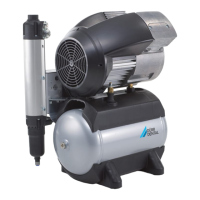
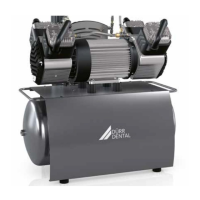
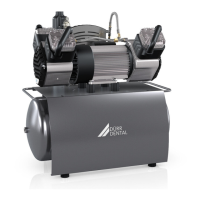
The DÜRR DENTAL Compressor is a device designed for generating oil-free, dry, and filtered compressed air, primarily for operating dental units and similar applications. It is available in various models, including Primo, Duo, Trio, Quattro, Duo-Tandem, and Quattro Tandem, with or without a dry-air system.
Function Description:
The compressor operates by drawing in atmospheric air through an intake filter (13). A cylinder piston (12) then compresses this air without oil contamination. The compressed air's flow is regulated by inlet/outlet valves.
In models with a dry-air system, the compressed air is directed through a spiral-shaped cooling tube (3). Here, the heated air cools, and a significant portion of its moisture is extracted as condensation water. This pre-dried air then passes through a drier (14), sintered metal filter (4), fine-mesh or sterilization filter (1), and a non-return valve (15a) before reaching the pressure tank (8). The non-return valve prevents backflow. When the compressor switches off, condensation water is blown into a collecting trough (5), and pressure hoses are vented.
The dry-air system also features a regeneration process. A polyamide band (16) inside the hygrostat expands in the presence of humidity. If the relative humidity in the pressure tank (8) exceeds a set limit, a valve on the hygrostat opens, causing air to flow out of the pressure tank in the opposite direction, which can be heard as a blowing sound. This regeneration process continues until the desired relative humidity is achieved, and it occurs when the compressor is at a standstill.
In models without a dry-air system, the compressed air is forced through a non-return valve (15b) directly into the pressure tank (8). After the compressor set switches off, the pressure hoses are vented via a vent valve (17).
All compressor models include a valve unit with a pressure switch (11). When compressed air is withdrawn, the pressure in the tank decreases. Once the minimum tank pressure (5.5 bar) is reached, the pressure switch activates the compressor. It continues to run until the maximum tank pressure (7.5 bar) is attained, at which point it switches off. The maximum permissible tank pressure is 10 bar, indicated in red on the pressure gauge (7). A safety relief valve (6) prevents this maximum pressure from being exceeded. A drain cock (9) is used to manually drain condensation water from the pressure tank.
Important Technical Specifications:
The compressors are designed for operation in dry, ventilated rooms with an ambient temperature range of +10 °C to +40 °C. They are not suitable for damp, wet, or explosive environments.
- Voltage: Available in 230 V and 400 V versions, with 50-60 Hz frequency.
- Current Consumption (at 8 bar): Ranges from 3.1 A to 14.3 A depending on the model and voltage.
- Motor Protection Switch: Maximum permissible settings vary by model (e.g., 6.3 A for Primo, 10.0 A for Trio).
- Rated Output: Ranges from 0.80 kW to 5.90 kW.
- Speed: Ranges from 1350 min⁻¹ to 1710 min⁻¹.
- Mains Fuse: LS-10A (characteristics B, C, D according to DIN EN 60898).
- Protection System: IP 54 for most models, IP 44 for Tornado 70 and 130.
- Noise Level: Ranges from 67 dB(A) to 79 dB(A).
- Number of Cylinders: 1 to 4, or 2x2 to 2x4 for tandem models.
- Delivery at 5 bar: Ranges from 60 l/min to 540 l/min, with variations for dry-air systems.
- Switch-on/off Pressure: 5.5/7.5 bar for all models.
- Safety Valve - Admissible Operating Pressure: 10 bar.
- Volume of Pressure Tank: 20 l to 90 l.
- Duty Cycle: 50% for models with dry-air system, 100% for models without dry-air system.
- Grade of Filtration: Cartridge for compressor (10 µm), Fine-mesh Filter for DAS (1 µm), Sterilized Filter for DAS (0.01 µm).
- Weight: Ranges from 47 kg to 175 kg depending on the model and presence of a dry-air system.
- Dimensions (H x W x D): Vary by model, e.g., 64 x 49 x 46 cm for Primo with DAS, 86 x 103 x 63 cm for Quattro Tandem with DAS.
- Charging Time (0-7.5 bar): Ranges from 40 s to 171 s.
Climatic Conditions:
- Storage and Transport: Temperature -25 °C to +55 °C (24h to +70 °C), Relative Atmospheric Humidity 10% to 90% (without condensation).
- Operation: Temperature +10 °C to 40 °C, Relative Atmospheric Humidity up to +70%.
Usage Features:
- CE-Marking: All products conform to European safety guidelines and directives.
- Intended Use: Specifically for generating compressed air for dental equipment.
- Installation: Must be installed in dry, well-ventilated rooms, free of dust. Adequate spacing (approx. 20 cm) from walls is required for air filter suction and ventilation slats.
- Electrical Connection: Must be carried out by a qualified electrician, ensuring mains voltage and frequency match rating plate data. A power disconnecting device with a contact opening width of at least 3 mm is required for permanent connections.
- Safety Valve Check: Must be checked for proper functioning during initial service by turning the screw (6) counter-clockwise until blow-off occurs, then closing it. The safety valve is factory-set to 10 bar and must not be altered.
- Pressure Switch Adjustment: The working pressure can be modified by adjusting screws (32, 33) on the pressure switch (11) in a live state.
- Condensation Water Drainage: For models without a dry-air system, condensation water must be drained at least once a month, or daily in high humidity environments. For models with a dry-air system, it is discharged automatically, but initial drainage is required upon installation.
- Shutting Down: For longer periods of disuse, drain condensation water, run the compressor for 10 minutes with the drain cock open, then switch off and disconnect from mains.
Maintenance Features:
- Maintenance Intervals:
- Setting the pressure reducer: Once a year.
- Draining off condensation water: Once a month (without dry-air system), once a day (without dry-air system in high humidity), check every six months (with dry-air system, draining if necessary).
- Safety-valve check: Every six months.
- Filter replacement: Once a year.
- Repair Work: Exceeding normal maintenance operations must only be carried out by a suitably qualified engineer or DÜRR DENTAL customer service staff. Only manufacturer-licensed spare parts and accessories should be used.
- Safety Precautions: Always switch off the compressor and disconnect from mains before performing any maintenance or repair work.
- Filter Replacement: Used filters must not be cleaned but replaced with new ones. The intervals depend on air dust content, but annual replacement is recommended.
- Pressure Reducer (40): This accessory controls flow pressure. It is connected to the pressure switch via an express coupling (20).
- Troubleshooting: A detailed troubleshooting guide is provided for users and technicians, covering issues like failure to start/switch off, unusual noises, decline in performance, and water dripping from air consumers. Solutions range from checking fuses and pressure switches to replacing components or cleaning filters.
- Dry-air System Failure: In case of failure, the dry-air system can be temporarily bridged over to allow continued operation, but prompt repair is necessary, and condensation water must be drained daily.

 Need help?
 General


 To Next Page