Need help?
Do you have a question about the Dyon LIVE 32 PRO and is the answer not in the manual?
Connect the TV to the power supply and establish antenna connection for desired reception mode.
Overview of key functions for menu navigation, selection, and volume control.
Guide through language, country, reception mode selection, and channel search process.
Identifies essential remote buttons for navigation, confirmation, and menu access.
Insert batteries into the remote control, ensuring correct polarity for operation.
Turn on the TV using the power button on the remote or the device itself.
Locate and use the physical power button on the TV unit for operation.
Covers 18 essential points for safe operation, cleaning, ventilation, and avoiding hazards.
Advises against exposing the apparatus to rain, moisture, or excessive heat.
Guidance on proper disposal of electrical equipment and batteries for recycling.
Details maximum transmission power for Wi-Fi frequencies.
Provides manufacturer contact details and website.
States compliance with EU directives and provides link to declaration.
Directs users to EU website for energy efficiency data via QR code.
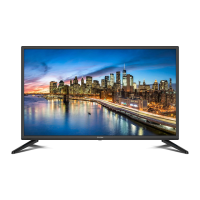
This document serves as a Quick Start Guide for the DYON 32 PRO television, providing essential information for its setup, operation, and maintenance. It covers initial mounting, power-on procedures, basic menu navigation, setup steps, and an overview of the remote control functions. Additionally, it includes important safety instructions, environmental protection tips, and manufacturer contact details.
The first step involves physically mounting the television. Users are directed to consult the separate manual for detailed instructions on stand mounting. Once mounted, the TV needs to be connected to a power supply. The guide then instructs on establishing the antenna connection based on the desired reception mode: Satellite, DVB-C, or DVB-T2. The antenna connections are located on the backside of the unit, to the left when viewed from the front.
To power on the device, batteries must first be inserted into the remote control, ensuring correct polarity. The TV can then be switched on by pressing the red power button located at the top left of the remote control. Alternatively, the device can be switched on directly at the unit itself. The on/off switch is located on the left side of the center, next to the status light at the bottom, when viewed from the front. A brief press of this button turns the unit on, while a press when the unit is already on will display the function menu. Upon initial power-on, the device will start and display the initial setup screen.
The function menu is accessed by briefly pressing a designated key. To select a desired function, the key is pressed briefly, and to execute a selected function, the key is pressed and held. Key functions include On/Off, opening the settings menu, selecting the signal source, and increasing/decreasing volume. In the setup menu and when selecting the signal source, specific key functions apply: the '+' button confirms selection (OK), the '►' key navigates right or left, and the '▾' key navigates up or down.
The setup process guides the user through several steps. First, the desired menu language is selected using the '+' button and confirmed with the OK button. The '►' button is then pressed to proceed. Next, the user selects their country. Following this, "on" is selected for home usage. The OK button is pressed to select the reception mode. Using the '+' button, the user chooses between analogue (ATV), digital (DTV), or both types of programs to be searched. The LCN (Logical Channel Numbering) setting will be automatically configured. If DVB-S (Satellite) is chosen as the reception mode, the EXIT button can be pressed to use a preinstalled channel list. The final step involves waiting for the channel search to complete, after which the first channel will be displayed.
The remote control provides comprehensive control over the television. Key functions include:
The guide provides specific notes regarding different reception modes. For DVB-T2, it clarifies that the number of receivable transmitters depends on location and availability, and that DVB-T2 radio stations are scarce. Users are advised to perform a new station search whenever changing location, as broadcast stations and frequencies vary. For DVB-C reception, both analogue and digital programs can be received, with digital mode offering more channels and better picture quality. For encrypted TV channels received via satellite, DVB-T2, or DVB-C, a CAM Module and a Smart card from the service provider are required. The usability of programs depends on the contract. The CI+ slot is where the CAM Module and Smart card are inserted. It's noted that the module and Smart card are not included and activation may take a few minutes. Users should consult the CI+ Module manual, and only CI+ Modules and Cards are supported. The guide also warns that CI+ functions may be limited on some channels by the program provider.
The document includes a comprehensive list of important safety instructions, covering aspects like proper handling, cleaning, ventilation, heat sources, power cord protection, and servicing. It warns against exposing the apparatus to rain or moisture and states that batteries should not be exposed to excessive heat.
Environmental protection tips are also provided. At the end of its life, the product should not be disposed of with normal household waste but taken to a collection point for recycling electrical and electronic equipment. The materials used are recyclable. Similarly, used batteries should not be disposed of with household waste but taken to a local retail or community collection point for recycling.
The manufacturer is identified as Axdia International GmbH. The document also includes a CE conformity statement, declaring that the device complies with the basic requirements and relevant regulations outlined in various EU guidelines. A link is provided to access the full CE declaration of conformity.
For further questions, users are directed to contact customer service via email. To facilitate quick resolution of issues, customers are asked to provide specific information: the product name (DYON), serial number, date of purchase, and a description of the problem.
This guide aims to provide a clear and concise overview, enabling users to quickly set up and operate their DYON 32 PRO television while adhering to safety and environmental guidelines. For detailed information, users are advised to consult the enclosed comprehensive manual.
 General
| Screen Size | 32 inches |
|---|---|
| Resolution | 1366 x 768 pixels |
| Display Type | LED |
| HD type | HD |
| Screen shape | Flat |
| Smart TV | No |
| Number of HDMI ports | 3 |
| Number of USB ports | 1 |
| Wi-Fi | No |
| Audio Output | 2x 8W |
| Digital signal format system | DVB-C, DVB-S2, DVB-T2 |
| VESA mounting | 100 x 100 mm |
| Display diagonal | 81 cm |
| Display resolution | 1366 x 768 |

 To Next Page