
 Need help?
Do you have a question about the Dyson Airblade 9KJ and is the answer not in the manual?
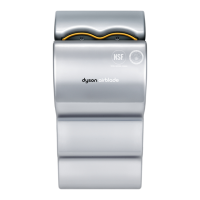
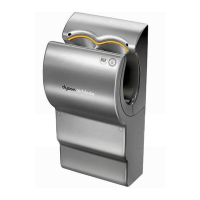
The Dyson Airblade™ hand dryer is an electrical machine designed for drying hands in commercial and public bathroom environments. It is intended for indoor use only, within an operating temperature range of 32°F (0°C) to 104°F (40°C).
The primary function of the Dyson Airblade™ hand dryer is to efficiently dry hands. When hands are placed beneath the hand dryer arms, it automatically activates, creating sheets of air that effectively scrape water from the hands. This process is designed to provide a quick and hygienic hand-drying experience.
To achieve the best dry time results, users should keep their hands flat and parallel to the machine's surface, approximately 0.2 inches (5mm) from the air aperture. Hands should be drawn through the airflow from the wrists to the fingertips, moving them slowly backwards and forwards, and turning them over to expose both the back and front to the airflow. It is recommended to keep hands flat, close the gaps between fingers, and keep thumbs tucked in, ensuring the entire hand is drawn through the airflow.
The hand dryer features two power modes: 900W and 650W. The machine is set to 900W as default, but the power mode can be changed to 650W before installation if required. This allows for flexibility in energy consumption based on specific needs.
The machine is equipped with sensors that detect hands for automatic activation. If the hand dryer is used continuously for 30 seconds, it will automatically turn off. To restart, users simply remove and replace their hands.
Installation of the Dyson Airblade™ hand dryer requires careful planning and adherence to specific guidelines to ensure safe and secure operation. The machine is designed for dry, internal locations. Installers must consult local and national accessibility codes and regulations for relevant installation guidelines and ensure compliance with all building codes and regulations. It is crucial to isolate the power supply before beginning any installation or service work.
Before drilling, installers must ensure that no pipework (gas, water, air) or electrical cables, wires, or ductwork are located directly behind the drilling/mounting area. The selected location should allow for accessibility to the machine and proper clearance from surroundings and the floor, with at least 8.25 inches (210mm) above for filter removal.
The hand dryer should not be fixed to unsupported plasterboard (drywall) as this will not provide a safe and secure installation and may invalidate the warranty. If only unsupported plasterboard is available, a Dyson backplate must be used. If the wall has an airgap, the fixings used must be of sufficient length to provide a secure installation. Sealant should not be used when fixing the machine to the wall.
For rear cable entry installation, the electricity supply cable must align from the wall to the entry point on the Mounting template. For side cable entry installation, an additional hole will need drilling as indicated on the Mounting template. Holes should be drilled using a suitable drill bit.
The installation process involves securing the backplate to the wall using suitable fixings (not countersunk screws). The cable clamp, terminal block, and terminal block holder are removed from the backplate. The three screws on the terminal block are loosened, ensuring the pre-installed earth wire remains in place. The gland should be cut smaller than the cable diameter, and the cable fed through the conduit box and gland without removing the gland from the backplate. The cable must sit securely in the cable guide to prevent issues when fixing the main body. Live, neutral, and earth wires are secured to the appropriate terminal block locations as indicated on the backplate, ensuring the pre-installed earth wire remains securely inserted into the connector block. The earth cable is wound around the earth terminal stud on the backplate and secured with a nut. Finally, the terminal block is secured to the backplate with the terminal block holder and the cable clamp. Only double insulated cables should be clamped with the cable clamp, and electrical fixtures should not be overtightened.
For side cable entry installation, the entry tab on the machine is unscrewed, and the rubber side tab of the conduit box on the side facing downwards is cut. A suitable cable gland/conduit connector (not supplied) is used for the installation, and the conduit box is secured to the wall using suitable fixings. The rest of the wiring steps are similar to the rear cable entry installation.
After the backplate and wiring are complete, the main body of the hand dryer is hooked onto the backplate and gently lowered until it is flush with the wall, ensuring both backplate hooks are securely in position. The two security screws are then fixed into the bottom of the machine using the supplied tool.
To complete the installation, the filter unit is placed into the machine, ensuring it clicks securely into place. The mains power supply is then turned on, and the machine is tested by placing hands in sight of the sensors.
The Dyson Airblade™ hand dryer should be cleaned daily. Sensors should be wiped with a soft cloth and a non-abrasive cleaner. It is important not to pressure wash or power wash the machine. All cleaning chemicals must be used exactly as indicated by the manufacturer's instructions, including appropriate dilution. Any chemicals should first be tested on an inconspicuous area to confirm suitability. Harmful fluids, particularly oils and alcohol-based products, should be avoided from coming into contact with the product.
Regularly check the air inlet to ensure it is free from dust and debris. Wiping the inlet with a soft cloth should be sufficient to remove dust and debris. If the air inlet becomes clogged, further cleaning or a filter change may be required. For high usage environments, a Dyson filter change kit is available, providing everything needed to change the machine's HEPA filter on site.
Filter cleaning or replacement can be carried out by carefully following the instructions in the filter change kit. If in doubt, a qualified electrician or the Dyson Helpline should be consulted.
If the hand dryer cuts out, after 30 seconds of continuous use, it will turn off automatically. Removing and replacing hands will restart it. If this does not work, turn the machine off and on again at the mains electricity supply. Ensure the sensors are clean. Check that the air apertures are clean and free of dust and blockages; if dusty, simply remove dust. Also, check that the air inlet is free from blockages.
If the dry time has increased, ensure the correct power mode has been selected. Check that the air inlet is free from blockages and inspect the air inlets for dust, removing any found.
If the airflow is running hotter than usual, check that the air inlet is free from blockages and inspect the air inlets for dust, removing any found.
If the air is continuously running, after 30 seconds of continuous use, the hand dryer will turn off automatically. Removing and replacing hands will restart it. Check that the air inlet is free from blockages and inspect the air inlets for dust, removing any found.
For further support or if the hand dryer needs servicing, contact the Dyson Helpline or visit the Dyson website.
The Dyson Airblade™ hand dryer comes with a 5-year limited warranty covering original defects, material, and workmanship when used in accordance with the Dyson manual. The warranty starts from the date of purchase, or 90 days after the date of manufacture if proof of purchase is not available. The warranty is void if the machine is installed and used in a country outside the one in which it was sold.
The warranty covers factory parts and, if the main body assembly needs replacing, Dyson will send a replacement to be fitted by the customer, who will need to return any defective parts using a prepaid postage box. Replaced parts must be returned to Dyson, or an administration fee will be levied. Any parts returned and replaced by Dyson become the property of Dyson. The replacement of any part under warranty will not extend the warranty period.
The warranty does not cover costs, damages, or repairs incurred as a result of purchases from unauthorized dealers, careless operation or handling, misuse, abuse, lack of maintenance, or use not in accordance with the Dyson manual. It also excludes the use of parts and accessories not produced or recommended by Dyson, external sources like weather or power surges, faulty installation not precisely following Dyson's instructions (unless installed by Dyson), repairs or alterations by unauthorized parties, normal wear and tear (e.g., fuse), damage caused by cleaning not in line with the Dyson manual, damage caused by water ingress due to prohibited cleaning or treatment, or any electrical, flooding, or structural damage, or loss of business/revenue due to product failure.
The warranty is limited to the duration of the warranty for implied warranties like merchantability or fitness for a particular purpose. The remedy for breach of warranty is limited to the warranty service described. Dyson is not liable for consequential or incidental damages. This limited warranty provides specific legal rights, and other rights may vary by state. It is not transferable.
When registering the Dyson machine, users will provide basic contact information to register the machine and enable warranty support. Users can choose to receive communications from Dyson regarding special offers and innovations. Dyson does not sell user information to third parties and uses it as defined by its privacy policies.
 General
| Type | Hand Dryer |
|---|---|
| Drying Time | 10-12 seconds |
| HEPA filter | Yes |
| Motor type | Digital motor |
| Power Consumption | 1600W |
| Noise Level | 79 dB |
| Color | White |
| Certifications | CE |






 To Next Page

