ILER-20 MK2 SSB QRP Transceiver Kit Page 29
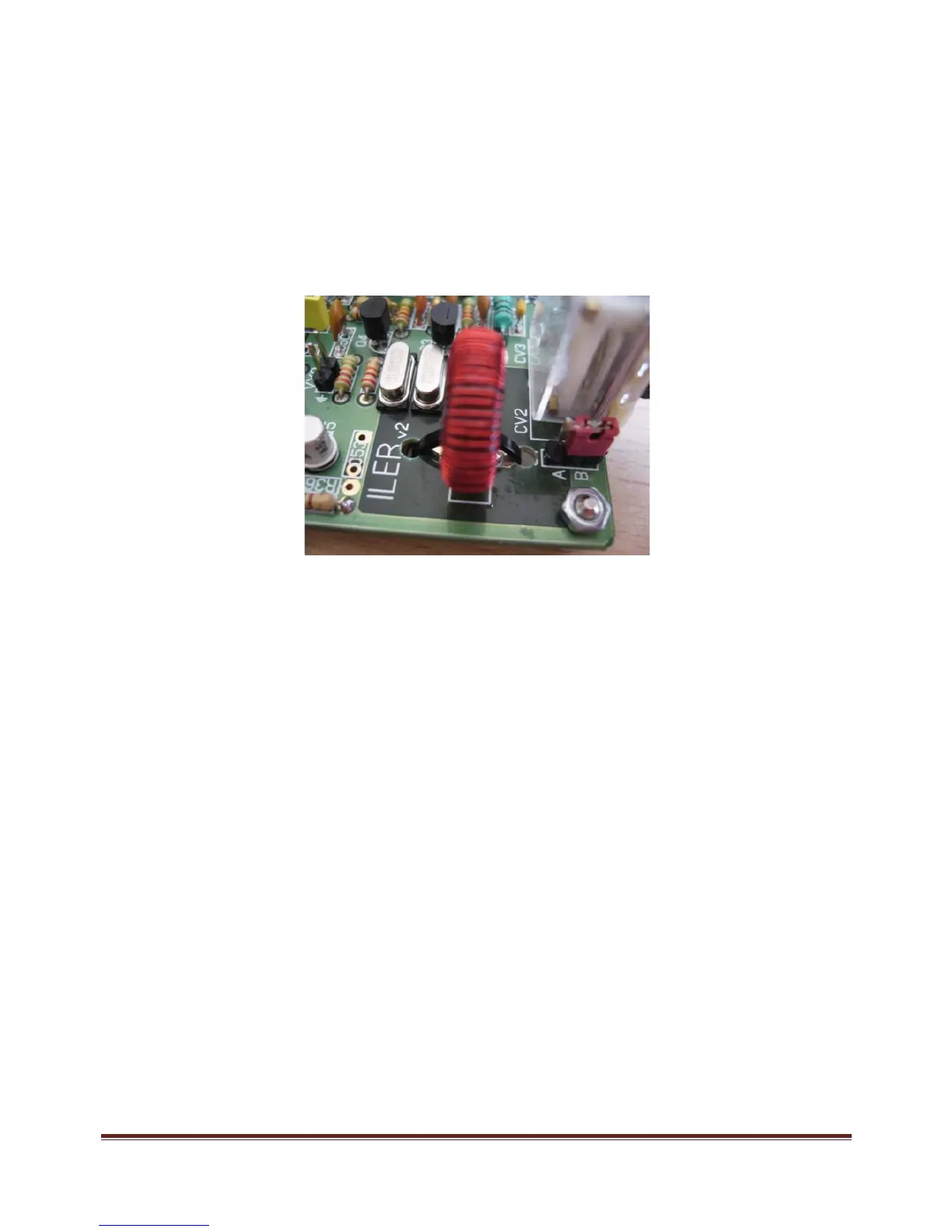
2) The most effective and cleanest option is t o use a small plastic tie-wrap, passing it through the
holes in the circuit board as showing in the picture.
Once the tie-wrap is f ully tightened, you will still be able to move the turns slightly and make slight
adjustments before securing them with a little bit of nail polish.
L6 should be well secured; this is very important, since vibrations may change the VXO frequency,
causing frequency "flutter" in the received and transmitted signals.
IMPORTANT: Prior to permanently securing L6, make all of the transceiver adjustments and checks and
confirm that the frequency coverage suits your needs.
I r ecommend this number of turns and type of toroid for L6. It works well! However, you can modify and
experiment with the inductance to try a different coverage. More inductance will increase the coverage
but reduce the stability and the VXO may even stop oscillating, and vice versa.
In order to obtain good stability, a maximum coverage of 50-60 KHz is
recommended.
In addition, a wide coverage will make tuning difficult, and it will be necessary to add a fine tuning control
by using gear reduction on the polyvaricon, a second variable capacitor or a varactor diode.
Do not worry too much about obtaining exact coverage down to the KHz. I s it so important to end up with
60, 59 or 61 KHz?
If you have graphical ability, you can draw a dial on the front panel with a frequency scale to serve as a
guide.
In order to put us in other segments of the band different from t hose specified here, you will need to use
VXO crystals with different frequencies.
Adjustment of the BFO/Carrier Oscillator
There are two ways to adjust the BFO oscillator frequency.
- Adjustment without instrumentation:
Turn on the transceiver. Leave it on for about 5 minutes.
You can adjust CV1 while listening to a USB signal on the 20 meter band. This is a “two-hand” operation;
tune the VXO to obtain the best possible intelligibility, and next adjust CV1 to obtaining the best possible
audio quality. Repeat these adjustments until obtaining the best possible results.



 To Next Page