Need help?
Do you have a question about the EAS Electric EDMV2 Series and is the answer not in the manual?
Safety warnings regarding product use, including immediate actions for abnormal situations, avoiding certain actions, and ventilation.
Warnings about cleaning and maintenance, emphasizing power disconnection and avoiding specific cleaning agents or excessive water.
Warnings related to electrical safety, including using specified power cords, proper grounding, and wiring standards.
Warnings for product installation, emphasizing authorized personnel, proper parts, firm location, and drainage.
Safety requirements for using flammable refrigerants, including storage in well-ventilated areas based on room size.
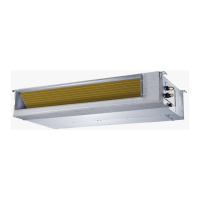
Description of indoor unit components and how to remove the air filter based on different configurations.
Explanation of the display panel indicators and buttons, including manual button functions and operating modes.
Recommended operating temperature ranges for cooling, heating, and dry modes for indoor and outdoor units.
Details on default setting, auto-restart function, louver angle memory, and refrigerant leak detection system.
Instructions for cleaning the indoor unit, emphasizing power disconnection and using specific cleaning methods.
Steps for maintaining the unit during long periods of non-use, including cleaning filters and turning off the unit.
Steps for pre-season inspection after long periods of non-use, including checking wires, filters, and leaks.
Safety precautions to take immediately if certain conditions occur, emphasizing contacting authorized service.
Common issues like unit not turning on, mode changes, white mist, and noises, with possible causes.
Further common issues like outdoor unit noise, dust emission, bad odor, and fan not operating, with causes.
Specific problems like poor cooling performance and their corresponding solutions.
Solutions for issues like the unit not working, starting/stopping frequently, poor heating, and indicator lamp flashing.
List and descriptions of included installation accessories and optional accessories like remote controls.
Guidance on selecting an appropriate installation location for the indoor unit, including unsuitable locations.
Instructions and diagrams for hanging the indoor unit, including detailed dimensions for different models.
Instructions for mounting on wood beams, concrete bricks, and steel roof structures.
Instructions for installing ducts and accessories, including filter, canvas tie-in, and static pressure guidelines.
Instructions for adjusting the air inlet direction, including ventilation panel and flange positioning.
Instructions for installing fresh air ducts and performing motor/drain pump maintenance.
Instructions for drilling wall holes for connective piping, emphasizing downward angle for drainage.
Instructions for connecting the drain hose, including insulation, pipe clasp, and drainage installation guidelines.
Procedures for connecting the drain hose and performing drainage tests for units with and without pumps.
Guidance on selecting an appropriate installation location for the outdoor unit, including space requirements and unsuitable locations.
Instructions for installing the drain joint on the outdoor unit, with different types and cold climate considerations.
Instructions for anchoring the outdoor unit to the ground or wall, with unit mounting dimensions.
Tables and diagrams detailing outdoor unit dimensions, mounting distances, and series installation spacing.
Table detailing maximum length and drop height for refrigerant piping based on model capacity.
Explanation of oil traps in gas piping to prevent oil flow back to the compressor.
Instructions for cutting refrigerant pipes and removing burrs from ends to ensure an airtight seal.
Instructions for flaring pipe ends to achieve an airtight seal, including sealing with PVC tape.
Instructions for connecting copper pipes, including applying oil, aligning, and tightening flare nuts with torque.
Table of pipe gauge, tightening torque, and flare dimensions for extension beyond the flare form.
Guidelines for bending refrigerant tubing, specifying minimum radius and number of bends.
General regulations and warnings for performing electrical wiring work, including compliance with codes and safety.
Guidelines for air switches and power cords based on maximum current, including North American requirements.
Wiring diagrams illustrating different connection configurations for indoor and outdoor units.
Instructions for outdoor unit wiring, including cable selection, wire preparation, and terminal connection.
Instructions for indoor unit wiring, including cable preparation and terminal connection.
Specifications for indoor unit power supply, including voltage, phase, and circuit breaker/fuse ratings for different models.
Specifications for outdoor unit power supply, including voltage, phase, and circuit breaker/fuse ratings for different models.
Power specifications for independent supply, detailing indoor/outdoor unit requirements and circuit breaker/fuse ratings.
Power specifications for inverter type units, covering indoor/outdoor requirements and circuit breaker/fuse ratings.
Precautions and preparations for air evacuation, emphasizing vacuum pump and manifold gauge usage.
Step-by-step instructions for air evacuation, including connecting hoses, operating the pump, and checking pressure.
Guidelines for adding refrigerant based on pipe length, with formulas and specific values for different refrigerants.
Points to confirm before performing the test run, covering installation, piping, wiring, leaks, and voltage.
Step-by-step instructions for performing the test run on both indoor and outdoor units, including drainage test.
EAS ELECTRIC warranty terms, including repair guarantees and duration for different product ranges.
List of warranty exclusions, covering improper use, lack of maintenance, unauthorized disassembly, and external factors.
 General
| Brand | EAS Electric |
|---|---|
| Model | EDMV2 Series |
| Category | Air Conditioner |
| Language | English |

 To Next Page