
 Need help?
Do you have a question about the Eaton Cutler-Hammer SJA and is the answer not in the manual?
Defines the types of contactors these instructions apply to.
Emphasizes danger of hazardous voltage and need for qualified personnel.
Advises caution when applying latched contactors and making provisions for manual tripping.
Explains how the contactor closes and latches mechanically when the coil is energized.
Describes trip solenoid function, sensitivity, and control power requirements.
Details the procedure and parts for adding a manual unlatch operator.
Warns to open main disconnect and ensure power is off before working on contactor.
Compares latch to a mousetrap and advises care to protect fingers during check-out.
Provides troubleshooting steps for when the contactor fails to latch or unlatch.
Offers guidance on de-sensitizing the latch if nuisance unlatching occurs.
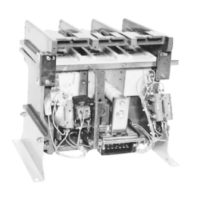
This document provides instructions for mechanical-latch attachments designed for Type SJA, SJD, SJO, and SJS contactors, rated at either 360 or 720 amperes. It emphasizes safety, proper installation, operation, and maintenance procedures for these devices.
The mechanical-latch attachment allows a contactor to remain in a closed (latched) position without continuous electrical power to its main coil. This is particularly useful in applications where maintaining the contactor's closed state is critical, even in the event of a power loss or solenoid coil failure.
When a Type SJ contactor with a latch attachment is open, the latch mechanism is unlatched and de-energized. To close the contactor, its coil is momentarily energized. This causes the armature to close, thereby closing the main power contacts. As the armature seals to the magnet, a spring-driven latch arm moves into position behind the armature, mechanically holding it closed. Simultaneously, an auxiliary coil-clearing contact (L63) opens the contactor coil circuit, de-energizing the main magnet. Despite the magnet being de-energized, the contactor remains latched closed.
To open (unlatch) the contactor, a trip coil must be energized, or the latch can be tripped mechanically by pushing against its trip arm. The latch mechanism may incorporate one or two trip (unlatch) solenoids, each with an isolated trip coil that can be AC or DC operated. Energizing either or both solenoids will cause the latch arm to be pushed down, allowing the armature to move to the open-contacts position. The latch arm features a roller-bearing cam wheel that engages the armature, minimizing friction and ensuring fast trip action.
The contactor pickup coil and trip solenoid coils are designed for intermittent duty. Continuous energization under normal operating conditions will lead to burnout. It is recommended that the contactor and solenoid coils be automatically de-energized by auxiliary contacts on the contactor itself, rather than relying on supplementary relays.
A latched contactor should only be used when necessary, with careful consideration of potential system failure modes, such as power loss or solenoid coil failure. Once latched, the contactor remains closed, which could allow a failure to persist. Since power is required to trip the unlatch solenoids, provisions for manual tripping (using the mechanical trip arm) or a standby power supply are essential in case of main control power loss.
Control power for closing the contactor typically comes from a control power transformer, whose primary winding is connected to the same source supplying power to the motor. This transformer can also power the trip (unlatch-open) solenoids. However, a manual operator (pushbutton type) is necessary to open the contactor if there's a power failure. If a standby control voltage source (e.g., a battery-supplied DC source) is available for the trip solenoid, manual operation may not be required. Most solenoid coils are rated for both AC and DC intermittent duty. Some latch attachments come with two trip solenoids, each rated for a different voltage, and the attachment will unlatch if either solenoid is energized.
For applications requiring a manual unlatch (trip) operator, a specific external operator kit (Part Number 10935H3, marked RESET) can be installed. This requires a 1.20-inch (30 mm) diameter hole opposite the trip arm of the latch attachment. A method for accurately locating this hole involves temporarily clamping a right-angle bracket to the trip arm and using an ink-soaked pencil to mark the inside of the door when closed. After installation, the operator's length must be adjusted so that the trip arm can be pushed far enough to unlatch the contactor, without accidental unlatching due to door deflection.
Installation, adjustment, repair, and maintenance of this equipment must be performed by qualified personnel familiar with its construction, operation, and associated hazards. All work on the contactor should be done with the main disconnect device open to prevent electrocution and severe burns.
The latch sensitivity is adjustable. If accidental unlatching occurs due to vibration or impact, the sensitivity should be decreased. Conversely, if an unlatch solenoid fails to trip the latch at its rated voltage, the sensitivity should be increased.
A maintenance program should be established upon installation. After initial monthly inspections, the frequency can be adjusted based on the contactor's duty severity.
Mechanical Check-Out: Before any mechanical check-out, ensure all power circuits are isolated. The contactor can be checked inside or outside its enclosure. If it's a new factory assembly, testing it as installed is often easiest. Verify that all mechanical interlocks function correctly. To check the latch mechanism, remove the latch spring. Temporarily block the single or bottom trip solenoid open. Hold the contactor in the fully sealed-closed position electrically, and manually close/open the latch using the trip arm. The latch should move easily. If not, check for rubbing between the latch arm and the armature. To eliminate rubbing, loosen the two latch mounting bolts on the right side and move the right latch bearing plate rearward until clearance is achieved, then retighten the bolts. Re-check for free motion. Next, with the contactor in the fully sealed-closed position, operate the latch with the trip arm, then abruptly release it. The latch should fall freely into the open position. If not, the "free-play" clearance is insufficient. To increase clearance on a 360A contactor, loosen all five latch mounting bolts and tap both the left and right bearing plates rearward slightly. Re-tighten the bolts and recheck. For a 720A contactor, loosen all four latch mounting bolts and tap bearing plates rearward. Re-tighten and recheck. Re-install the latch spring. Check the overtravel of the main vacuum interrupters; increasing "free-play" decreases overtravel, which must not fall below .020 inch (5 mm) with worn contacts. Remove any blocking shim from the bottom trip solenoid and ensure both solenoid armatures move freely.
Failure to Latch: If the contactor fails to latch after mechanical adjustments: a. Verify that the voltage applied to the contactor coil is within 80% of its rating. b. Check the setting of the Type L-63 normally-closed coil-clearing auxiliary contact to ensure it doesn't open too soon, preventing the contactor from closing far enough to latch. c. Confirm the latch spring is properly in place. d. Decrease latch sensitivity by loosening the lock nut on the latch adjustment and backing off the adjustment bolt by half a turn. If latching is still unsuccessful, back off another half-turn, and so on, until it works, then re-tighten the lock nut.
Failure to Unlatch: If the trip solenoid(s) do not unlatch the mechanism after adjustments: a. Verify that the voltage applied to the solenoid(s) is within 80% of rated voltage. b. Check each solenoid coil for continuity and replace if burned open. c. Ensure there is an airgap of .120 to .130 inch (3.05-3.30 mm) under each solenoid armature when the contactor is latched. Without this gap, the solenoid armatures cannot move to push the latch arm. d. Increase latch sensitivity by loosening the lock nut on the latch adjustment and tightening (turning the bolt clockwise) by half a turn. If unlatching is still unsuccessful, turn the bolt another half-turn, and so on, until each solenoid unlatches dependably, then re-tighten the lock nut.
Failure to Remain Latched: If nuisance unlatching occurs, de-sensitize the latch adjustment as described under "Failure to Latch."
 General
| Frame Size | SJA |
|---|---|
| Product Name | SJA |
| Voltage | 600V AC |
| Poles | 2, 3 |
| Standards | UL, CSA, IEC |



 To Next Page