Need help?
Do you have a question about the ebm-papst VBH0630CTTRS and is the answer not in the manual?
Explains hazard level symbols (DANGER, WARNING, CAUTION, NOTE) used in the instructions.
Specifies required qualifications for personnel handling the device.
Outlines fundamental safety principles and workplace rules for safe operation.
Details safety precautions related to electrical voltage and connections.
Emphasizes the importance of guards and protective devices for preventing injury.
Discusses potential electromagnetic interference and necessary shielding measures.
Warns about dangers from rotating parts, entanglement, and ejected objects.
Addresses noise emissions and necessary protective measures for personnel.
Warns about the risk of burns from hot surfaces on the device.
Provides essential guidelines for safe transportation and handling of the fan.
Details proper storage conditions, recommendations, and environmental protection.
Defines the device's exclusive purpose and highlights prohibited or hazardous applications.
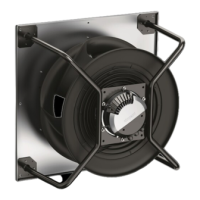
Illustrates the device with dimensions, callouts, and mounting details.
Lists essential operational specifications like voltage, current, speed, and power.
Presents energy efficiency data as per Commission Regulation (EU) 327/2011.
Details technical features, materials, size, and operational modes.
Provides information on screw strength and securing against unintentional loosening.
Specifies permissible ambient temperatures for transport and storage.
Discusses requirements for parallel connections and grid compatibility.
Guides on physically installing and connecting the device, including precautions.
Details safe procedures for electrical hookup, wiring, and grounding.
Lists prerequisites for electrical connection, including voltage and cable checks.
Specifies cable cross-sections and fuse assignments for power supply.
Recommends specific RCCB types for installations with the device.
Explains potential increases in leakage current under specific operational conditions.
Notes that starting current is protected and equals or is less than nominal current.
Provides instructions for making electrical connections within the terminal box.
Guides on stripping cables and ensuring proper fit and strain relief for connections.
Details the process of connecting wires to the device terminals safely.
Advises on routing cables to prevent moisture penetration and ensure strain relief.
Ensures isolation, proper fit, and secure closure of terminal box connections.
Details prerequisites and steps for safely switching on the installed device.
Outlines procedures for switching off the device during operation or for maintenance.
Explains how to avoid speed ranges with excessive vibration velocities.
Describes protective functions that automatically shut off the motor upon fault detection.
Explains the meaning of LED status codes and flash patterns for fault indication.
Lists specific warning codes, their associated messages, and required actions.
Lists status codes, possible causes, and recommended remedies for device errors.
Details manual vibration testing procedures, frequency, and measurement guidelines.
Provides instructions and precautions for cleaning the device to ensure longevity.
Outlines inspection items, checks, frequency, and required actions for safety.
Provides recommendations for ecological disposal of the product and its components.
Emphasizes adherence to local regulations for product disposal.
Outlines procedures and safety warnings for product disassembly by qualified personnel.
Categorizes recyclable materials and their disposal methods.
This document outlines the operating instructions for a device, likely a fan or similar air-moving apparatus, designed for integration into a larger system. It emphasizes safety, proper installation, and maintenance to ensure optimal performance and longevity.
The device is primarily designed for air movement within various applications. It operates based on electrical power, with control inputs allowing for regulation of its speed and functionality. The motor is equipped with integrated protective functions that automatically switch it off in the event of faults such as rotor position detection error, blocked rotor, line undervoltage, or phase failure, ensuring operational safety and preventing damage. The device also features a sensor that can measure vibration velocities, which is crucial for identifying and avoiding speed ranges with excessive vibration, thus preventing premature failure. Its design allows for continuous operation within specified environmental conditions.
The device is intended for use as a built-in component within a larger system. It can be operated in various orientations (horizontal, vertical, or on top) depending on the installation requirements. The control inputs allow for flexible integration into open- and closed-loop control systems, enabling precise regulation of its operation. The device is designed to handle different types of air, including conveying corrosive air, salt spray, dusty air, flammable materials, and explosive atmospheres, provided the appropriate safety measures and configurations are in place. It can also be used in systems with ground-neutral (TN/TT power systems) or IT power systems. The device is suitable for operation in networks with quality characteristics as per EN 50160. It supports both stationary and intermittent operation. The device is designed to operate within a specific ambient pressure range and temperature range, as detailed in the technical data. It is crucial to ensure that the device is adequately safeguarded with a fixed protective device and guard grill before operation, as it contains rotating parts that could cause injury. The device's electronics housing includes an LED that indicates its status with various colors and flash codes, providing immediate visual feedback on its operational state or any warnings/errors.
Regular maintenance is crucial for the device's reliable operation. This includes checking the device's electrical equipment at regular intervals and replacing loose connections or defective cables immediately. Before any maintenance, it is imperative to disconnect the voltage at all poles and wait at least five minutes to ensure the device is de-energized, as live terminals and connections can pose an electric shock risk even when the device is switched off. When working on an electrically charged device, standing on a rubber mat is recommended. The device should be cleaned regularly, especially its rotating parts, to prevent imbalance and ensure smooth operation. If the device is not operated for a lengthy period, it should be started up and operated at full speed for a specified duration (one hour every four months in dry environments, or three hours once a month in damp environments) to move the bearings and evaporate any condensate. This helps prevent bearing damage and ensures proper lubrication. The device's connections, including cables and terminal box, should be checked for proper fit and tightness. The terminal box cover must be securely screwed back on, and all screw plugs and cable glands must be properly tightened to ensure a sealed enclosure. The fan's air flow paths should be checked for foreign matter and cleared before switching on. The device is designed for easy replacement of components, with instructions for checking and replacing various parts like the impeller, motor, and cables. The device is not intended for user repair; instead, it should be sent to ebm-papst for professional repair or replacement. Regular visual inspections of the device, cables, and connections are recommended at least every six months. The device also supports vibration testing and measurement to identify and address any excessive vibration levels, which could lead to bearing damage and a shorter service life.
 General
| Manufacturer | ebm-papst |
|---|---|
| Model | VBH0630CTTRS |
| Category | Computer Hardware |
| Type | Fan |
| Size | 60 x 60 x 30 mm |
| Bearing Type | Ball Bearing |

 To Next Page