34
EN
insu cient experience and skills prevent him from safely
using the appliance, if they are not supervised or if they
have not been instructed regarding the use of the appliance
by a person responsible for their safety. Child supervision is
essential to prevent them from playing with the appliance.
Do not expose yourself microwave
energy excessively.
1. Do not attempt to operate the microwave oven if the
door is open. By doing so, you can become exposed to
harmful microwave energy. It is important not to damage or
circumvent the function of the security lock.
2. Do not insert foreign objects between the oven door. Make
sure dirt or residue from cleaning agents are not left on the
door seal or sealing elements of the oven.
3. Do not use the oven if damaged. The oven door should be
perfectly tight upon closing and should not be damaged.
Examples of damage caused to the oven door:
a) DENTING the oven door.
b) Loose or broken door HINGES or SAFEGUARDS.
c) OVEN DOOR SEAL OR SEALING AREAS ON THE FRAME
HEAD.
Adjustments or repairs to the microwave oven should
only be performed by a quali ed person.
4. As with the majority of appliances intended for baking, strict
supervision is necessary to reduce the risk re around the
oven.
In case of re:
1. Do not open oven door.
2. Turn o the oven and unplug cord from socket.
3. Turn o the master power switch.
CLEANING
Always unplug the appliance before cleaning.
1. Wipe the inside of the oven using damp
cloth.
2. Clean the accessories as usual in water with
detergent.
3. Wipe the door frame and seal carefully,
using damp cloth in case they are dirty.
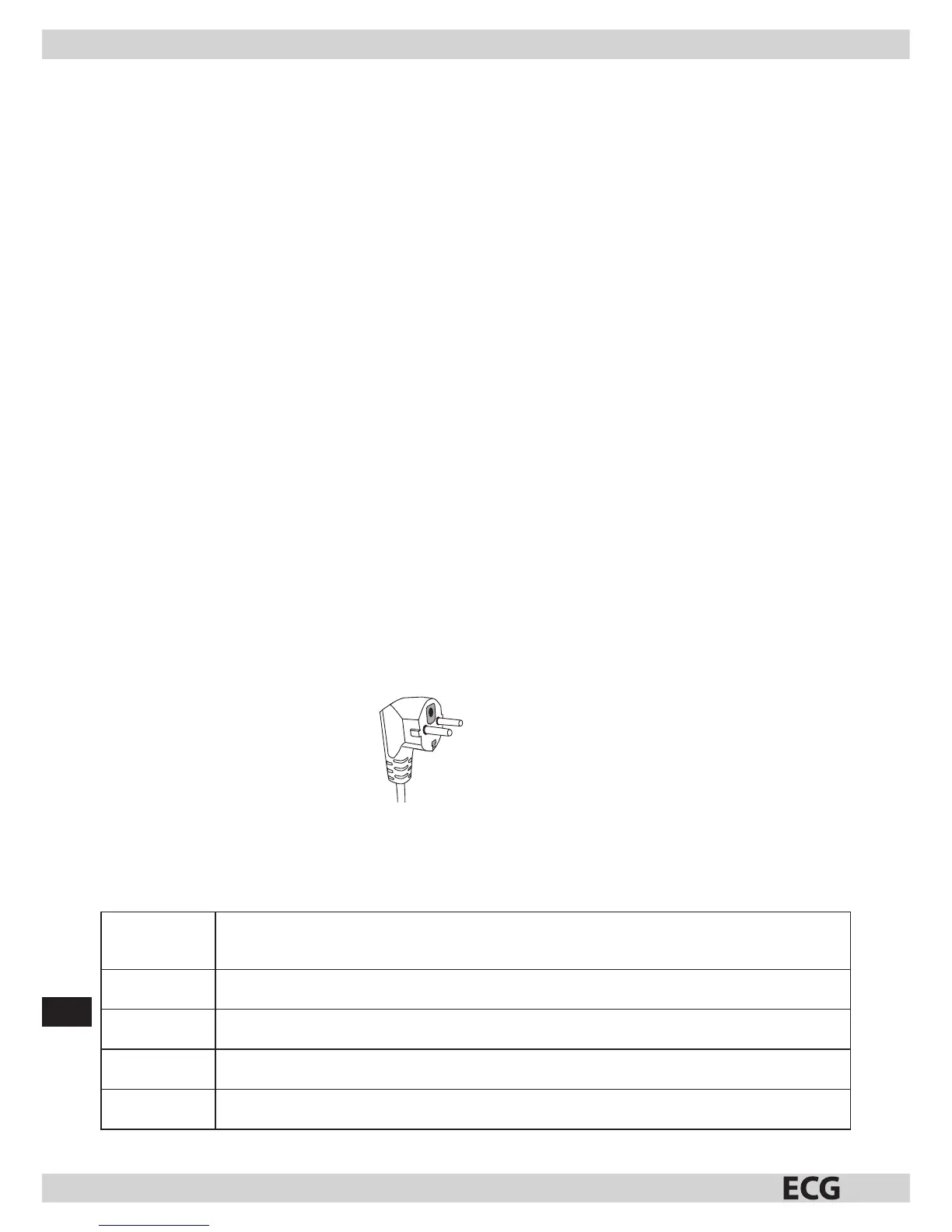
This appliance must be grounded. In case of short circuit the
grounding reduces the danger of electric shock, because the
grounding conductor closes the electrical circuit. The microwave
oven is equipped with a cable with a grounding wire and a
three-prong plug. It must be plugged into a power outlet that is
properly installed and grounded. If you do not understand some
instructions or if you have doubts about the grounding of the
appliance, contact a quali ed person or a service center. If you
must use an extension cord, it has to be a three-wire one, and
made according to current standards.
1. The supplied short and solid power cord reduces the risk of
damage and tripping, as could happen with a long cord.
2. If you need to use an extension cord:
a) Power load of the extension cord must be the same or
higher than the rated current of the appliance.
b) The extension cord must be a three-wire one with
appropriate plugs.
c) A long extension cord must be led and fastened in such a
way that it does not cross a table or work space, and that
e.g. children cannot grab it or there is not risk of tripping.
UTENSILS AND DISHES
CAUTION
Risk of injury
Read the instructions in the chapter “Materials that may or may
not be used in the microwave oven”. Some non- metalllic objects
are not suitable for use in the microwave oven. When in doubt,
contact the manufacturer or perform the following test.
Test of utensils and dishes:
1. Fill a container suitable for microwave oven with cold water
(cca 250 ml) and put it in the oven together with the tested
dish.
2. Turn the heating to max. power for 1 minute.
3. Carefully remove the container. If the dish is warm, it is not
suitable for microwave oven.
4. Do not exceed the 1 minute heating time.
Materials which you may or may not use in the microwave oven
Utensils and
dishes
Notes
Aluminum foil Only for shielding of small parts. It is possible to use small pieces for shielding meat or poultry from burning. If
the foil is too close to the oven walls, arcing may occur. The foil must be at least 2.5 cm away from the oven
walls.
Baking dishes Follow the manufacturer’s instructions. The bottom of the baking dish must be at least 5mm away from the
oven’s glass tray. Improper use may cause breakage of the tray.
Plates Use only the types designed for microwave ovens. Follow the manufacturer’s instructions. Do not use cracked
or chipped plates.
Glass vessels Always remove the lid. Use only to heat food to correct temperature. Most of glasses are not heat resistant and
may break.
Glass dishes Use only glass, which is heat resistant. Make sure that the dish does not contain metal parts. Do not use cracked
or chipped plates.


 To Next Page