GB
55
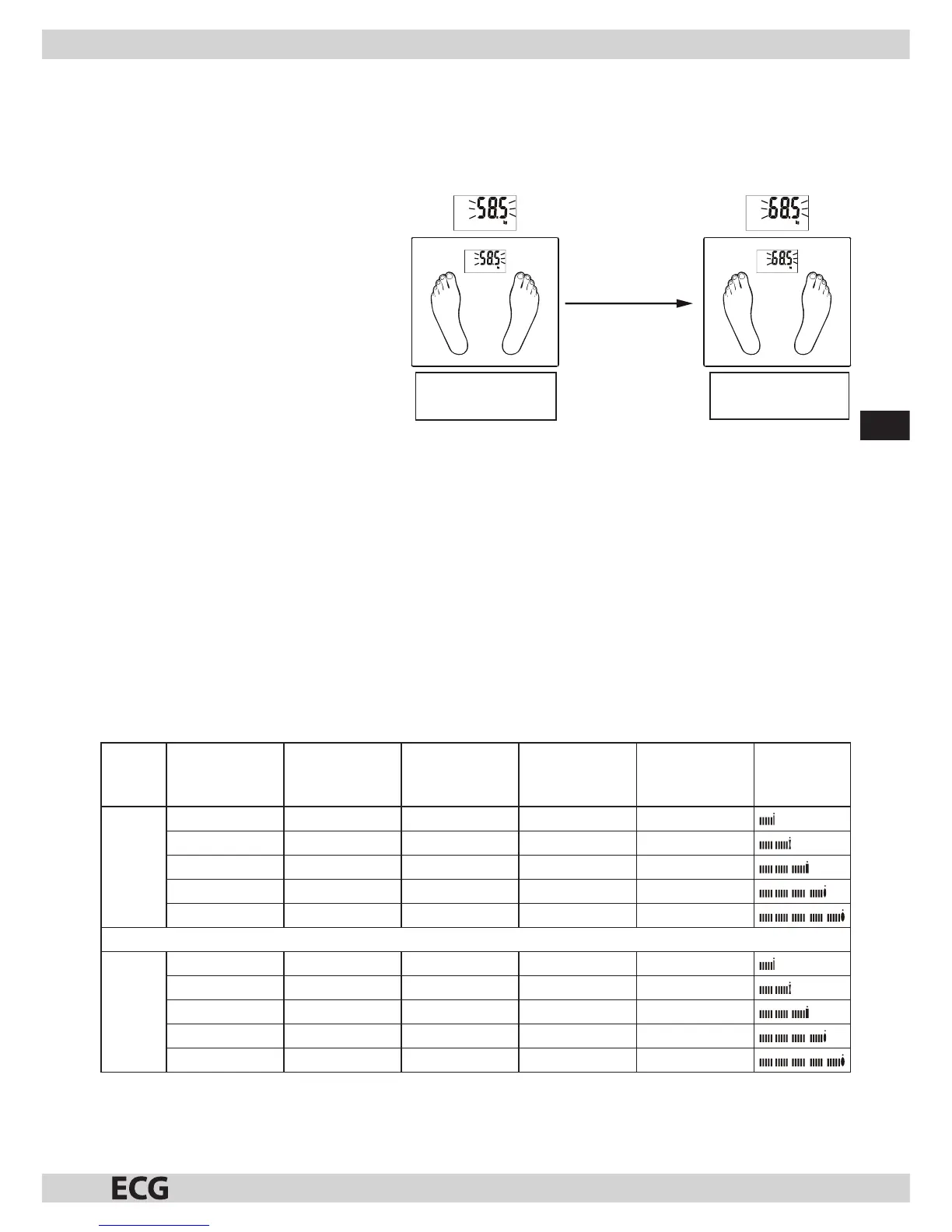
Adding weight
The weighed object must weigh more than 2 kg. If you want to nd e.g. the weight of your baby, weigh yourself
rst (wait until the numbers stabilize), then without stepping o the scale, take the baby in your arms. The
numbers start ashing, then they stabilize and the resulting weight stabilizes. Subtracting your own weight
from the newly obtained value will give you the weight of your child.
Take baby into your
arms without stepping
o the scale
Display of total weight
The numbers ash,
stabilize and lock
Measurement of body fat, water, muscle mass, bones and calories
Measurement principles
Through human body pass electric signals of acertain frequency, whereby the impedance of body fat is higher
than the impedance of muscle or other human tissues. The device generates an alternating electrical current
with safe frequency and low voltage. Using the analysis of biological resistance, impeding the passage of the
current through the human body (impedance of various tissues, fats and muscles), the percentage of the body
fat in human organism is derived from the di erences in resistance.
About the percentage of body fat
This index is an indicator of the percentage of body fat in the human body.
The fat content in the body should be maintained around certain level, excess body fat impairs metabolic
processes and thus increases the risk of various diseases.
Physical tness table according to fat/water content
Age
Fat proportion
(F)
Water
proportion (F)
Fat proportion
(M)
Water
proportion (M)
Physical tness
Indication
of obesity
degree
≤30
4.0-16.0 % 66.0-57.8 % 4.0-11.0 % 66.0-61.2 % too thin
16.1-20.5 % 57.7-54.7 % 11.1-15.5 % 61.1-58.1 % thin
20.6-25.0 % 54.6-51.6 % 15.6-20.0 % 58.0-55.0 % normal
25.1-30.5 % 51.5-47.8 % 20.1-24.5 % 54.9-51.9 % obese
30.6-60.0 % 47.7-27.5 % 24.6-60.0 % 51.8-27.5 % heavily obese
>30
4.0-20.0 % 66.0-55.0 % 4.0-15.0 % 66.0-58.4 % too thin
20.1-25.0 % 54.9-51.6 % 15.1-19.5 % 58.3-55.3 % thin
25.1-30.0 % 51.5-48.1 % 19.6-24.0 % 55.2-52.3 % normal
30.1-35.0 % 48.0-44.7 % 24.1-28.5 % 52.2-49.2 % obese
35.1-60.0 % 44.6-27.5 % 28.6-60.0 % 49.1-27.5 % heavily obese
Note: The values stated in this table are merely for orientation purposes.


 To Next Page