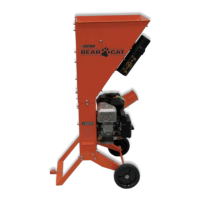
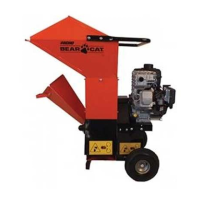
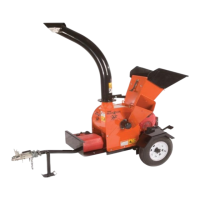
This document is the owner's manual for the ECHO Bear Cat 5 Inch Chipper/Shredder, model SC5540-540 PTO.
Function Description:
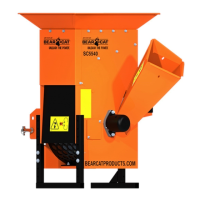
The ECHO Bear Cat 5 Inch Chipper/Shredder is a robust piece of outdoor equipment designed to process various organic materials into smaller, more manageable pieces. It features two primary operations: chipping and shredding. The chipping mechanism, located at the front of the machine, utilizes hardened steel chipper blades mounted on a rotating rotor assembly. Material fed into the chipper chute is sliced into small chips and then propelled out through a discharge tube. The shredding operation uses hardened steel shredder knives to grind material fed into the shredder chute. The shredded material exits through a discharge screen, which can be directed into a container or onto the ground. This machine is designed to be connected to a tractor via a Power Take-Off (PTO) driveline, leveraging the tractor's power for its operation.
Important Technical Specifications:
- Overall Size: 43" x 43" x 44" (109 cm x 109 cm x 112 cm)
- Overall Weight: 450 lbs. (204.1 kg)
- Max Chipper Capacity: 5" (12.7 cm)
- Chipper Blades: 4 reversible (3.125" x 2" x 0.25" or 7.9 cm x 5 cm x 0.64 cm)
- Max Shredder Capacity: 0.75" (1.9 cm)
- Shredder Knives: 36
- Rotor Speed: 2000 RPM
- Rotor Size: 19" (48.3 cm)
- Rotor Weight: 112 lbs. (50.8 kg)
- Drive Type: Belt
- Belt Size: BX56
- 3 Point Hitch: Category 1 (Category 0 may require 5/8" (1.6 cm) pins; a bushing kit must be installed for Category 2 hitches).
- PTO: 540 +/- 10 RPM (standard 540 RPM PTO shaft required).
Usage Features:
The chipper/shredder is designed for ease of use with clear operational guidelines.
- Starting: Connect the PTO driveline to the tractor, adjust the 3-point top link for a level chipper, start the tractor engine, engage the PTO, and increase engine speed to the rated PTO RPM.
- Stopping: Move the tractor throttle to the slowest position, disengage the PTO lever, shut off the tractor engine, and allow the machine to come to a complete stop.
- Material Feeding:
- Chipper Chute: Handles materials up to 5" (12.7 cm) in diameter. Limbs should be placed butt end first and fed from the side to avoid being hit by moving brush.
- Shredder Chute: Processes materials up to 3/4" (1.9 cm) in diameter, including grass, leaves, garden refuse, and small branches.
- Operation Guidelines: Always run the engine at rated PTO RPM before feeding material. If the rotor slows, stop feeding and allow it to process backed-up material. If the chipper jams, remove the branch, rotate it, and reinsert it, or alternately insert and retract the limb. Alternate green/fresh cut material with dry material to lubricate blades and enhance performance.
- Safety: Emphasizes reading the manual, wearing safety glasses and hearing protection, avoiding loose clothing, keeping bystanders at least 50 feet away, and ensuring all guards and shields are in place. Never operate under the influence of alcohol or if tired/ill. Always shut off the machine and ensure all moving parts have stopped before inspection or service.
- PTO Driveline Connection: The driveline may need to be cut to length for proper tractor operation. Detailed instructions are provided for measuring and cutting the plastic tubes and steel shafts to ensure correct fit and prevent overlap.
- Control Box Wires: Two electrical wires (red and white) connect to the tractor; the red wire to a 12-volt power source and the white wire to ground.
Maintenance Features:
Regular maintenance is crucial for optimal performance and to prevent warranty voidance.
- Maintenance Schedule: A detailed schedule outlines checks for tightness of nuts and bolts, chipper anvil clearance, chipper blade sharpness and torque, shredder knife condition, overall machine cleanliness, PTO cross journal and inner tube lubrication, PTO shield retaining bearing lubrication, drive belt condition, tension, and alignment, and grease zerks.
- Chipper Blades:
- Inspection: Check sharpness every 5-15 hours. Replace if cracked, broken corners, or nicks greater than 1/8", or if the cutting edge no longer extends past the chipping slot after repeated sharpening.
- Removal: Requires removing the discharge door, discharge screen, and access cover, then rotating the rotor to access and remove the blade bolts.
- Sharpening: Blades can be ground on a bench grinder or by a professional. Regrind the angled edge to 45 degrees, avoiding the mounting surfaces. Prevent overheating during grinding.
- Installation: Secure blades with bolts, torque to 25 ft-lbs, and reinstall the discharge screen and door.
- Shredder Knives:
- Inspection: Do not sharpen shredder knives. Inspect frequently for cracks or damage and replace immediately if found.
- Removal: Involves removing the discharge door, screen, and rear side access cover, then driving out the knife shaft to remove spacers and knives.
- Reassembly: Ensure serrated edge faces the same direction as chipper blades. Install new #10-24 bolt and nut, torque to 36 in-lbs, and maintain the original order of spacers and knives for rotor balance.
- Discharge Screen: Instructions for removal and installation are provided for changing or cleaning the screen.
- Blade Clearance: The chipping blades should clear the chipper anvil by 1/16" to 1/8". Adjustment involves loosening bushing bolts, tapping the rotor shaft, and then replacing lock collars and tightening set screws.
- Clearing a Plugged Rotor: Requires removing the discharge door and screen to clean debris from the screen area.
- Drive Belts: Check annually or every 50 hours. Replace if cracked, frayed, or worn. Replacement involves removing the PTO shield and shaft, loosening jackshaft pillowblock bearings, and sliding the jackshaft to remove/install the belt. Ensure pulleys are aligned and belt deflection is 7/16" under a 20 lb. load.
- Rotor Removal: The rotor is heavy (over 100 lbs.) and requires support during removal. Steps include removing various covers and components, loosening bolts, and driving the shaft out.
- Lubrication:
- PTO Driveline: Lubricate PTO cross journals, inner tubes, and shield retaining bearing every 8 hours.
- General: Lubricate the machine periodically with lithium-based grease, especially every 50-100 hours of operation. Avoid mixing polyurea and lithium-based greases. Do not over-grease bearings.
- Troubleshooting: A comprehensive chart lists common problems, possible causes (e.g., dull blades, obstructed discharge, loose belts), and remedies (e.g., flip/sharpen blades, clear obstructions, adjust belt tension).
- Bolt Torque: Detailed tables provide torque specifications for various SAE and Metric bolts, emphasizing that figures are for non-greased/non-oiled threads unless otherwise specified.


 To Next Page
 General