Need help?
Do you have a question about the ECO-WORTHY 100W and is the answer not in the manual?
Determine a location for the solar panel that is in direct sunlight and clear of any shading.
Procedure for safely securing the panel on thin cabin roofs or RV roofs using Z-Brackets.
Using well-nuts for secure module mounting in thin RV roofs and blind holes.
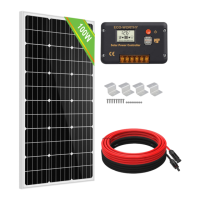
Connecting the solar panel's MC4 connectors, which are easy to install.
Wire the panels' positive and negative posts to the controller's P&N posts.
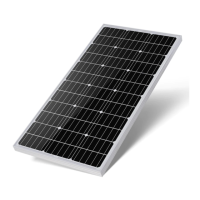
This manual describes the ECO-WORTHY 100W Solar Panel, a high-quality renewable energy product designed for building off-grid solar systems. It provides quiet power production and promotes grid independence, making it an ideal starting point for those venturing into solar energy. The manual covers essential information regarding the installation, operation, and maintenance of the solar module, ensuring users can effectively set up and manage their solar power system.
The ECO-WORTHY 100W Solar Panel is designed to convert sunlight into electrical energy, providing a sustainable power source for various applications, particularly in off-grid settings such as RVs, boats, or remote cabins. Its primary function is to capture solar radiation and generate direct current (DC) electricity, which can then be used to power devices, charge batteries, or feed into an inverter for AC power. The panel is engineered to deliver reliable performance, contributing to energy independence and reducing reliance on traditional power grids. It serves as a fundamental component in a complete solar energy system, working in conjunction with a charge controller and batteries to store and regulate power. The panel's design focuses on efficiency and durability, ensuring a consistent energy supply under various environmental conditions. Its ability to provide quiet power production is a significant advantage, especially for residential or recreational use where noise levels are a concern. The system is scalable, allowing users to expand their solar capacity by adding more panels as needed.
The ECO-WORTHY 100W Solar Panel offers several user-friendly features that simplify its installation and integration into an off-grid system. The manual emphasizes the importance of proper location selection to maximize energy capture. Panels should be positioned in direct sunlight, free from shading by obstacles like trees or roof overhangs, and ideally oriented to minimize wiring distance to the charge controller. For Northern Hemisphere installations, the panels should face true south (true north for Southern Hemisphere installations), with a mounting angle equal to the local latitude. While achieving a perfect angle might be challenging due to space limitations, users are encouraged to orient the panel as close to the ideal angle as possible to maximize power output.
Mounting the solar panel is facilitated by the use of Z-Brackets, which are commonly employed for "flat mount" installations on thin cabin roofs or RV roofs. Although Z-Brackets are not included with the panel, their use is detailed in the manual. The process involves attaching the Z-Brackets to the solar panel's mounting holes, marking and drilling holes on the mounting surface, and then securing the panel using well-nuts. Well-nuts, also known as "expansion nuts," are highly recommended as they provide a secure hold and prevent water leakage due to their rubber expansion properties. The manual provides a clear illustration of how to properly insert the well-nut, ensuring its rubber flange is flushed with the roofline, and how the Z-Bracket, flat washer, and lock washer secure it in place. For added waterproofing, a film of caulk can be applied between the RV roof and the Z-Bracket before attachment. This method ensures a watertight bond, even though the well-nut itself offers significant sealing. The well-nut system is versatile, working effectively not only on thin RV roofs but also in blind holes, where tightening causes the body to expand and apply pressure against the hole walls, creating a secure hold. For house roof installations, Z-Brackets can also be used, provided a proper roof penetration sealant is applied between the roof and the Z-Bracket to prevent water leakage.
The solar panel connection system is designed for ease of use and reliability. Each ECO-WORTHY Solar Panel comes with a pair of MC4 connectors (male and female) at the back. This "snap-in" type of safety locking clip system ensures easy installation and prevents unintentional disconnection. The mating contacts are sealed against the ingress of dust and water, enhancing the durability and longevity of the connections. When connecting the solar panels to a controller (not included), the positive and negative posts from the Y branches are wired separately to the P&N posts of the controller using a pair of MC4-copper cables. This straightforward connection process allows users to quickly integrate the solar panel into their overall power system.
To ensure optimum performance and longevity of the ECO-WORTHY 100W Solar Panel, regular maintenance is recommended. The manual outlines several key maintenance practices that users should follow:
Cleaning the Glass Surface: The glass surface of the solar panel should be cleaned as necessary. It is important to use water and a soft sponge or cloth for cleaning. A mild, non-abrasive cleaning agent can be used to remove stubborn dirt without damaging the panel surface. Regular cleaning helps maintain maximum light absorption and energy production.
Checking Electrical and Mechanical Connections: Every six months, users should inspect all electrical and mechanical connections. This check is crucial to verify that the connections are clean, secure, and undamaged. Loose or corroded connections can lead to intermittent behavior, sparks, and reduced efficiency, so ensuring they are tight and secure is vital.
Inspecting for Debris: The solar panels should be inspected regularly to ensure their surfaces are free from dust, dirt, and other debris. Accumulation of debris can block sunlight and reduce the panel's output. If debris is present, the panels should be cleaned with a wet cloth or a glass cleaner.
Verifying Structural Components: All structural components, mechanical fasteners, and electrical connections should be checked to ensure they are secure, clean, and corrosion-free. This includes inspecting the mounting brackets and wiring for any signs of wear, damage, or loosening.
Replacing Damaged Components: In the event that any components are found to be damaged during inspection, they should be replaced promptly. Timely replacement of damaged parts helps prevent further issues and ensures the continued safe and efficient operation of the solar panel system.
By adhering to these maintenance guidelines, users can significantly extend the lifespan of their ECO-WORTHY 100W Solar Panel and ensure it consistently delivers optimal performance. The manual emphasizes that proactive maintenance is key to maximizing the return on investment in a solar energy system.
 General
| Power Output (Pmax) | 100W |
|---|---|
| Type | Monocrystalline |
| Optimum Operating Voltage (Vmp) | 18V |
| Optimum Operating Current (Imp) | 5.56A |
| Open-Circuit Voltage (Voc) | 22.5V |
| Warranty | 25 years |
| Cell Type | Monocrystalline Silicon |
| Frame Material | Anodized Aluminum Alloy |
| Junction Box | IP65 Rated |
| Connector Type | MC4 |
| Maximum System Voltage | 600V DC |

 To Next Page