2. Description of system components
2.1 Septic/Primary tank
The size and configuration of the septic/primary tank shall be in accordance with the NSF listing (as applicable) or
State or local requirements. Septic/Primary tank allows the clarification of wastewater by letting suspended solids
settle to the bottom and retaining floating matter to avoid clogging the secondary or advanced secondary treatment
system. Primary treatment can be done using a septic tank that meets local regulation.
Some Ecoflo Coco Filters housed into polyethylene tank are available into a monobloc configuration (PACK unit)
that combines both, the septic/primary tank and the Ecoflo Coco Filter. Consult technical datasheets and respective
installation guides for more information on this Ecoflo Coco Filter configuration.
Premier Tech Aqua provides a complete line of high-performance polyethylene septic tanks ranging from 600 US gal
to 1530 US gal. that are all certified with Standard CSA-B66-16 and equipped with an effluent filter meeting this
same standard. Premier Tech Aqua also offers a full line of septic tank accessories such as extensions (PSR-060
and PSR-140) single- or double-walled covers (LID-240S and LID-240D) as well as adaptors for accessing concrete
septic tanks (TAD-240). For more information on these products, consult the Peripherals section on
ptzone.premiertechaqua.com
.
You may decide to keep an existing septic tank, in which case, it will need to be carefully inspected to make sure
that it is in good condition. If the tank is not equipped with an effluent filter, an effluent filter will need to be installed
in a tank located immediately downstream of the septic tank. Premier Tech Aqua sells such a tank equipped with a
PL-122 effluent filter (TLF-240P).
The effluent filter extends the life of any treatment system by keeping solids in the septic tank. The effluent filter is
especially important if the household is equipped with a sewage pump or any other appliance that is liable to
increase the suspended solids content in the wastewater and, thereby, jeopardize the operation of the system and
affect its performance. In situations where an effluent pump is required as part of the septic system, an effluent filter
will also prevent solids from reaching said pump. We do not recommend the use of a garbage disposal unit. If a
garbage disposal is used, you must follow the state & local code for tank and absorption field sizing.
Effluent filters to be used with the Ecoflo
®
Coco Filter shall have a minimal flow area of 9 in² and filter particles 1/16”
and larger. While many different brands of effluent filters meet those specifications, Premier Tech Aqua highly
recommends the use of the effluent filter PL-122 from Polylok or equivalent.
2.2 Ecoflo
®
Coco Filter
Once the wastewater has passed through the septic/primary tank, it then flows towards the Ecoflo
®
Coco Filter.
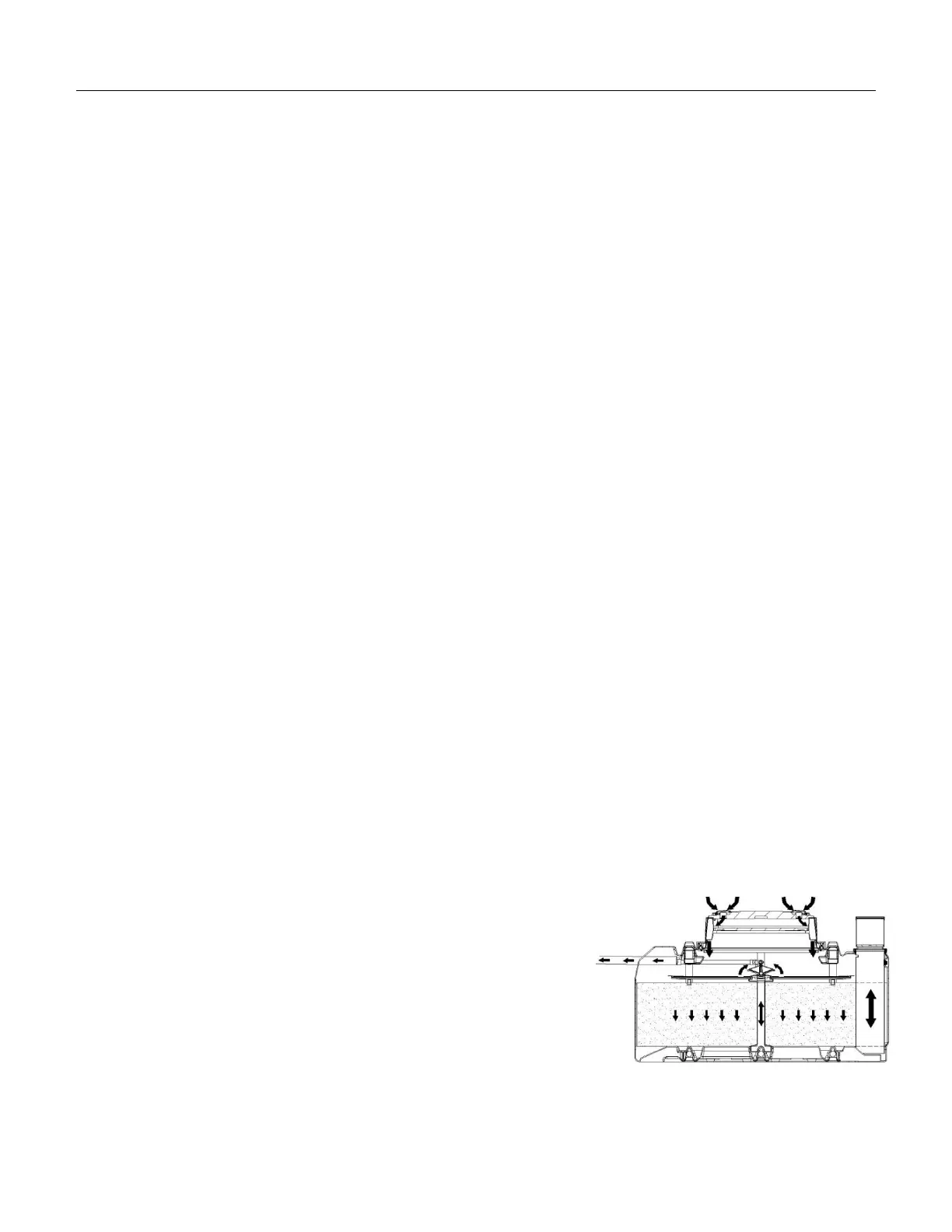
Inside the biofilter, a central tipping bucket equally scatters the wastewater on both sides of the biofilter. Both sides
are equipped with specially designed plates which evenly distribute the wastewater on top of the filtering media.
The wastewater then trickles through a filtering medium composed of coconut husk fragments. The organic matter
contained in the wastewater is then decomposed by the microorganism attached to the media via an optimized
water/air (oxygen) mass transfer process.
To ensure effective treatment, there must be enough oxygen present in
the system to feed the microorganisms in the filtering media. Air enters
the system through vents located on the main access cover. Depending
on the model used, the pumping station and/or central support allows air
to naturally circulate between the surface and base of the filtering media.
Air circulates throughout the system by way of convection from the
residence’s vent (or a standalone vent) through the feed pipe to the septic
tank.
The operating principle of the Ecoflo
®
Coco Filter allows the system to be
used continuously or intermittently without requiring any special
precautions or having any impact on the effectiveness of the treatment.
In most cases, no specific action by owner is required to start the system.


 To Next Page
 Loading...