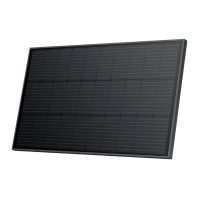
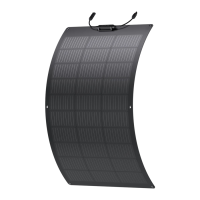
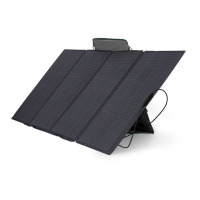
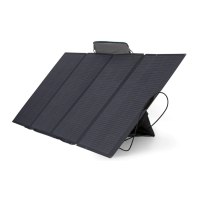
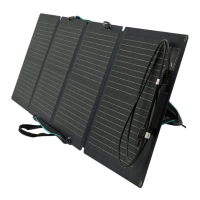
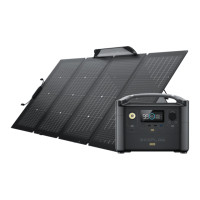
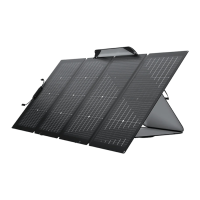
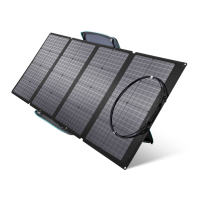
The EcoFlow 400 W Rigid Solar Panel is designed for efficient and reliable power generation, suitable for various installations, including residential and off-grid systems. This user manual (V1.0) provides comprehensive instructions for its installation, usage, and maintenance.
Function Description
The EcoFlow 400 W Rigid Solar Panel converts sunlight into electrical energy, providing a sustainable power source for compatible devices and systems. It is designed to be a robust and durable component of a solar power setup, capable of being connected in series or parallel to meet varying power requirements. The panel's rigid design ensures stability and longevity, making it suitable for both permanent and semi-permanent installations.
Important Technical Specifications
- Rated Power: 400W (±3%)
- Open Circuit Voltage: 37.10V (±3%)
- Short Circuit Current: 13.79A (±5%)
- Maximum Operating Voltage: 31.00V
- Maximum Operating Current: 12.90A
- Temperature Coefficient of Rated Power: -0.38%/°C
- Temperature Coefficient of Open Circuit Voltage: -0.35%/°C
- Temperature Coefficient of Short Circuit Current: 0.06%/°C
- Maximum System Voltage: 1500V DC (UL)
- Maximum Fuse Current: 25A
- Net Weight: Approx. 21.8kg (48.1 lbs)
- Dimensions: 1722 x 1134 x 35mm (67.8 x 44.6 x 1.38in)
- Ingress Protection (IP) Rating: IP68
- Standard Test Conditions: 1000 W/m², AM1.5, 25°C (77°F)
Usage Features
The solar panel offers flexible installation options and is designed for optimal performance under various conditions.
- Multiple Panel Connection: Multiple solar panels can be connected in series to increase voltage or in parallel to increase current. Series connection is generally recommended. When connecting, ensure all panels have the same specifications.
- Series Connection: Connect the positive pole of one module to the negative pole of the next.
- Parallel Connection: Connect positive cables of all modules together and negative cables of all modules together.
- Mounting: The panel features 12 mounting holes (14x9mm / 0.55x0.35in) for secure installation. It is crucial to use these designated holes and avoid modifying the module frame, as this may void the warranty.
- Installation Environment:
- Recommended Operating Temperature: -20 to 50°C (-4 to 122°F).
- Operating Temperature Limits: -40 to 85°C (-40 to 185°F).
- Storage Temperature: -20 to 50°C (-4 to 122°F).
- Temperature: <85RH%.
- Avoid installation in areas with high humidity (>85RH%) without consulting EcoFlow technical support.
- Install in an unshaded area throughout the year.
- Installation Methods:
- Tilt Mount Bracket Installation: Allows for flexible adjustment of the elevation angle to maintain a vertical angle to the sunlight. It can also be fixed on a flat level. The kit includes fixing brackets, adjusting brackets, and bolts.
- Support Bracket Installation: For fixing panels parallel to the installation surface. Each module requires at least eight support brackets for stability. The kit includes support brackets and drill screws.
- Bolt Installation: For fixing panels to a bracket system using bolts. Recommended for vertical module placement. Applied torques are 16-20 N·m for M8 and 14-18 N·m for M6. Anti-corrosion stainless steel fasteners are required.
- Pressing Block Installation: Used to fix single or multiple solar panels. Each module requires at least four pressing blocks and M8 bolts. Pressing blocks should be over 50mm long and over 3mm thick. Ensure the pressing block contacts the solar panel surface for more than 7mm and does not cast shadows.
- Safety Precautions:
- Installation should be performed by a qualified solar installation company.
- Do not disassemble the module or nameplate.
- Use provided installation components.
- Cover the solar panel with opaque material and disconnect terminals before installation to prevent power generation.
- Inspect for damage (broken glass, damaged back panel) before installation.
- Wear no metal jewelry and use insulated tools during installation.
- Ensure appropriate cable cross-sectional area and connector capacity for multiple panels.
- Avoid installing near open flames, inflammables, explosives, or in areas with water immersion.
- Keep children away from the installation site.
- Do not step on the solar panel or touch it with sharp tools.
- Comply with local and national regulations for roof and ground installations.
- Operational Precautions:
- Module overcurrent protection applies to DC fuses.
- Do not plug or unplug system connectors under load.
- Ensure the system's fire resistance rating meets standards and configure necessary accessories (fuses, circuit breakers, grounding connectors).
- Ensure the installation area is well ventilated and connectors are clean and dry.
- Seal all solar system connections to prevent moisture.
- Follow safety regulations for all other modules in the system (wires, connectors, controllers, inverters, batteries).
- Do not apply light-blocking substances (paint, adhesive) to the light-receiving surface.
- Do not irradiate the module surface with artificially amplified sunlight.
- Do not place heavy objects on the solar panel during use.
- Avoid dropping the panel or hitting its surface with tools, as this can damage the monocrystalline silicon wafer and void the warranty.
- Performance Considerations:
- Actual power output may vary from nominal power due to light intensity, surface temperature, light angle, and light occlusion.
- On a sunny day without clouds, a 400W panel typically achieves 320-350W (at 800-900W/m² irradiance and 50°C surface temperature).
- Optimal performance is achieved when the panel is perpendicular to sunlight.
- Avoid shading from projections, foreign objects, or dirt.
- Component Supply: The solar panel module is supplied with a three-part junction box and 4mm² wires. Additional components can be purchased from EcoFlow's official sales channel.
Maintenance Features
Regular maintenance is crucial for maintaining optimal performance of the module.
- Cleaning:
- Clean dust accumulation on the glass surface with a soft sponge or damp cloth.
- For stubborn dirt, use a mild detergent.
- It is recommended to clean in the morning and evening when sunlight is weak (irradiance ≤ 200W/m²).
- Prevent accumulation of leaves and other debris to avoid affecting power generation efficiency and potential local current issues leading to component burn.
- Connection Checks: Check electrical and mechanical connections at least every six months to confirm they are clean, secure, and undamaged.
- Troubleshooting: In case of abnormal power generation, perform the following checks:
- Ensure all wiring has no open circuits or poor connections.
- Check the open circuit voltage of each module.
- Cover the module with opaque material, check the open circuit voltage, then remove the material and re-measure. If the voltage differs by over 5% from the nominal value at an irradiance of ≥ 700W/m², it indicates a poor electrical connection.
- All commissioning and repair work must be performed by a qualified solar technician. Follow maintenance instructions for all system components (brackets, charging regulators, inverters, batteries).

 Need help?
 General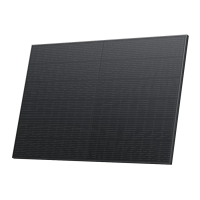

 To Next Page