en
27
OPERATION
Chain Brake Operation
Refer to Safety-Chain Brake Section before use.
The chain brake Run Position (A, Fig. 58) and Brake Position
(B) are illustrated below.
The chain brake operating condition should be checked prior to
each use as follows:
1. Start the engine and grasp front and rear handles securely with
both hands.
2. Pull the throttle trigger to bring the chain saw up to full speed.
Using the back of your left hand, engage the chain brake by
pushing the chain brake lever / hand guard toward the bar while
the chain is rotating rapidly, see Fig, 59.
3. The chain brake should engage and stop the chain immedia-
tely, if not, take the saw to a Servicing Dealer for repair and
discontinue use until the repair is made.
4. Reset the chain brake back into the run position by grasping the
guide bar side (right side from operator's position) of the chain
brake lever / hand guard and pull toward the front handle until
an audible click is heard. See Fig, 60.
WARNING: If chain brake does not stop the chain
immediately, take the saw to a Servicing Dealer for
repair prior to use.
WARNING: An improperly maintained chain brake
may increase the time needed to stop the chain after
activation, or may not activate at all.
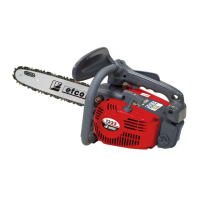
WARNING: This chainsaw equipped with a top handle
is designed specifically for tree surgery and mainte-
nance. Due to the special handle design (closely spa-
ced handles), there is an increased risk in its use. For
this reason this special chainsaw should be used only
for work in a tree by persons trained in special cutting
and working techniques.This type of chainsaw cannot
be used for felling operations; for this reason, this
manual does not contain instructions for felling. For
bucking and other operations on ground the use of a
normal forest chainsaw is highly recommended.
Bucking
Bucking is the term used for cutting a fallen tree to the desired log
length.
• Cut only one log at a time.
WARNING: Support small logs on a saw horse or
another log while bucking. Never allow another per-
son to hold the log while cutting and never hold the
log with your leg or foot.
WARNING: Keep a clear cutting area. Make sure that
no objects can contact the guide bar nose and chain
during cutting, this can cause kickback (D, Fig. 61).
WARNING: During bucking operations always stand
on the uphill side so that the cut-off section of the log
can not roll over you.
58
59
60
(A)
(B)
61


 To Next Page