20
Italiano FrançaisEnglish
OPERAZIONI PRELIMINARI
PREPARATIONPREPARING TO WORK
CORRETTA REGOLAZIONE DEL CINGHIAGGIO
dei modelli DS 4200 T
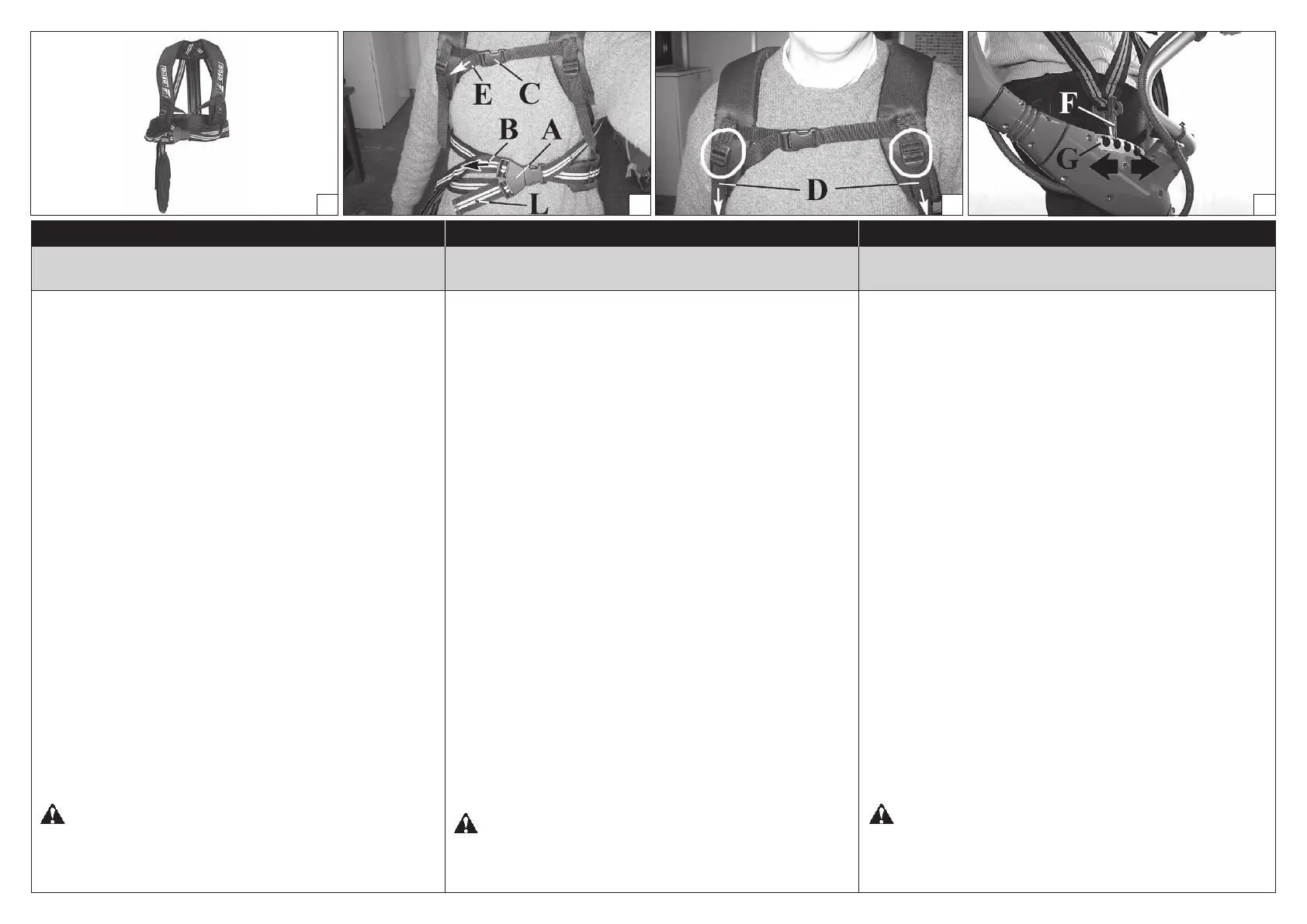
1. Indossare il cinghiaggio di tipo doppio (Fig.20).
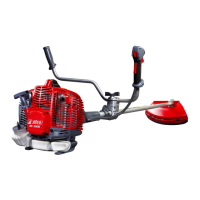
2. Agganciare la bbia (A, Fig.21) in zona cintura e
regolarla agendo sulla cinghia superiore (B).
3. Agganciare la bbia (C) in zona torace.
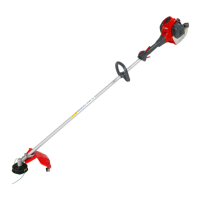
4. Regolare le spalline con le due cinghie (D, Fig.22).
Con questo cinghiaggio è possibile distribuire il carico
maggiormente sulle spalle o in cintura a discrezione
dell’operatore.
5. Regolare la cinghia (E, Fig.21) zona torace.
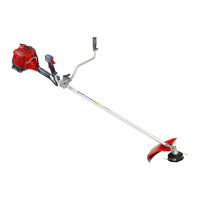
6. Agganciare il decespugliatore al cinghiaggio tramite
il moschettone (F, Fig.23).
7. Posizionare il gancio (G) per ottenere il miglior
bilanciamento del decespugliatore.
8. Regolare l’altezza della macchina dal terreno agendo
sulle due cinghie (H-L, Fig.24). La corretta distanza
tra la cintura ed il moschettone (F, Fig.23), può essere
misurata come in Fig.25. Questa regolazione favorisce
inoltre la ripartizione corretta del peso per ottenere
un buon bilanciamento del decespugliatore.
ATTENZIONE! - Nel caso di utilizzo di lame da
legno (22-60-80 denti) è obbligatorio l’utilizzo di un
cinghiaggio doppio dotato di sgancio rapido.
RÉGLAGE CORRECT DU HARNAIS
modeles DS 4200 T
1. Porter le harnais double (Fig.20).
2. Attacher la boucle (A, Fig.21) de la ceinture et la régler
en agissant sur la courroie supérieure (B).
3. Attacher la boucle (C) sur le thorax.
4. Régler les épaules avec les deux courroies (D, Fig.22).
Ce harnais permet de répartir la charge davantage sur
les épaules ou au niveau de la ceinture, comme le préfère
l’opérateur.
5. Régler la courroie (E, Fig.21) au niveau du thorax.
6. Accrocher la débroussailleuse à l’aide du mousqueton
(F, Fig.23).
7. Placer le crochet (G) de sorte à équilibrer la
débroussailleuse.
8. Régler la hauteur de l’appareil par rapport au sol en
agissant sur les deux courroies (H-L, Fig.24). La gure
25 illustre comment régler correctement la distance
entre la ceinture et le mousqueton (F, Fig.23). Ce réglage
facilite également la bonne répartition du poids pour
mieux équilibrer la débroussailleuse.
ATTENTION! - En cas d’utilisation des lames à bois
(22-60-80 dents), il est obligatoire d’utiliser une courroie
double équipée d’un dispositif de déblocage rapide.
CORRECT ADJUSTMENT OF THE HARNESS
DS 4200 T models
1. Put on the double harness (Fig.20).
2. Fasten the waist buckle (A, Fig.21) and adjust by
tightening the top belt strap (B) until comfortable.
3. Fasten the chest buckle (C).
4. Adjust t he shoulders by tightening the two straps
(D, Fig.22) until comfortable. With this type of harness,
the weight of the machine can be distributed between
shoulders and waist according to the preference of the
operator.
5. Adjust the chest strap (E, Fig.21).
6. Hook the brushcutter to the harness with the snap
(F, Fig.23).
7. Position the hanger (G) so that the machine is balanced
to best advantage.
8. Adjust the carrying height by shortening or lengthening
the belt straps (H-L, Fig.24). e correct distance
between the belt and the snap (F, Fig.23) can be
measured as in Fig.25. is adjustment will also help
to distribute the weight of the brushcutter so that it
stays comfortably balanced during operation.
WARNING! – When using wood-cutting blades
(22-60-80 teeth) a double harness with quick-release
mechanism must be worn.
20
21 22 23


 To Next Page