EasyManua.ls Logo

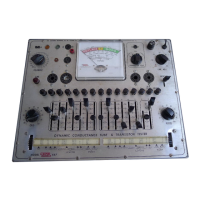
Eico 667 - DEVELOPING SETTINGS FOR NEW TUBES; General Procedure for New Tube Settings; Lever Switch Configuration

Eico 667
29 pages
Print Icon
To Next Page IconTo Next Page
To Previous Page IconTo Previous Page
Loading...
667 TUBE
TESTER
*
7
E/CO
<
PAGE
15
To
install the roll
chart,
unfasten
and
lift out the
panel
assembly
(the
entire
instrument)
release both
rollers and
remove
the rollers
from
the bracket.
Install
the new
chart
as
follows:
a) Fasten the
top
end
of the chart
to one roller
with
good
quality
adhesive
tape.
The printed
surface
of
the chart must
face away from the
roller;
b)
Wind
the chart
onto
the roller
carefully,
being
certain that
it does not wrinkle
or
bind
on the side
wheels;
d)
Place
the other
roller
under the one on which the
chart
is wound
so
that adjacent
gears mesh
—
then
pass
the
bottom
end of the chart through
the opening
between the rollers
and fasten it
to
the
surface
of
the lower
roller with
another piece
of
adhesive
tape
(pull the
chart
tight onto
the lower
roller
when
you
fasten
the end
to it); e)
Insert
the pair
of rollers
in the roll
chart bracket
with the
full
roll
toward
the open side,
which
when mounted
is closest to the panel;
f) Mount
the
bracket on
the
front panel
with the
four screws
which
were removed
at the beginning
of
the
replacement
steps;
g)
Finally,
check to see that
the
bracket
has
been mounted
so that the
printing
on
the chart
reads
right side
up
and
that turning
the wheels
to
roll
the
chart
through its
entire length
does
not reveal any
binding
on
the wheels or
the
chart paper.
SPECIAL
APPLICATIONS
CHECKING
PILOT
LAMPS
AND
CHRISTMAS
TREE
LAMPS
In the center
of the NOVAR
socket
is
a receptacle for
miniature-base
lamps.
It is
suitable
for either
screw
or
bayonet
base types,
since both have
center
contacts on
the end
of
the
base
and shells
around
the side
of the
base
to
serve
as the
other
contact.
As the
wall
around
the
receptacle
is grounded
and
the center
contact of
the
receptacle
is
connected
to the
rotor
of
the
FILAMENT
selector
switch,
whatever
filament
voltage
is selected
will
be
applied
to
a
miniature
-
base lamp
inserted
in the
receptacle for
testing.
The
test
procedure,
therefore,
is the
following:
a)
Set
the
FILAMENT
selector
to the rated
voltage
of the lamp;
b) Depress
the LINE
button and
turn the
LINE
ADJ.
potentiometer
until
the meter
reads
at
the LINE
ADJ.
mark on
the
scale;
c)
Insert
the
lamp
in the
test
receptacle. A
good lamp
will
light
to its
normal
intensity.
DEVELOPING
SETTINGS
FOR NEW
TUBES
Paragraphs a
through
k cover
the procedure
for all
single triodes
and
pentodes.
Paragraph
I
gives the
procedure
for
half-wave
rectifiers,
and
paragraph
m the
procedure
for
light-duty
detecting diodes
(usually in the
same
envelope
with
a
triode
or~pentode).
Paragraph
n deals
with testing
dual-triodes,
triode
-pentodes, and full-wave
rectifiers.
~
a)
Set
the TRANSISTOR
TEST selector
to
'’TUBE".
b)
Set the
FILAMENT
selector
switch
to the required
filament
voltage.
For
center-
tapped
heaters,
use the
series
connection
with the
higher filament
voltage
(see
step
c).
c)
Set
lever
switches 1
through 12 and
C
to
positions
which
will
connect
the proper
source of
voltage
to
each
tube element.
Levers
1
through 12
set the
connections
for base pins 1
through
12
respectively,
and lever
C sets the
connection for
the
cap
lead.
The
positions of the
switches are
as follows:
1 is
ground;
2
is filament;
3 is
screen or
optional plate; 4
is
plate;
5 is control grid;
and
6 is open
(no
connection).
The following
rules
must
be
observed:
1)
One
side
of the
filament
must
be
grounded;
filament taps
must
be connected
to
position
6;
2)
For
tubes
having
several
pins
connected
to the
same
element,
connect only
one
of these
pins
to the
appropriate
voltage
(or
ground, in the
case of
a
cathode);
all
other
suchpins
must
be connected

Related product manuals