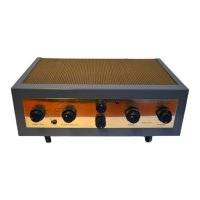
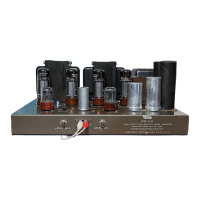
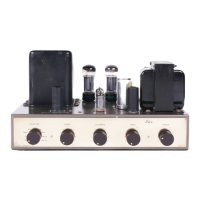
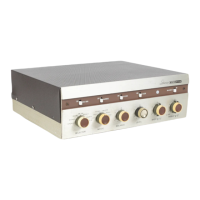
mechanical
installation
GENERAL
a)
HEAT
DISSIPATION
(VENTILATION): Incommonwith
other electronic equipment,
the HF-85 produces consid-
erable heat
In normal operation. Unless continuous and
adequate
air flow is obtained around the heat producing
elements, these elements will over-heat and
their useful
life will
be reduced.
Adequate ventilation will
be provided if the
HF-d5 is
installed inan
open-back console provided thot
the top of
the unit
is spaced at least two inches
below <xiy shelf
mounted above it. IF the cabinet
Is enclosed at the rear,
provide several large
holes or slots as low down and
as
high up in the cabinet back
as possible. As an alternative,
holes may be provided
in the sides, bottom, or top of
the
cabinet.
The
important
thing to remember
is
that effective
ventilation
requires provision for
cool air
to enter
at the
bottom
and hot
air
to
leave ot the top.
If the HF-85 is not installed
in a console, it may be sit-
uated on an
open
surface
or on a
shelf
of
a
bookcose.
Four
rubber feet are also provided so
that It will not
mar
the
surface
of furniture
on
which It
Is placed.
b) EASY
ACCESS TO CONTROLS: Mount the preampli-
fier at
a
height
which will permit eosy manipulation of
the
controls.
e)
ACCESSIBILITY TO PARTS: Tubes ore the most fre-
quently reploced items
in
electronic
equipment.
If
the
preamplifier Is installed
in a console,
sufficient
spoce
should
be alloted to reach and remove
any
tube
in
the
unit.
Furthermore, input and output terminals
of the pre-
amplifier should be accessible
to
permit
easy Interchang-
ing of system
components for comparison. If antennas ore
strung around the
back of the console in which the pre-
amplifier is
installed, arrange them
so they will not in-
terfere with access to fhe unit.
d)
ACOUSTICAL ISOLATION: If preamplifier and speaker
are installed inthe
same
cobinet(not
recommended), pro-
vide sufficientseparationtomlnlmize
mechanical speaker
vibration
reaching the preamplifier which may result
in
mtcrophonicsand howling. The minimum separation
Is o-
bout one foot.
A
baffle, usually the preamplifier mount-
ing shelf, should be present between preamplifier and
speaker. In extreme coses, it
may be necessary to mount
the
preamp] if
ier
on
sponge
rubber
pods.
CONSOLE
MOUNTING
a) Operations
on console
front
panel preliminory to [ye-
amplifier mounting
:
(1)
Tape the panel template provided
to the face of the console so that the top
of
the mounting
Mirfoce line on the template is
level
with the top
of the
amplifier mounting shelf.
(2)
Use an awlornallto pierce
the centers
of the four extreme outers holes For mounting
the control plate, to transfer their
locations
to the
con-
sole panel beneath.
(3)
Trace out the rectangular cut-
out with
an
awl or
nail ond
then
pierce the centers of the
Four 1/2”
holes, one in each corner of the cutout.
(4)
Remove
the
panel template.
(5)
Drill the four
1/2"
holes
in the console panel, one in each corner of the rectan-
gular cutout area. Cut out the rectangular
piece
with
a
keyhole saw, using the four
1/2”
holes
as starting
holes.
b)
Preamplifier mounting In
console;
(1)
Pull off
the con-
trol knobs.
(2)
Remove
the
four screws that fasten the
bezel to the side pieces and remove the bezel.
(3)
Re-
move
the
two screws and nuts that Fasten the control plate
to the bezel.
The bezel
it
not
used
In
console mounting.
(4)
Fasten
the control plate to the console panel
with
the
two ^4 X
3/6
wood
screws supplied.
(5)
If the rubber feet
hove been
inserted in the bottom plote, remove them.
(They moy be pried out with
a
thin screwdriver.)
(6)
Place the unit on the mounting shelf
and slide It forward
until the slideswitch support
l^oekets are up against the
panel and both slide switches
oceeuible from the front;
the control
shafts should be approximately centered In
the corresponding
holes in the control plate.
(7)
With
a
sharp pencil, draw the outline
of the side and rear bottom
edges on the chassis shelf.
As the bottom plote falls short
of the full width
by
3/16”
on each side, draw
new side
edge lines
3/16^ Iruide the original side edge lines.
(8)
Now remove
the knobs and take the
chassis off the shelf.
{9)
Remove the 6 screws which fasten
the bottom plate to
the chassis.
(10)
Place
the bottom plate exactly in the
outline drown
on
the
shelf and mark the position
of the
center hole
on
the
left side and the center
hole on the
right side.
(11)
Remove the bottom plate and drill
each
of the marked
holes on the shelf to
a
diameter
of
1/4".
(12)
Refesten the bottom plate
to
the
chassis, with the
four of
the six screws previously
removed, using
the two holes at the rear and the two
holes at the front
of the chassis.
(13)
Replace the chassis on the shelf,
positioning it exactly
in
the outline
previously drawn,
and restore the knobs.
This time make sure that the
In-
dicator dot on
each
knob
agrees with the control position.
(14)
From the
bottom side of the shelf, insert
a^Sx!"
screw, with
a
1/2"
flat washer against the head, through
both the left
and right side center holes.
These screws
engage the stamped nut over
each hole on
the
chassis
flange ondwhen tightened
secure the chosslsto theshelf.
3


 To Next Page
 Loading...