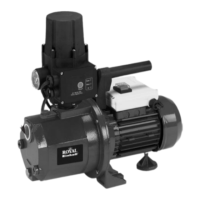
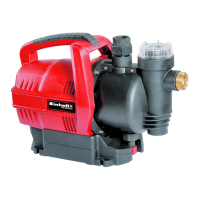
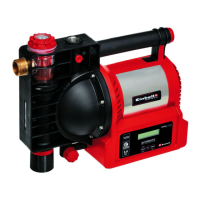
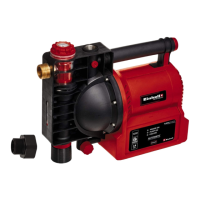
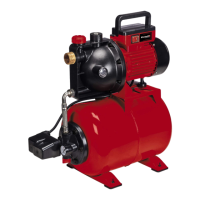
This document describes the Einhell RG-WW 6536 domestic waterworks, a device designed for various water supply and irrigation tasks around the home and garden.
Function Description
The Einhell RG-WW 6536 is a domestic waterworks system primarily intended for the following applications:
- Irrigation and watering: Suitable for green areas, vegetable beds, and gardens.
- Lawn sprinklers: Can be used to operate lawn sprinklers.
- Water extraction: Designed for drawing water from ponds, streams, rainwater butts, rainwater cisterns, and springs.
- Service water supply: Provides water for various domestic uses.
The device is designed to pump clear water (fresh water), rainwater, or light suds/service water. It is not suitable for pumping flammable, gassing, or explosive fluids. Aggressive liquids (acids, alkalis, silo seepage, etc.) and liquids with abrasive substances (sand) must also be avoided. Importantly, this equipment is not designed to convey drinking water.
The RG-WW 6536 operates by drawing water through an intake line, filtering it through a coarse filter, and then pumping it under pressure through a discharge line. It features a pressure switch that automatically turns the pump on and off based on the set cut-in and cut-out pressures, maintaining a consistent water supply. A built-in temperature monitor protects the motor from overheating and blocking, automatically shutting off the pump if it gets too hot and restarting it once it cools down.
Important Technical Specifications
- Mains connection: 230V ~ 50 Hz
- Power rating: 650 Watt
- Pumping rate without non-return valve: 3750 l/h
- Pumping rate with non-return valve: 3450 l/h
- Max. delivery head: 38 m
- Max. delivery pressure: 0.38 MPa (3.8 bar)
- Max. suction height: 8 m
- Pressure and suction connector: ca. 33.3 mm (R1IG)
- Max. water temperature: 35 °C (for continuous operation)
- Tank capacity: 20 l
- Cut-in pressure approx.: 0.15 MPa (1.5 bar)
- Cut-out pressure approx.: 0.30 MPa (3.0 bar)
- Fuse protection: Minimum 10 Ampere
Usage Features
Before putting into operation:
- Placement: The device should be placed on a firm, level, and horizontal surface.
- Priming: Remove the ventilation screw (8) and the coarse filter screw (7). Take out the coarse filter (9) with the non-return valve (10) as shown in Figure 2. Fill the pump housing with water via the coarse filter screw (7). This step accelerates the priming process. Reassemble in reverse order.
- Intake Line Connection:
- The intake hose or pipe should have a minimum diameter of 25 mm (1"); for suction heights exceeding 5 m, 32 mm (1 1/4") is recommended.
- Mount an intake valve (foot valve) with an intake cage to the intake line.
- Position the intake line so it rises from the water withdrawal point to the equipment to prevent air bubbles from impeding priming.
- Ensure intake and discharge lines do not exert mechanical pressure on the equipment.
- The intake valve should be deep enough in the water to prevent dry running if the water level drops.
- A leaky intake line will draw in air and prevent water from being drawn in.
- Discharge Line Connection:
- The discharge line (min. 19 mm (3/4")) must be connected to the 33.3 mm (R1IG) female thread discharge line connector, either directly or with a threaded nipple.
- During priming, fully open any shut-off devices (spray nozzles, valves, etc.) in the discharge line to allow air to escape freely.
- Electrical Connection: Connect to a 230 V ~ 50 Hz protective contact socket with a minimum 10 A fuse.
- Operation: Open the discharge line. Connect the mains cable. Switch on the device using the power switch (3). Priming can take up to 5 minutes at maximum suction height. The device will switch off automatically when the cut-out pressure of 3 bar is reached. It will switch on automatically (cut-in pressure approx. 1.5 bar) when the pressure drops due to water consumption. After use, switch off the device at the power switch (3).
Safety Regulations:
- In stagnant water bodies, garden ponds, swimming ponds, and their surrounding areas, the unit may only be used with an earth-leakage circuit breaker with an actuating rated current of up to 30 mA.
- The equipment is not designed for use in swimming pools or paddling pools where people or animals may be present during operation.
- Always inspect the equipment visually before use. Do not use if safety devices are damaged or worn. Never disable safety devices.
- Use the equipment only for its intended purpose.
- The operator is responsible for complying with local safety and installation regulations.
- If the cable or plug is damaged, it must be replaced by a trained electrician.
- Never use the power cable to lift, transport, or secure the equipment.
- Ensure electrical connections are protected from flooding/moisture.
- Pull the mains plug before any work on the equipment.
- Do not expose the equipment to a direct jet of water.
- Prevent consequential damage from flooded rooms by suitable measures (e.g., alarm systems, reserve pump).
- In case of failure, repairs must only be carried out by an electrician or ISC after-sales service personnel.
- The equipment must never run dry or be used with a fully closed intake line. Dry running voids the warranty.
- The pump must not be used for swimming pools or installed in the drinking water pipe line.
Maintenance Features
The device is largely maintenance-free, but regular inspection and care are recommended for a long service life.
Before any maintenance, disconnect the device from the mains by pulling the plug from the socket.
- Clearing Blockages: If the device is blocked, connect the discharge line to the water pipe and remove the suction hose. Open the water pipe. Switch the device on several times for about two seconds. This often clears blockages.
- Pressure Tank Maintenance: The pressure tank contains an expandable water bladder and an air cushion, which should have a pressure of approx. 1.3 bar. If the air pressure is too low, unscrew the plastic lid on the tank and top up the pressure via the valve using a tire pressure gauge. Before doing this, completely empty the water bladder via the water drain screw (5).
- Replacing the Mains Cable: If the mains cable is damaged, it must only be replaced by a qualified electrician. No other parts inside the device require maintenance.
- Cleaning the Coarse Filter Insert:
- Regularly clean the coarse filter insert, replacing it if necessary.
- Remove the coarse filter screw (7) and take out the coarse filter (9) with the non-return valve (10) (Figure 2).
- Disassemble the coarse filter insert as shown in Figure 3.
- Do not use harsh cleaners or petrol to clean the coarse filter and non-return valve.
- Clean the coarse filter and non-return valve by tapping them on a flat surface. For heavy soiling, wash with soapy water, then rinse with clear water and air-dry.
- Reassemble in reverse order.
Storage:
- For longer periods of non-use or winter storage, thoroughly rinse the pump with water, completely drain it, and store it dry.
- In case of frost, the device must be completely drained.
- After long periods of inactivity, check for proper rotor rotation by briefly switching the pump on and off.
- Store the device and its accessories in a dark, dry, and frost-free place, out of reach of children. The optimal storage temperature is between 5 and 30 °C. Keep the power tool in its original packaging.
Troubleshooting Guide (Common Faults and Remedies):
- Motor fails to start up:
- Cause: No mains voltage. Remedy: Check voltage.
- Cause: Pump rotor blocked, thermostat switched off. Remedy: Dismantle and clean pump.
- No intake:
- Cause: Non-return valve dirty. Remedy: Clean.
- Cause: Pump chamber without water connection. Remedy: Fill water into intake.
- Cause: Air in intake line, not airtight. Remedy: Make sure intake line is sealed.
- Cause: Max. suction height exceeded. Remedy: Check suction height.
- Inadequate delivery rate:
- Cause: Suction height too high. Remedy: Check suction height.
- Cause: Coarse filter dirty. Remedy: Clean.
- Cause: Water level falling rapidly. Remedy: Place the suction hose at a deeper level.
- Cause: Pump performance diminished by contaminants. Remedy: Clean pump and replace wearing parts.
- Thermostat switches pump off:
- Cause: Motor overloaded - friction caused by foreign substances too high. Remedy: Dismantle and clean pump. Prevent intake of foreign substances (filter).
Disposal and Recycling:
The device is supplied in packaging to prevent transport damage. This packaging is raw material and can therefore be reused or returned to the raw material cycle. The device and its accessories are made of various materials, such as metal and plastics. Defective components must be disposed of as special waste. Consult your dealer or local council for information. Electrical and electronic equipment must not be disposed of with household waste.

 Need help?
 General

 To Next Page