INSTALTATION
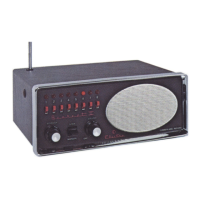
This receiver
is
shipped
complete
with
the necessary
ac-
cessories
for
mobile
or table use.
As a fixed
receiver
in areas
of
fair-to-good
signal strength,
the telescoping
whip
antenna
supplied.
may
be used
on all bands.
If
an outside
antenna is necessary
for fringe
reception, you
may use a
l55mHz
antenna on all bands, a 40mHz antenna
for
L
and
H bands or a 460mHz antenna on
U
band only.
Exter-
nal antennas should
be coupled to the receiver by 50
ohm
coaxial cable,
such
as RG-58 A/U,
using
the
supplied
auto-
motive
type
connector.
Suitable antennas
are available
at
most radio
dealers.
INSTRUCTIONS
The BC-4 has
high noise immunity
because
of the noise
squelch system.
However,
the noise
generated
by the
auto
electrical
system and other
parts
of
the
car
is
sometimes a
problem, particularly
in
areas of
low
signal
strength. The
sub-
ject
of noise elimination
is
too
lengthy
to deal with
adequate-
ly in
this instruction
book.
It is
recommended for
those who
wish
to become
familiar
with the
subject to
purchase
"The
Radio
Amateur's Hand-
book" or
"The
Mobile Manual" published
by
the
American
Radio Relay
l,eague and
sold
by most electronic
parts
stores.
It is further
recommended
that the vehicle
be taken
to a ser-
vice center which
specializes
in
VHF-UHF
two way radio
communications equipment for
correction
of a noise
problem.
MOBILE INSTALLATION
This
receiver
may
be installed in
any car,
truck,
boat, etc.,
having
a 12
VOLT
NEGATIVE
GROUND
SYSTEM.
[n
some areas it is illegal for
unauthorized
persons
to
receive police
communications
on
a mobile receiver.
The
user
of this
radio
is responsible for
obtaining
any
necessary
author-
ization
through local
agencies and Electra Company
cannot
he responsible
for
any illegal
installation
or
usage.
l.
Place
the
mobile
mounting
bracket under.the
dash
to
hold
the receiver in
the desired position.
Mark
and drill
two
holes
using
a 7164 drill
bit and
secure
the bracket with
the two
No.
6 self-tapping
screws.
3.
Insert
the two
plastic
"T"
washers,
flanges
turned
inward,
in
the desired pair
of
mounting holes
and
secure the receiver
in place
with
the twoIl4-20bolts
and
two ll4" lD x
9l16"
OD flat washers.
4.
Attach
the
DC
power
cable
and connect
it
to the
"acccssory"
or
"radio"
terminal
on
the
fuse
block.
5.
External
mobile
antennas may
be
used
as described
above.
The autornotive
antenna
may
be used fully
extended for
L
or
H bands. It
should be reduced
to
approximately
lB" for U bands.
OPE RATI ON
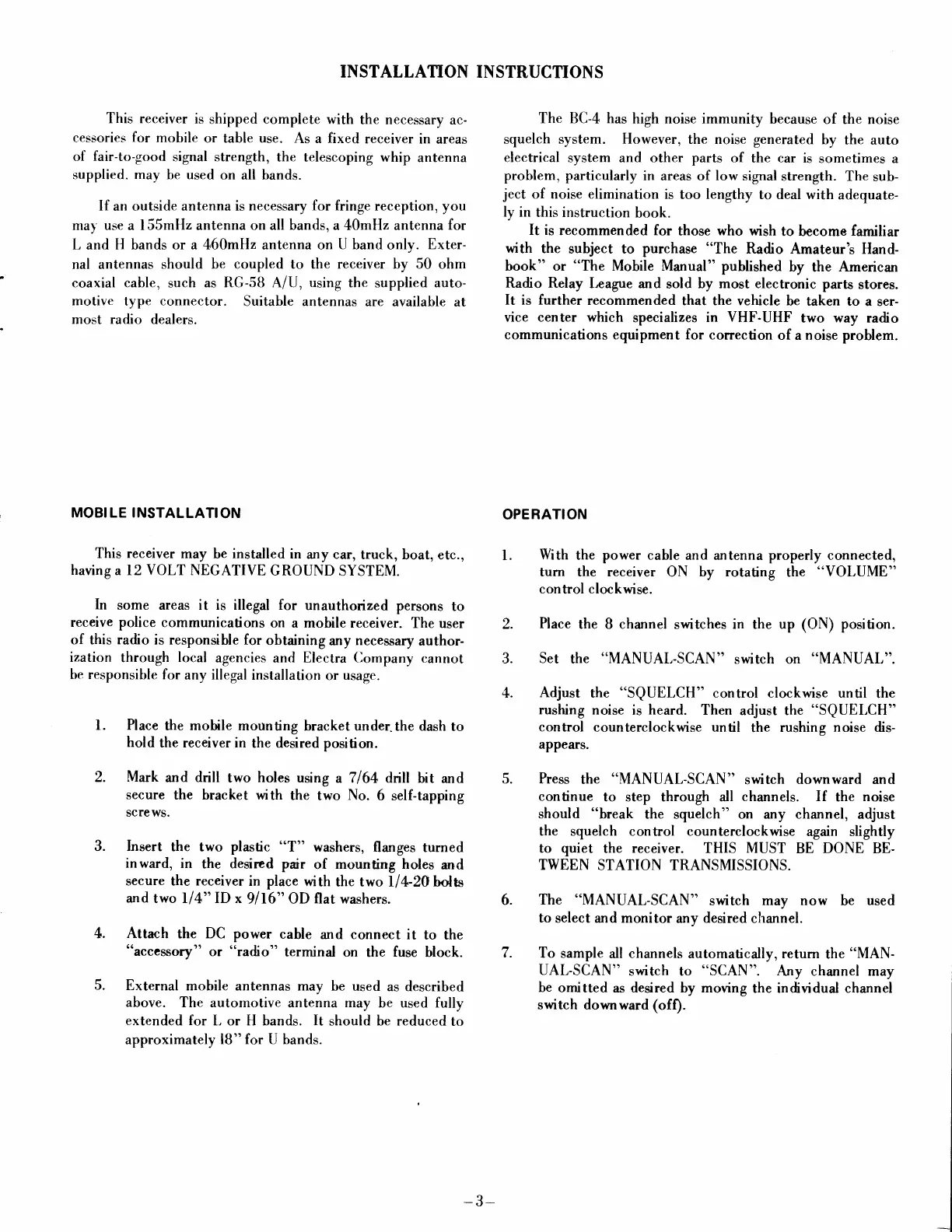
Mth the power cable and antenna properly connected,
turn the receiver
ON
by rotating
the
"VO[,UME"
control clockwise.
Place
the B channel switches in the up
(ON) position.
Set
the
"MANUAL-SCAN"
switch on
"MANUA[,".
Adjust
the
"SQUELCH"
control clockwise until
the
rushing
noise
is
heard.
Then
adjust the
"SQUE[,CH"
control
counterclockwise until
the
rushing noise dis-
apPears.
Press
the
"MANUA[,-SCAN"
switch
downward and
continue
to step through all
channels. If
the
noise
should
"break
the squelch" on any channel,
adjust
the
squelch control counterclockwise
again slightly
to quiet
the receiver. THIS MUST
BE
DONE
BE-
TWEEN
STATION TRANSMISSIONS.
The
"MANUAL-SCAN"
switch
may now
be
used
to
select and monitor
any desired cl"rannel.
To
sample
all
channels
automatically, return
the
"MAN-
UAL-SCAN"
switch to
"SCAN".
Any channel may
be omitted
as desired by moving
the individual channel
switch
downward ("f0.
l.
3.
5.
6.
7.
-3-


 To Next Page
 Loading...