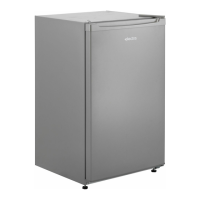
This document is a user manual for the Electra EFUL133IE built-under fridge. It provides essential information for safe operation, maintenance, and optimal use of the appliance.
Function Description
The Electra EFUL133IE is a built-under fridge designed for domestic use, primarily for cooling and storing fresh food. It features a single fresh food compartment (fridge) and is not equipped with a freezer compartment. The appliance is intended to be integrated into kitchen units, ensuring a seamless look in the kitchen environment. It is suitable for various domestic settings, including staff kitchen areas, farmhouses, hotels, motels, bed and breakfast environments, and catering applications. The fridge operates by automatically regulating the temperature within its compartment via a thermostat knob.
Important Technical Specifications
- Model: EFUL133IE
- Type: Built-under Fridge
- Refrigerant: R600a (environmentally friendly and natural gas, but explosive if leaked)
- Operating Voltage: 220-240 V at 50Hz
- Power Connection: Specially grounded plug, 13 amperes, BS 1363A 13A fused plug (for UK type plug). Requires a specially grounded socket.
- Minimum Clearance: 150 mm at the top of the appliance.
- Installation Dimensions:
- Width: 595 mm
- Depth: 548 mm
- Height: 812-882 mm
- Recess Width: 600 mm
- Recess Height: 820-890 mm
- Min. Recess Depth: 550 mm
- Adjustable Legs: 100-170 mm
- Climate Class: The appliance is designed to operate within specific ambient temperature ranges (SN, N, ST, T) as indicated on the information label. For example, SN (extended temperate) is 10°C to 32°C, N (temperate) is 16°C to 32°C, ST (subtropical) is 16°C to 38°C, and T (tropical) is 16°C to 43°C.
- Light Bulb: Not more than 15 W (for incandescent bulbs). If LED lighting is present, it must be changed by authorized personnel only.
- Altitude Limit: Not intended for use at altitudes exceeding 2000 m.
Usage Features
- Thermostat Control: The fridge temperature is regulated by a thermostat knob with settings from 1 to 5.
- Position 1: Lowest cooling.
- Position 5: Maximum cooling.
- Recommended Settings: Low/medium (up to 3) for short-term storage, medium (3 or 4) for long-term storage, and maximum (4-5) for extended long-term storage.
- Larder (Cooler) Temperature: Can cool up to 4-6 °C.
- Initial Operation: Upon first switch-on, allow the appliance to run for 24 hours to reach operating temperature before loading food. Avoid opening the door frequently during this period.
- Food Storage Recommendations:
- Vegetables and Fruits: Store in the vegetable bin for up to 1 week. Store loose fruit and vegetable items in crisper containers, ideally separately to prevent ethylene-sensitive items from being affected by ethylene-releaser fruits. Do not put wet vegetables in the refrigerator.
- Meat and Fish: Loosely wrapped in plastic foil, bags, or a meat container, stored on the glass shelf above the vegetable bin for 2-3 days. Avoid cross-contamination with fruits and vegetables.
- Fresh Cheese: On the designated door shelf for 3-4 days.
- Butter and Margarine: On the designated door shelf for 1 week.
- Bottled Products (milk, yoghurt): On the designated door shelf until the expiry date recommended by the producer.
- Eggs: On the designated egg shelf for 1 month.
- Cooked Food: On all shelves for 2 days.
- General Advice: Store liquids in sealed containers to reduce humidity and frost formation. Allow warm food to cool to room temperature before placing it in the fridge. Ensure no items touch the rear wall. Do not put hot food directly into the refrigerator. Foods should be placed in closed containers or covered to prevent moisture and odors. Potatoes, onions, and garlic should not be stored in the refrigerator.
- Power Outages: Unplug the appliance during a power cut. After power is restored, wait 5 to 10 minutes before plugging it back in to prevent compressor damage.
- Adjustable Front Legs: Use to ensure the appliance is level and stable before placing food inside.
Maintenance Features
- Cleaning:
- Frequency: The appliance should be cleaned regularly.
- Method: Disconnect from power supply. Use a solution of bicarbonate of soda and lukewarm water. Rinse with clean water and dry carefully.
- Avoid: Abrasive products, detergents, soaps, pouring water directly on the appliance, or washing accessories in a dishwasher.
- Specific Areas: Clean the condenser with a brush at least twice a year to maintain energy efficiency. Ensure no water enters the lamp housing or other electrical components.
- Accessories: Clean separately by hand with soap and water.
- Defrosting:
- Automatic: Defrosting occurs automatically in the refrigerator compartment. The water is collected by the evaporation tray and evaporates.
- Drain Hole Maintenance: The evaporation tray and water drain hole should be cleaned periodically with the defrost drain plug to prevent water accumulation. Pouring half a glass of water down the drain hole can help clean it.
- Light Bulb Replacement:
- Procedure: Unplug the unit. Remove the screw on the light cover, press the hooks, open the cover, pull it out, then turn the light bulb counter-clockwise to remove. Replace with a new bulb (max 15W). Reassemble in reverse order. Wait 5 minutes before plugging the unit back in.
- LED Lighting: If the appliance has LED lighting, contact the help desk for replacement by authorized personnel.
- Door Gasket: Keep clean and pliable. Replace if worn.
- Long-term Storage (e.g., holidays): Unplug the appliance, clean it, and leave the door open to prevent humidity and odors.
Safety Warnings and Precautions
- Ventilation: Keep ventilation openings clear.
- Defrosting: Do not use mechanical devices or other means to accelerate defrosting other than those recommended by the manufacturer.
- Electrical Appliances: Do not use electrical appliances inside food storage compartments unless recommended by the manufacturer.
- Refrigerant Circuit: Do not damage the refrigerant circuit.
- Power Cord: Ensure the supply cord is not trapped or damaged when positioning. Do not use damaged, torn, or old plugs. Do not pull, bend, or damage the cord. Never touch with wet hands.
- Socket Outlets: Do not locate multiple portable socket-outlets or portable power supplies at the rear.
- Stability: Fix the appliance in accordance with instructions to prevent instability hazards.
- Flammable Materials: Do not store explosive substances or aerosol cans with flammable propellant.
- Children Safety:
- Children aged 8 and above, and persons with reduced capabilities, can use the appliance with supervision and instruction.
- Children aged 3 to 8 years are allowed to load and unload but not clean or perform user maintenance without continuous supervision.
- Very young children (0-3 years) are not expected to use appliances.
- Children should not play with the appliance or hang off the door.
- If an old fridge has a lock, break or remove it before discarding to prevent children from getting trapped.
- Damaged Supply Cord: Must be replaced by the manufacturer, an authorized service agent, or similarly qualified persons.
- Placement: Avoid direct sunlight, stoves, gas ovens, heater cores (at least 50 cm away), and electrical ovens (at least 5 cm away). Maintain at least 2 cm clearance from a deep freezer to prevent humidity.
- Overloading: Do not overload the appliance.
- Dust: Ensure there is no dust on the condenser.
- Space: Ensure enough space near the rear and side walls for proper air circulation.
- Commercial Use: This appliance is for domestic use only. Commercial or common use will void the warranty.

 Need help?
 General

 To Next Page