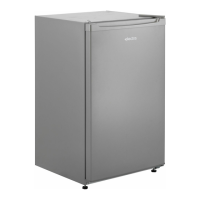
This document is a user manual for an Electra BLU106WE refrigerator, providing essential information for its safe operation, maintenance, and optimal performance. It covers various aspects from initial installation to troubleshooting and customer service.
Function Description
The Electra BLU106WE is a refrigerating appliance designed for household and domestic use, specifically for cooling and storing fresh foods. It is not intended for commercial applications or for storing non-food substances. The appliance features a fresh food compartment (fridge) with shelves, a crisper, a crisper cover, bottle shelf, and door shelves for organized storage. It also includes an egg holder. The refrigerator operates by automatically regulating the temperature within its compartment, controlled by a thermostat knob. This model is a larder (cooler) type, meaning it does not have a separate freezer compartment but can cool down to 4-6 °C.
Usage Features
- Thermostat Setting: The temperature of the fridge compartment is regulated by a thermostat knob with settings from 1 to 5. Users can adjust the knob to higher numbers for colder temperatures. It's crucial not to force the knob beyond position 1, as this will stop the appliance from working.
- For short-term food storage, a low/medium position (up to 3) is recommended.
- For long-term food storage, a medium position (3 or 4) is suitable.
- For maximum cooling for long-term storage, settings 4-5 can be used.
- Temperature Warnings: The internal temperature is influenced by ambient temperature, the temperature of freshly stored food, and door opening frequency. Adjust the thermostat accordingly. The appliance is designed to operate within specific ambient temperature ranges (climate classes T, ST, N, SN) as indicated on the information label; operating outside these ranges may reduce cooling efficiency.
- Initial Operation: When first switched on, the appliance should run for 24 hours to reach its operating temperature. During this period, avoid opening the door or storing large quantities of food.
- Power Outages: In case of a power cut, unplug the appliance to prevent compressor damage. After power is restored, wait 5 to 10 minutes before plugging it back in.
- Food Storage Guidelines:
- To prevent frost and humidity, store liquids in sealed containers.
- Allow warm food to cool to room temperature before placing it in the refrigerator to ensure proper air circulation and prevent increased internal temperature.
- Avoid direct contact between food items and the rear wall to prevent frost buildup and packaging sticking.
- Minimize frequent door openings to prevent warm air entry and unnecessary compressor operation.
- Meat and clean fish are best stored loosely wrapped on the glass shelf above the vegetable bin, where the air is cooler.
- Loose fruits and vegetables should be stored in the crisper containers. Storing them separately helps prevent ethylene-sensitive vegetables from being affected by ethylene-releaser fruits.
- Do not place wet vegetables in the refrigerator.
- Ensure food products are consumed before their recommended expiry date.
- The ideal fridge compartment temperature range is 0-8 °C. Temperatures below 0 °C can cause icing and rotting, while above 8 °C can lead to increased bacterial load and spoilage.
- Do not place hot food directly into the refrigerator; allow it to cool down first.
- Meat and fish should be stored in the chiller compartment (if available), and vegetables in the vegetable compartment.
- To prevent cross-contamination, meat products and fruit/vegetables should not be stored together.
- All foods should be stored in closed containers or covered to prevent moisture loss and odor transfer.
- Potatoes, onions, and garlic should not be stored in the refrigerator.
- Do not obstruct the air flow passage with food.
- Energy Saving Tips:
- Install the appliance in a cool, well-ventilated room, away from direct sunlight and heat sources.
- Allow warm food and drinks to cool before placing them inside.
- Cover drinks and other liquids to reduce humidity and energy consumption.
- Avoid prolonged door openings and frequent access.
- Keep covers of temperature compartments (crisper, chiller) closed.
- Ensure the door gasket is clean and pliable; replace if worn.
Maintenance Features
- Cleaning:
- Always disconnect the appliance from the power supply before cleaning.
- Do not wash the appliance by pouring water directly on it.
- Avoid abrasive products, detergents, or soaps. Use a solution of bicarbonate of soda and lukewarm water.
- Rinse with clean water and dry thoroughly.
- Ensure no water enters the lamp housing or other electrical components.
- Clean accessories separately by hand with soap and water; do not use a dishwasher.
- Clean the condenser with a brush at least twice a year to maintain energy efficiency and productivity.
- Defrosting: Defrosting occurs automatically in the refrigerator compartment. The melted water is collected by the evaporation tray and evaporates. The evaporation tray and water drain hole should be cleaned periodically with the defrost drain plug to prevent water accumulation. Pouring half a glass of water down the drain hole can help clean it.
- LED Lighting Replacement: If the appliance has LED lighting, contact the help desk for replacement, as this should only be done by authorized personnel.
- Shipment and Repositioning:
- Retain original packaging for re-transportation if needed.
- Secure the appliance with packaging, bands, or cords.
- Remove or secure all movable parts (shelves, accessories, bins) to prevent damage during transport.
- Always transport the appliance in an upright position.
- Door Repositioning: For models without door handles, the door opening direction may be changed by contacting an Authorised Service Centre. This is not possible for models with handles installed on the front surface.

 Need help?
 General

 To Next Page