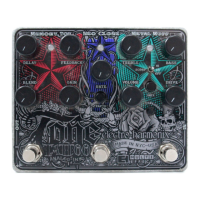
VOLUME Knob – Controls the overall output volume of the METAL
MUFF section of the TONE TATTOO.
NEO CLONE SECTION
RATE Knob – Controls the Neo Clone’s speed of modulation. As you
turn the RATE knob clockwise, the modulation speed of the chorus gets
faster. The speed of modulation varies from 0.4 Hz to 9 Hz.
DEPTH Button – Changes the intensity, or depth, of the chorus effect
choosing between high and low depth. In the up position, the Neo Clone
chorus is set to low depth, giving a subtle chorus effect. The Neo Clone
LED lights up red in the lower depth position. When the button is pushed
in, the chorus’ depth is set to high for a more intense chorus effect. The
Neo Clone LED lights up green when the button is pushed in.
MEMORY TOY SECTION
DELAY Knob – Controls the delay time of the Memory Toy section of
the Tone Tattoo. As you turn the DELAY knob clockwise, the delay time
increases. The range of delay time is 30mS to 550mS.
FEEDBACK Knob – Controls the number of echo repeats each note
produces. As you turn FEEDBACK clockwise, the number of repeats
increases. When you turn FEEDBACK all the way down, you will only
hear one echo for each note you play. If you turn FEEDBACK up to its
maximum clockwise position, the Memory
Toy’s echoes will build on top of each other for a “run-away” effect after
you play a note. A fairly high feedback setting with short delay settings
produces a reverb type of effect.
BLEND Knob – Allows you to vary the mix of the dry signal coming into
the Memory Toy section with the delayed signal produced within the
Memory Toy effect. BLEND varies from 100% dry, when set to full
counter-clockwise, to 100% wet at full clockwise.
GAIN Knob – Controls the input gain into the Memory Toy. As you turn
the GAIN knob clockwise the gain increases, making for a louder overall
effect. The GAIN knob increases the volume of both the dry and delayed
signal. Use the GAIN knob in conjunction with the BLEND knob to set the
Memory Toy to your preferred volume. Please Note: the delay signal will
saturate before the dry signal. The range of the GAIN knob is 0dB to
+23dB.
4
FOOTSWITCHES & LEDs
Each effect section of the Tone Tattoo has its own independent
footswitch to toggle the associated effect in and out of bypass. Bypass
through the Tone Tattoo is buffered bypass.
METAL MUFF Footswitch and STATUS LED - The footswitch located
nearest to the IN jack toggles the Metal Muff effect on or off. When the
LED in the Metal Muff
section is lit (either red or green), the Metal Muff effect is active. When
the Metal Muff LED is off, the Metal Muff section is bypassed. A red LED
in the Metal Muff section indicates that the GATE function if off. A green
LED in the Metal Muff section indicates that the GATE is enabled.
NEO CLONE Footswitch and STATUS LED - The footswitch located in
the middle of the Tone Tattoo toggles the Neo Clone effect on or off.
When the LED in the Neo Clone section is lit (either red or green), the
Neo Clone effect is active. When the Neo Clone’s LED is off, the Neo
Clone section is bypassed. A red LED in the Neo Clone section indicates
that the chorus is on its low depth setting. A green LED in the Neo Clone
section indicates that the chorus is set to the high depth setting.
MEMORY TOY Footswitch and STATUS LED - The footswitch located
nearest the OUT jack of the Tone Tattoo toggles the Memory Toy effect
on or off. When the LED in the Memory Toy section is lit, the Memory
Toy effect is active. When the Memory Toy’s LED is off, the Memory Toy
section is bypassed.
I/O & POWER JACKS
IN Jack – Connect the output of your instrument or other effects pedal
to the ¼ inch IN jack. The impedance presented at the IN jack is 1 MΩ.
OUT Jack – Connect the output of the Tone Tattoo to the input of an
amplifier or another effects pedal. The output impedance varies from
200 Ω to 2.5 kΩ depending on which effects are enabled and the setting
of the BLEND knob in the Memory Toy.
9V PWR JACK – Connect the output plug of the supplied AC Adaptor
into the 9V power jack at the top of the Tone
Tattoo. The Tone Tattoo draws 75mA at 9VDC. The polarity of the power
jack is center negative.


 To Next Page
 Loading...