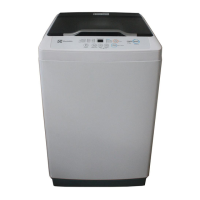
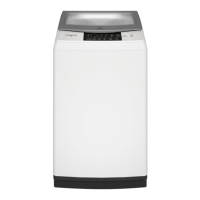
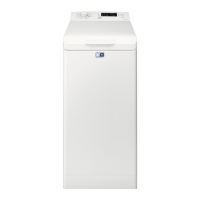
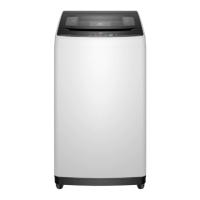
This document is a user manual for Electrolux Top-Load Washing Machines, covering models EWT7078K6WA, EWT8078K6WA, EWT9078K6WA, and EWT0H78K6WA. It provides comprehensive information on the appliance's function, technical specifications, usage, and maintenance.
Function Description
The Electrolux Top-Load Washing Machine is designed for domestic use, offering a range of wash programs and options to suit various fabric types and soil levels. Key features include:
- Auto Sensing Water Level: The washer automatically fills with the correct water level for the load, optimizing water usage and wash performance. Users also have the option to manually set the water level.
- Power Failure Recovery: In the event of a power failure during washing, rinsing, or spinning, the machine attempts to save its current stage and resumes the program once power is restored. However, if the supply voltage drops below 170V, the PCB may not start normally, or the machine might switch off automatically, requiring manual restart. If the voltage is between 170V and 187V, a drainage timeout error (E1) might occur, requiring the "Start/Pause" button to be pressed to continue.
- Child Safety Lock: This function prevents children, the elderly, and the frail from accidentally operating the control panel. When activated, the digital tube displays "CL." If the door is opened while the child lock is active, an alarm sounds, and an error message (E5) appears, initiating automatic draining after 5 seconds unless the door is closed sooner. To deactivate, both "Delay End" and "Phase Select" buttons must be held simultaneously for 3 seconds.
Important Technical Specifications
The manual provides detailed technical data for four models:
| Model no: |
EWT7078K6WA |
EWT8078K6WA |
EWT9078K6WA |
EWT0H78K6WA |
| Rated voltage: |
220V~ |
220V~ |
220V~ |
220V~ |
| Rated frequency: |
50Hz |
50Hz |
50Hz |
50Hz |
| Washing capacity: |
7.0kg |
8.0kg |
9.0kg |
10.5kg |
| Spinning capacity: |
7.0kg |
8.0kg |
9.0kg |
10.5kg |
| Water resistant: |
IPX4 |
IPX4 |
IPX4 |
IPX4 |
| Input power (wash): |
400W |
400W |
400W |
500W |
| Input power (spin): |
300W |
300W |
300W |
350W |
| Net dimensions: |
525x560x950mm |
550x592x965mm |
550x592x965mm |
580x620x980mm |
| Packaged dimensions: |
575x610x1005mm |
630x640x1015mm |
630x640x1015mm |
685x685x1040mm |
| Net/Gross weight: |
31kg/35kg |
32kg/37kg |
34kg/39kg |
39kg/44kg |
Water pressures between minimum 50kPa and maximum 800kPa are acceptable.
Usage Features
The control panel includes buttons for Power, Start/Pause, Program, Delay End, Phase Select, and Water Level.
- Programs: Nine wash programs are available: Regular, Quick, Heavy, Hand Wash, Delicates, Jeans, Rinse & Spin, Tub Clean, and Tub Dry. "Regular" is the default.
- Delay End: Allows users to set a delayed finish time for the wash program, ranging from 2 to 24 hours. The digital display shows the remaining time.
- Phase Select: Enables selection of single wash processes or combinations of wash phases.
- Water Level: Offers 5 water level gears (1-5) to choose from based on the quantity of clothes.
- Starting a Program: After selecting a program, pressing the Start/Pause button initiates the wash. For Rinse & Spin, there's a 2-minute delay for draining before spinning.
- Changing a Program: A running program can only be changed by switching off the appliance and setting a new program.
- Changing Options: Some options can be changed after a program has started by entering PAUSE mode, adjusting settings, and then resuming.
- End of Program: The appliance stops automatically, signals with three long beeps, and the laundry can be removed. It's recommended to leave the lid ajar to prevent mildew and odors and to turn off the water tap.
- Washing Hints:
- Sort laundry by color and fabric type. New colored items should be washed separately the first time.
- Ensure pockets are empty, and buttons/zips are fastened to prevent damage.
- Avoid overloading; clothes should move freely.
- Treat stains like paint, ink, rust, and grass before washing.
- Garments with volatile petroleum products should not be machine washed.
- Use a washing bag for small items to prevent them from slipping between the tub and agitator.
- Lint collectors (e.g., corduroy, synthetics) should be washed separately from lint producers (e.g., towels, nappies).
- Detergent Usage:
- Use detergents specifically designed for top-load or high-efficiency top-load washing machines (e.g., "Matic").
- Avoid soap-based products.
- Use the correct quantity of detergent based on fabric type, load size, soil level, and water hardness. Too little detergent results in poor wash; too much causes excessive suds, poor rinsing, and low spin speeds.
- Liquid detergent can be poured directly onto clothes. Washing powder should be poured into the drawer.
- For models EWT7078K6WA, EWT8078K6WA, EWT9078K6WA, fabric softener should be mixed with warm water and poured into the hole in the top of the washing tub during fill. For model EWT0H78K6WA, softener is poured into the right compartment of the detergent box. Do not spill softener on clothes to avoid stains.
Maintenance Features
Regular maintenance ensures optimal performance and longevity of the appliance.
- Cleaning the Dispenser: The dispenser drawer should be cleaned regularly, preferably after each wash, to remove detergent residue. It can be removed by pulling it out until it stops, then lifting it up. Clean with water and a brush.
- Cleaning the Drawer Recess: After removing the drawer, clean the recess with a small brush to remove all washing powder residue.
- Cleaning the Inner Tub Filter: Push out the filter from the inner tub, clean it in water to remove thread, and then reinstall.
- Cleaning the Water Inlet Filter: If water is hard or contains lime, the inlet filter may clog. Close the water tap, remove the inlet hose, clean the filter with a stiff brush, and then reinstall the hose, ensuring tight connections.
- Cleaning the Washing Machine (Exterior): Wipe surfaces with warm water and dry with a soft cloth. Avoid using solvents, alcohol, aerosol cleaners, glass cleaners, metal polishes, caustic materials, scourers, or general household cleaners on or near the top panel, lid, or control panel.
- Cleaning Stains in the Washbowl: Stains can be caused by metal objects, salt, body oils/grease, or excessive foam. Check pockets before loading. Do not leave wet clothing in the bowl for too long. Clean stainless steel washbowls with products suitable for stainless steel or with a mild dishwashing detergent and warm water for oily deposits. Never use bleach cleaners or steel wool.
- Troubleshooting: The manual provides a detailed troubleshooting guide for common issues and error codes (E0, E1, E2, E3, E4, E5, E8), along with checking points and solution plans. For example, E0 (water inlet timeout) suggests checking the tap, filter, or contacting service. E1 (drainage timeout) suggests checking drain hose position or contacting service. E2 (top lid not closed) requires closing the lid. E3 (imbalance) suggests adjusting the machine's level or clothes placement. E5 (top lid opened during child lock) requires closing the lid and deactivating child lock if needed.
Installation
- Unpacking: Remove cardboard box, styrofoam packing, and plastic bag. The top polystyrene must be removed last. Tilt the appliance carefully onto its rear side on a polystyrene element to avoid damaging hoses.
- Positioning: The machine must stand firm and level on a flat, hard floor to ensure correct operation. Use a spirit level to check levels. The left front leg is adjustable; the other legs are fixed. Ensure air circulation around the machine and avoid contact with walls or cupboards. Do not place cardboard or wood under the machine to compensate for unevenness.
- Water Inlet: Connect the water inlet hose (supplied) to a 3/4" BSP tap. Do not use old hoses. Ensure connections are tight and turn on taps to check for leaks.
- Drain Hose Installation: Use the supplied drain hose and clip. If the sewage outlet is in the opposite direction, connect the drain hose to the machine's drain exit, fasten with the clip, and then route it to the sewage outlet. If the sewage outlet is in the same direction, cut the rear half of the drain hose and connect it properly.
Environmental Concerns
- Packaging Materials: Packaging materials (PE, PS, PP) are recyclable.
- Old Machine Disposal: Dispose of old appliances at authorized disposal sites. The symbol on the product indicates it should not be treated as household waste but handed over to a collection point for recycling electrical and electronic equipment.
- Ecological Hints: To save water and energy, wash normally soiled laundry without prewashing, fully load the machine, pre-treat stains to allow lower wash temperatures, and measure detergent according to water hardness, soil level, and load quantity.

 Need help?
 General

 To Next Page