12
EN
Operating and assembly instructions ND www.elektror.com
9016303 01.20/15
Maximum frequency (see
rating plate)
Minimum frequency
50 Hz 5 Hz
60 Hz 5 Hz
> 60 Hz 20 Hz
Device with temperature
barrier (independent of the
frequency)
35 Hz
2 INFORMATION ON TRANSPORT,
HANDLNG AND STORAGE OF THE
MACHINE
2.1 Transportation and handling
• Prior to installation and putting into service, check all parts
for transit damage. A damaged blower is a potential safety
hazard and, therefore, should not be put into service.
• Do not store the blower unprotected in the open
(protect against moisture).
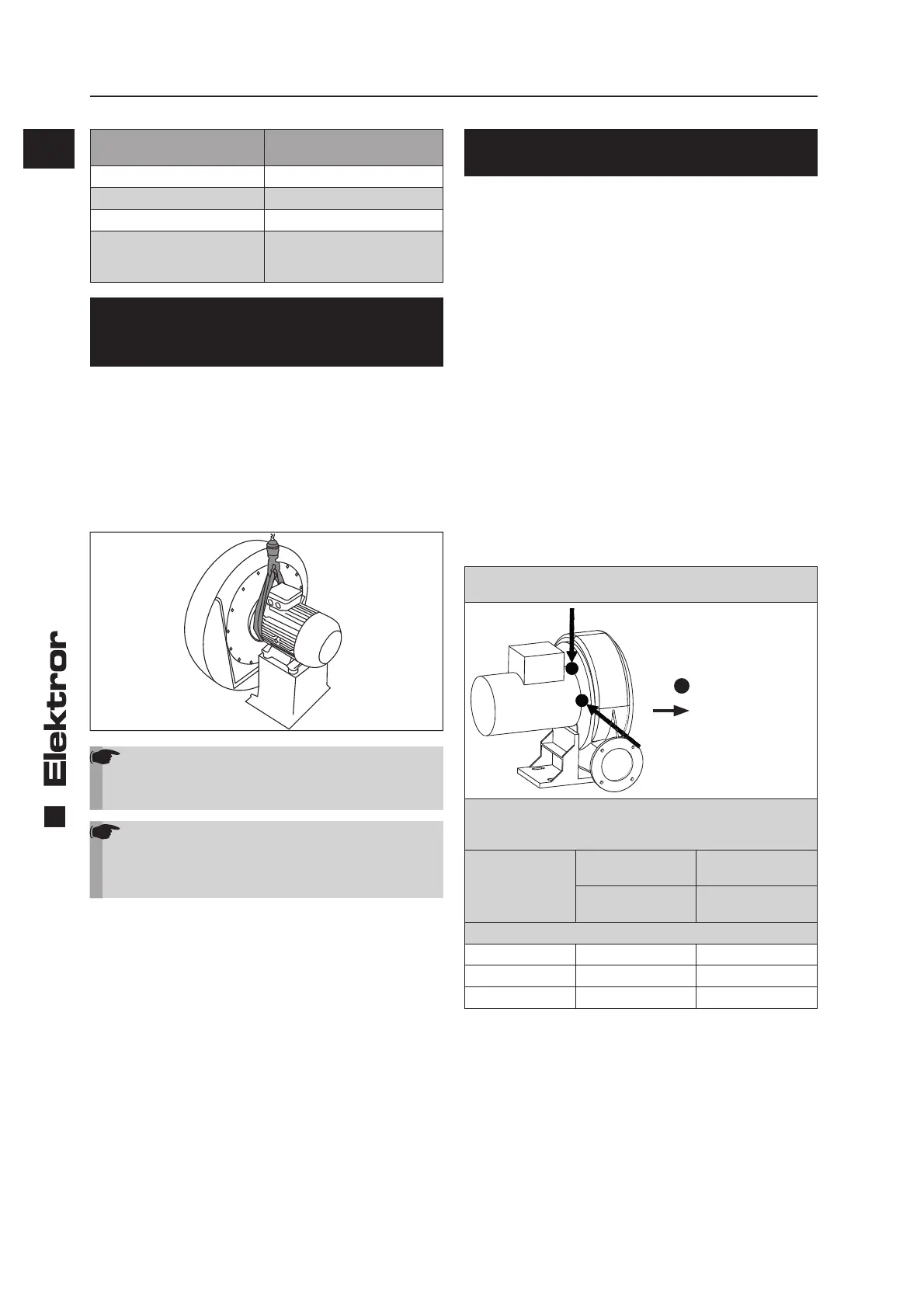
• Attach hoist securely. Only use hoists and load
suspension devices with suffi cient load-carrying capacity.
Secure the route of transportation.
Note!
The eye bolt on the motor must not be used to lift
the entire blower. This is used if the motor needs
to be (dis-)assembled.
Note!
On devices with in-built frequency converters
(FUK devices):
The frequency converter must never be used to
lift the device or as a climbing aid!
2.2 Storage
• Ensure that the air intake connection and pressure connec-
tion are closed.
• Store the blower
-> in its original packaging if possible
-> in a closed room
-> in a dry, dust-free and vibration-free area.
• Storage temperature range from -20°C to +60°C
• After a storage period of 6 months, the blower bearings
and/or motor bearings should be checked before they are
mounted in the blower.
• Devices may be stored for a maximum of 2 years.
3 INFORMATION ON COMMISSIONING
THE MACHINE
3.1 Basic information
• Prior to the fi rst start-up and before any other start-up, the
proper operating status of the unit must be inspected. Units
that, for example, are found to be defective upon delivery
or during installation, must be examined by qualifi ed techni-
cians.
• Installation, assembly and operation must only be performed
by properly trained and qualifi ed specialists. Operation fol-
lowing incorrect installation, maintenance or unapproved
replacement of components constitutes non-designated use
and renders the warranty void. The resultant risk shall be
borne solely by the customer or owner.
3.2 Installation and assembly
• Protect the blower from the weather and install it in a
horizontal position, see also “1.1 Designated use”. For
outdoor use, protection from the weather must generally
be provided that fulfi ls the requirements listed in
“1.1 Designated use” and protects the blower from the
infl uences of the weather.
• Avoid vibrational and impact loads during operation.
Permissible vibrational load on blower:
refer to ISO 14694, BV-3.
Measurement at the fl ange bearing shield, preferably
near the bearing
= Measuring point
= Measuring
direction
Maximum permissible vibration speed
(Limit values according to ISO 14694:2003 (E),
category BV-3)
Rigidly mounted
[mm/s]
Flexibly mounted
[mm/s]
Eff ective value
[r.m.s.]
Eff ective value
[r.m.s.]
At installation
Start-up 4,5 6,3
Alarm 7,1 11,8
Shut-down 9,0 12,5
• Standard blowers with base:
Bolt securely to a level and fi rm surface at the place of
use, making sure that the surface has adequate load-
bearing capacity and avoiding vibration transmission or
vibrational load.
• Standard blowers without base:
Bolt securely to a fi rm surface at the place of use, making
sure the surface has adequate load-bearing capacity and
avoiding vibration transmission or vibrational load. This
type of installation can be used for ND blowers with an
intake and/or a discharge side connection up to type:
D 066 or E 066 and 2D 066.


 To Next Page