13
www.elektror.com
Operating and assembly instructions RD
9016306 06.22/17
EN
pliance is reliably protected against restarting while work is
in progress.
Also make sure that no hazardous situation can occur as a
consequence of restarting after shutdown, e.g. as a result of
a power cut or blockage.
1.4 Weight and stability
Beware of falling hazards during transportation and installa-
tion in particular. Refer to 2.1 – Transportation and handling,
as well as 3.2 – Installation and assembly.
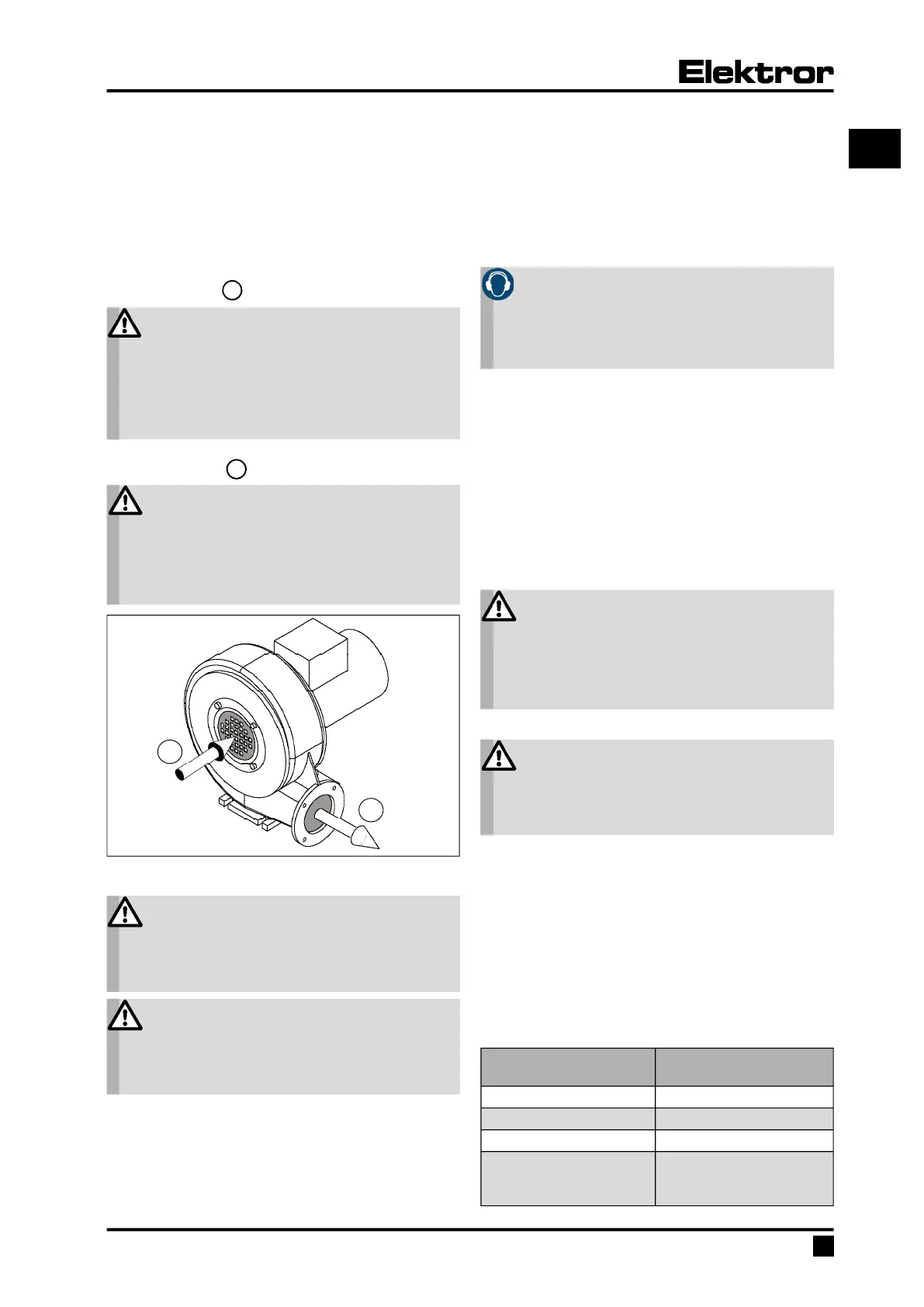
1.5 Suction eff ect
Warning!
Risk of injury due to suction eff ect!
Objects, clothing and hair can be sucked in at the
intake port.
The operator is required to wear a hairnet and
tight-fi tting clothing.
Do not stay near the suction opening during
operation!
1.6 Blowing eff ect
Warning!
Risk of injury due to strong blow-out eff ect of the
medium and ejected parts!
Impurities, debris and impermissible media may
cause objects to be thrown out of the fan outlet at
high speed!
Make sure that the fan delivers only clean air!
1
2
1.7 Temperature
Warning!
The blower housing assumes the temperature of
the conveyed medium during operation. If this
is above +50° C, the blower must be protected
against direct contact by the operator
(risk of burning!).
Warning!
The motor housing heats up during operation. If
the temperature rises above +50 °C, the blower
must be protected by the operating company
against direct contact
(risk of burning!).
In the case of high-power models in particular, the tempera-
ture of the conveyed medium can increase as it fl ows from
the intake side to the exhaust side. The temperature diff er-
ence can be in the region of up to +20°C, depending on the
operating conditions. This varies from one model to another.
1
2
1.8 Motor circuit breaker
Before putting the blower into operation, be sure to safeguard
the drive motor with a motor circuit-breaker (this does not
apply to frequency-converter-operated appliances). Where
appliances are frequency-converter-operated, the existing
temperature sensor (PTC resistor sensor) or temperature
switch (normally-closed contact) must be connected to the
converter and evaluated.
1.9 Noise emission
Note!
Wear hearing protection during operation at a
daily exposure level of 80 dB(A) and above, and/
or a peak sound pressure level of 135 dB(C) and
above.
Failure to do so may cause hearing damage.
The noise generated by a blower is not constant throughout
the performance range. For details of noise emission levels,
please refer to the table on pages 20 and 21.
In some cases, sound insulation may be necessary (it is rec-
ommended that emission levels be measured by the opera-
tor). Sound insulation must be provided by the operator to
avoid exceeding the statutory maximum levels at the work-
place and in the immediate vicinity of the blower.
No sound insulation of any kind whatsoever should cause
the ambient temperature to exceed +40°C at the drive motor
(this is not permissible).
1.10 Electrical hazards
Danger!
Danger from electric current!
Live components carry current and cause fatal
injuries!
Deactivate the device before opening it, reaching
into it or inserting tools into it; check that compo-
nents are not live and secure it against reactivation.
1.11 Speeds
Warning!
The maximum speed stamped on the motor rating
plate must never be exceeded in order to prevent
personal injury. The blower is at risk of mechani-
cal damage if the speed is exceeded.
This can cause serious injury or death!
Each component on the blower has unique natural frequen-
cies. These can be induced by certain blower speeds, which
may result in resonance mode.
The blowers are designed in such a way that resonance does
not generally occur at a constant operating speed.
This may be induced in certain circumstances when the speed
is changed if the blower is operated on a frequency converter.
These circumstances are also infl uenced by the customer’s
individual installation situation or ventilation connection.
These natural frequencies must be excluded by parametris-
ing the frequency converter accordingly should they be pre-
sent within the speed range of the blower.
Maximum frequency (see
rating plate)
Minimum frequency
50 Hz 5 Hz
60 Hz 5 Hz
> 60 Hz 20 Hz
Device with temperature
barrier (independent of the
frequency)
35 Hz


 To Next Page
 Loading...