70 of 83
ELM329DSC Elm Electronics – Circuits for the Hobbyist
www.elmelectronics.com
Modifications for Low Power Standby Operation
The ELM329 may be placed in a low power
standby mode in which it consumes very little current.
This will find its greatest use with semi-permanent
vehicle installations where you want the current
consumption to be as low as possible (ideally zero)
when the ELM329 is not needed.
Just how effective the low power mode is depends
on your attention to detail when designing your circuit.
If you use our example circuit of Figure 9, you will
likely find that with 12.0V applied as ‘Battery Positive’,
the measured current is typically:
base current (on the bench) = 25 mA
That is, with the circuit powered on, but with no PC or
ECU connected. If you connect it to a vehicle and a
computer, the current typically rises to:
base current (in the vehicle) = 32 mA
with the Active LED on. When actually monitoring
data, this current rises further, and has been
measured at:
active current (in the vehicle) = 46 mA
Any power supply designs should be able to
supply this last current continuously, and be able to
supply more than that under transient conditions
(when transmitting, the data bus capacitance needs to
be continually charged and discharged).
The “Low Power Mode” of operation section (page
61) discussed the ways in which you might initiate low
power operation, but the easiest is to use the low
power command (AT LP). After sending this, the total
circuit current is typically:
current after AT LP = 0.25 mA
That is the typical current that you would expect
with the circuit of Figure 9. If you were to use the
MCP2551 CAN transceiver instead of the MCP2561
as shown, the measured current would then be about
0.50 mA. Note that whether the Active LED is set to
flash or not has very little influence on this current (it
uses an average of about 25 µA). Similarly, the CAN
Monitor typically only uses about 20 µA during low
power operation, so does not appreciably affect the
total current.
This is a very low current, and should be suitable
for most applications. It would be difficult to reduce it
further than that, but you may be able to do so by
perhaps eliminating the voltage monitoring circuit (R9
and R10), or by choosing a lower current voltage
regulator. We leave those improvements to you.
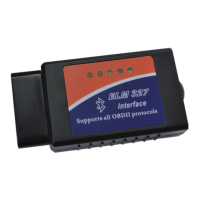
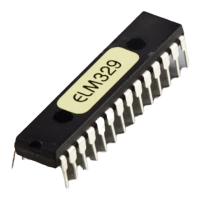
Compatibility with the ELM327
In designing the ELM329, we have purposely
maintained an almost identical pinout with our ELM327
integrated circuit. What this means is that you can
remove the ELM327 chip from its circuit and simply
insert an ELM329 chip, without causing damage to the
ELM329.
There is only one consideration that we are aware
of if you do this - the 510Ω resistors that are used for
the ‘K’ and ‘L’ lines may get hot. If you are going to use
an ELM327 circuit with the ELM329, we recommend
that you either:
- disconnect the 510Ω resistors (you may be able
to simply lift one end), or
- replace the 510Ω resistors with a higher value
resistance (2K or greater), or
- set PP 20 to 00
Any of the above will allow the ELM329 to function
in an existing ELM327 circuit without generating
excessive heat, or causing other problems.
Another consideration is software. The ELM329
uses many of the same instructions as the ELM327,
and even pretends to support protocols 1 to 5 in order
to be more compatible with it, so the software needed
will be almost identical. The one problem that you may
encounter would be with software that is set to only
work with certain chips (ie. if it looks for ELM320,
ELM322, ELM323, or ELM327 ID strings). If that is the
case, it would not be too big a task for the software
developers to add this new chip to their list - that may
very well be done even before you read this.


 To Next Page