GB
29
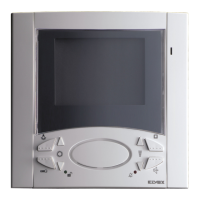
Restoring the default values of push-buttons
Programming phase:
1) Press and hold down .
2) Press and hold down also together with .
3) Wait for nearly 3 seconds until the red led flashes.
4) Release both push-buttons and
5) Press and hold down the push-button to be restored to its default set-
ting.
6) After 2 seconds the video-interphone emits a high-pitched tone.
7) Release and press again the push-button to be restored to default.
Deleting all settings
This procedure is recommended when you want to change the ID of
a previously programmed video-interphone without retaining its pro-
gramming parameters.
Programming phase:
1) Press and hold down .
2) Then press and hold down also together with .
3) Wait for nearly 3 seconds until the red led flashes.
4) Now the microprocessor is physically reset.
5) Release both push-buttons and .
6) Press and hold down the self-start push-button .
7) After 2 seconds the video-interphone emits a continuous tone for two
seconds.
8) Release the self-start push-button .
9) During the long tone press the lock push-button .
If the deletion procedure was successful, press the lock push-button
and the video-interphone will emit a triple “BEEP”.
OPERATION
Calls from an entrance panel, intercommunicating calls and landing calls
are differentiated by means of different tones.
Call from entrance panel
Calls from entrance panels are not activated after the push-button is pres-
sed but are generated inside the monitor. The call interval or call cycle is a
1-second ringtone and a 2-second pause repeated twice (default value set
on panel). The duration of “Ding-Dong” and “Ding-Dong-Dang” ringtones
follows the natural length of the ringtone, rather than the time set by the call
cycle.
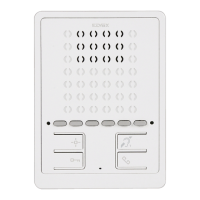
- Operation for monitor programmed in "HANDS FREE" communica-
tion mode
To answer, press and release push-button . If push-button
is already pressed during the call, release and press it again.
The call answer time (30 secs) and the conversation time (2 minutes by
default) are set in the panel parameters. To end the conversation, press
push-button . The red LED remains on as long as the audio
connection is active.
- Operation for monitor programmed in "PUSH-TO-TALK" commu-
nication mode
To answer, press and release push-button . If push-
button is already pressed during the call, release and press it
again. The call answer time (30 secs) and the conversation time (2 mi-
nutes by default) are set in the panel parameters. When the conversa-
tion time has elapsed, the user can continue without pressing
push-button again, if a new call is made within 10 seconds from
the same panel. During conversation, the audio connection can be mo-
mentarily interrupted (5 seconds max), by releasing push-button
. To resume the conversation, press push-button again
within 5 seconds, otherwise communication is lost.
To end the conversation, release push-button . The red LED
remains on as long as the audio connection is active.
Intercom call
Press the intercom button, if programmed, for the interphone/monitor to
be called. From the loudspeaker of the monitor called, a call tone will ring
(if the call is enabled) or an engaged tone will ring (if not enabled). On the
called interphone/monitor the ringtone starts sequentially at intervals of 1
second ringing and 4 seconds pause. The maximum duration of the call is
30 seconds (6 cycles). To interrupt the call, press push-button be-
fore the call recipient answers. To answer the call from the called monitor,
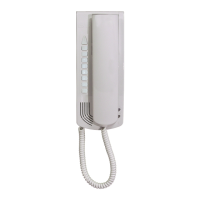
lift the handset or press push-button (keeping it pressed if the mo-
nitor is programmed to push-to-talk mode). When the call is answered, the
monitor will be put directly in communication with the call recipient for 5 se-
conds. The audio connection is made automatically. The maximum dura-
tion of the conversation is 5 minutes. When the conversation time has
elapsed, the user can continue the conversation if a new call is made wi-
thin 10 seconds. Calls from entrance panel have priority over intercommu-
nicating calls.
Denied calls
Call mute is indicated by steady illumination of the red LED . If calls are
made from the entrance panel to the monitor when call mute is enabled,
they are denied. A denied call causes the red LED to briefly switch off
according to the number of times calls are denied (maximum 4 denied
calls). The signal is repeated every 10 seconds (approx.). Deletion of denied
calls is by: re-enabling the ringtone, pressing the RESET button on the mo-
nitor, or a system power failure. On the panel, a denied call is indicated by
means of a dissuasion tone (a series of beeps at 100ms intervals with a
pause of 100ms for a total of 5 seconds). The message "Do not disturb"
also appears on panels with display.
Lock Release Button
The lock release button of each device functions as follows.
- Device with handset on hook : opens the lock corresponding to the
last entrance panel in communication with the device (whether incoming
or outgoing call).
- Device with handset off hook but not engaged in conversation : call
to switchboard if the Switchboard flag is YES. Otherwise it reverts to
the first case.
- Device with handset off hook and engaged in internal conversation
: as per first case
- Device with handset off hook and engaged in external conversation or
call from entrance panel : opens the lock corresponding to the last
entrance panel in communication with the device (whether incoming or
outgoing call).
NOTE: in the 7200 and 6600 family the equivalent operation is performed
by briefly tapping push-button and then . Also in this case
the switchboard is called.


 To Next Page
 Loading...