EasyManua.ls Logo

Emerson Fisher 61 Series - User Manual

Emerson Fisher 61 Series
4 pages
Print Icon
To Next Page IconTo Next Page
Loading...
Introduction
This installation guide provides instructions for
installation, startup and adjustment. To receive a copy
of the instruction manual, contact your local Sales
Office or view a copy at www.fisher.com. For further
information refer to: 61 Series Instruction Manual,
D103233X012. For information on mounting on
pilot-operated regulators, refer to: Type 1098-EGR
Instruction Manual, D100339X012, or Type 99
Instruction Manual, D100260X012.
PED Categories
This product may be used as a safety accessory with
pressure equipment in the following Pressure Equipment
Directive categories. It may also be used outside of the
Pressure Equipment Directive using sound engineering
practice (SEP) per table below. For information on the
current PED revision see Bulletin: D103053X012.
PRODUCT SIZE CATEGORIES FLUID TYPE
1/4 NPT SEP 1
Specifications
Available Configurations
Type 61L: Low pressure pilot for 0.02 to 1.38 bar /
0.25 to 20 psig set points
Type 61LD: Low pressure, narrow proportional
band pilot for 0 to 1.38 bar / 0 to 20 psig
Type 61LE: Low pressure, wide proportional band
pilot for 0.02 to 1.38 bar / 0.25 to 20 psig
Type 61H: high pressure pilot for set pressures
from 0.69 to 4.48 bar / 10 to 65 psig
Type 61HP: high pressure pilot for set pressures
from 1.03 to 20.7 bar / 15 to 300 psig
Maximum Inlet Pressure
(1)(2)
Types 61L, 61LE, 61H
(3)
: 20.7 bar / 300 psig
Type 61LD: 11 bar / 160 psig
Type 61HP: 41.4 bar / 600 psig
Reduce Pressure Ranges
See Table 1
Proof Test Pressure
All Pressure Retaining Components have been
proof tested per Directive.
Temperature Capabilities
(1)
Standard Elastomers: -29 to 66°C / -20 to 150°F
High-Temperature Elastomers: -18 to 149°C /
0 to 300°F, except -18 to 82°C / 0 to 180°F for
water service
Installation
!
WARNING
Only qualied personnel should install
or service a regulator. Regulators
should be installed, operated and
maintained in accordance with
international and applicable codes
and regulations and Emerson Process
Management Regulator Technologies,
Inc. instructions.
If the regulator vents uid or a leak
develops in the system, it indicates that
service is required. Failure to take the
regulator out of service immediately may
create a hazardous condition.
Personal injury, equipment damage or
leakage due to escaping uid or bursting
of pressure-containing parts may result
if this regulator is overpressured or
is installed where service conditions
could exceed the limits given in the
Specications section, or where
conditions exceed any ratings of the
adjacent piping or piping connections.
To avoid such injury or damage, provide
pressure-relieving or pressure-limiting
devices (as required by the appropriate
code, regulation or standard) to prevent
service conditions from exceeding limits.
Additionally, physical damage to the
regulator could result in personal injury
and property damage due to escaping
uid. To avoid such injury and damage,
install the regulator in a safe location.
1. The pressure/temperature limits in this installation guide or any applicable standard limitation should not be exceeded.
2. For stability or overpressure protection, a pressure reducing regulator may be installed upstream of the pilot according to the Installation section.
3. Type 61H pilot used with a 99 Series regulator can handle a maximum inlet pressure of 27.6 bar / 400 psig.
Table 1. Reduced Pressure Ranges
TYPE
PILOT CONTROL SPRING
Reduced Pressure Ranges
bar psig
61LD
(1)
0 to 10 mbar
7 to 30 mbar
0 to 4 in. w.c.
3 to 12 in. w.c.
61L,
61LD
(1)
,
61LE
(2)
17 mbar to 0.14
69 mbar to 0.35
0.14 to 0.69
0.35 to 1.0
0.69 to 1.4
0.25 to 2
1 to 5
2 to 10
5 to 15
10 to 20
61H 0.69 to 4.5 10 to 65
61HP
1.0 to 3.1
2.4 to 6.9
6.9 to 20.7
15 to 45
35 to 100
100 to 300
1. Type 61LD construction has narrower proportional band than the standard Type 61L Pilot.
2. Type 61LE construction has wider proportional band than the standard Type 61L Pilot.
61 Series
Installation Guide
D103233X014
English – June 2011

Question and Answer IconNeed help?

Do you have a question about the Emerson Fisher 61 Series and is the answer not in the manual?

Overview

This document is an installation guide for the Fisher 61 Series Pilot, a device used in pressure regulation systems. It provides instructions for installation, startup, adjustment, and taking the unit out of service, along with technical specifications and a parts list.

Function Description

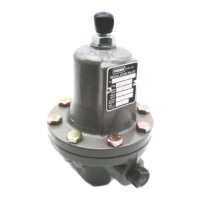
The Fisher 61 Series Pilot is a crucial component in pressure regulation, designed to control set pressures in various applications. It acts as a pilot for larger regulator systems, influencing their operation to maintain desired outlet pressures. The series includes several configurations tailored for different pressure ranges and proportional band requirements:

  • Type 61L: A low-pressure pilot for set points ranging from 0.02 to 1.38 bar (0.25 to 20 psig).
  • Type 61LD: A low-pressure pilot with a narrow proportional band, suitable for 0 to 1.38 bar (0 to 20 psig) set points. The "narrow proportional band" implies a more precise control over a smaller range of pressure changes.
  • Type 61LE: A low-pressure pilot with a wide proportional band, designed for 0.02 to 1.38 bar (0.25 to 20 psig) set points. The "wide proportional band" suggests a more stable control over a broader range of pressure changes, potentially with a slower response.
  • Type 61H: A high-pressure pilot for set pressures from 0.69 to 4.48 bar (10 to 65 psig).
  • Type 61HP: A high-pressure pilot for set pressures from 1.03 to 20.7 bar (15 to 300 psig).

These pilots can be used as safety accessories with pressure equipment under the Pressure Equipment Directive (PED) or outside the directive using sound engineering practice.

Important Technical Specifications

The 61 Series Pilots offer a range of capabilities and limitations:

  • Maximum Inlet Pressure:
    • Types 61L, 61LE, 61H: 20.7 bar (300 psig)
    • Type 61LD: 11 bar (160 psig)
    • Type 61HP: 41.4 bar (600 psig)
    • Note: A Type 61H pilot used with a 99 Series regulator can handle a maximum inlet pressure of 27.6 bar (400 psig).
  • Reduced Pressure Ranges (Pilot Control Spring): The specific pressure ranges depend on the control spring used, as detailed in Table 1 of the manual. These ranges vary from 0 to 10 mbar (0 to 4 in. w.c.) for the 61LD to 6.9 to 20.7 bar (100 to 300 psig) for the 61HP.
  • Proof Test Pressure: All pressure-retaining components have been proof tested per the relevant directive, ensuring structural integrity under specified conditions.
  • Temperature Capabilities:
    • Standard Elastomers: -29 to 66°C (-20 to 150°F)
    • High-Temperature Elastomers: -18 to 149°C (0 to 300°F), with an exception for water service at -18 to 82°C (0 to 180°F). These temperature limits are critical for safe operation and material compatibility.
  • Product Size: The pilot is available in a 1/4 NPT connection size.
  • Fluid Type: The pilot is designed for Fluid Type 1, indicating its suitability for specific types of fluids, though the exact fluid types are not detailed in this document.

Usage Features

  • Installation: The regulator should be installed in accordance with international and applicable codes. Pipelines must be cleaned before installation to prevent damage from foreign material. For NPT bodies, pipe compound should be applied to external pipe threads. For flanged bodies, suitable line gaskets and approved piping/bolting practices are required. The regulator can be installed in any position, but flow must follow the arrow on the body. A critical note emphasizes that the vent hole in the spring case must remain unobstructed, especially in outdoor installations, to prevent water, ice, or other foreign materials from entering.
  • Startup: The regulator is factory set at approximately the midpoint of its spring range or the requested pressure. Initial adjustment may be necessary. After proper installation and relief valve setup, upstream and downstream shutoff valves should be opened slowly.
  • Adjustment: Outlet pressure can be adjusted by removing the closing cap or loosening the locknut and turning the adjusting screw. Clockwise rotation increases outlet pressure, while counterclockwise rotation decreases it. A test gauge should be used to monitor the outlet pressure during adjustment. The closing cap or locknut must be replaced/tightened to maintain the desired setting.
  • Overpressure Protection: The manual stresses the importance of overpressure protection if the actual inlet pressure exceeds the maximum operating outlet pressure rating or the safe working pressure of downstream equipment. This is a crucial safety feature to prevent personal injury, equipment damage, or leakage.
  • Proportional Band: The 61LD offers a narrower proportional band compared to the standard 61L, while the 61LE offers a wider proportional band. This allows users to select a pilot that best suits their control precision and stability requirements.

Maintenance Features

  • Service Requirement Indication: If the regulator vents fluid or a leak develops, it indicates that service is required, and the regulator should be taken out of service immediately to prevent hazardous conditions.
  • Inspection After Overpressure: The regulator should be inspected for damage after any overpressure condition, even if it operates below maximum pressure limitations, as external sources or debris can cause damage.
  • Taking Out of Service (Shutdown): Before attempting any disassembly, the regulator must be isolated from all pressure to prevent sudden release of pressure and potential personal injury.
  • Parts List: The manual includes a detailed parts list with key numbers and descriptions for various components, including the Relay Spring Case, Relay Valve Body, Control Spring, Diaphragm, Orifices, and other essential parts. Items marked with an asterisk (*) are recommended spare parts, facilitating maintenance and repair.

The document also provides contact information for Emerson Automation Solutions in various regions and links to online resources for further information and support. It emphasizes that only qualified personnel should install or service the regulator and that responsibility for proper selection, use, and maintenance rests solely with the purchaser.

Emerson Fisher 61 Series Specifications

General IconGeneral
BrandEmerson
ModelFisher 61 Series
CategoryController
LanguageEnglish

Related product manuals