EasyManua.ls Logo

Emery Thompson CB-200 - User Manual

Default Icon
27 pages
Print Icon
To Next Page IconTo Next Page
Loading...
0
v. 3.07
EMERY THOMPSON
BATCH FREEZER
INSTALLATION
OPERATING, MAINTENANCE
AND CLEANING MANUAL
MODEL CB-200 COUNTERTOP
Question and Answer IconNeed help?

Do you have a question about the Emery Thompson CB-200 and is the answer not in the manual?

Summary

Initial Warnings and Setup Requirements

Licensed Electrician for Installation

Machine installation requires a licensed electrician; failure to comply voids the warranty.

Common Operational Errors and Recipe Blends

Discusses user errors causing malfunction and the importance of ingredient solids for proper freezing.

Dedicated Circuit for 115 V Models

Advises using a dedicated circuit for 115V models to prevent electrical overload and damage.

Supplemental Bulletin on Feature Variations

Details potential changes in refrigeration controls and circuit breakers based on manufacturing date.

Machine Overview and Components

CB-200 Component Identification

Illustrates and labels key components of the CB-200 batch freezer for user familiarization.

Unpacking and Inspection

Provides step-by-step instructions for safely unpacking the machine and inspecting for damage.

Work Area and Electrical Connections

Details required clearance, surface stability, and specific electrical connection guidelines for the machine.

Safety Procedures

General Machine Safety Precautions

Outlines essential safety measures, including not altering safeguards, avoiding water spray, and careful part handling.

Critical Operational Safety Warnings

Lists critical DO NOTs for operation, assembly, and preventing over-freezing, emphasizing electrician installation.

Operation Guide

Controls and Basic Operation

Describes the function of the beater and refrigeration controls and the general operation sequence.

Step-by-Step Operating Procedure

Details the process for operating the machine, from preparation to product discharge.

Cleaning, Assembly, and Sanitizing

Cleaning and Sanitizing Process

Explains how to clean and sanitize food-contact parts, emphasizing health inspector guidelines and dishwasher safety.

Assembly and Sanitization Steps

Details assembly steps involving food-grade grease and the sanitization process using recommended chemicals.

Care and Maintenance

Daily Care and Lubrication Requirements

Covers daily maintenance, including exterior cleaning and lubricating specific parts for longevity.

Wear Parts Identification and Storage

Lists wearable parts with life expectancy and provides guidance on proper storage and handling.

Recipes

Introductory Recipes for Familiarization

Offers introductory recipes like Lemon Ice and Coffee Ice Cream to help users understand freezing times and operation.

Additional Sorbet Recipes

Provides recipes for Bordeaux Wine Sorbet and Fresh Mango Sorbet for exploring different frozen dessert options.

Parts Diagrams

Diagram 3-A: Discharge Gate Components

Illustrates and lists parts for the discharge gate and handle assembly with part numbers.

Diagram 3-B: Dasher Assembly Parts

Shows the dasher assembly, including blades, springs, and bearings, with associated part numbers.

Diagram 5-A: Lubrication Point Guide

Visually indicates specific areas on the dasher and door assembly for applying food-grade grease.

Warranty Information

12-Month Limited Warranty Terms

Outlines the 12-month limited warranty, including coverage, exclusions, and purchaser responsibilities.

Warranty Exclusions and Limitations

Details what the warranty does not cover, such as consequential damages, misuse, and unauthorized repairs.

Factors Voiding the Warranty

Lists external factors and conditions that void the warranty, including alterations, misuse, and electrical issues.

Company Information

Emery Thompson Company History

Provides historical background on Emery Thompson, its product evolution, and manufacturing facilities.

Overview

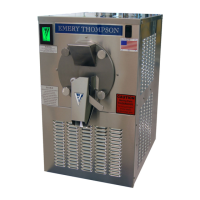
The Emery Thompson CB-200 Countertop Batch Freezer is a robust and versatile machine designed for producing a variety of frozen desserts, including Super Premium Hard Ice Cream, Fresh Fruit Sorbets, Artisan Gelatos, Old World Italian Ice, and New England Style Frozen Lemonade. Built with speed, versatility, longevity, and safety in mind, this all-stainless steel construction unit is meticulously crafted and tested to provide years of satisfied service.

Function Description:

The primary function of the CB-200 is to rapidly freeze liquid dessert mixes into a desired frozen consistency. It operates as a batch freezer, meaning it processes one batch of product at a time. The machine features a freezing cylinder where the mix is introduced and agitated by a dasher/blade assembly while refrigeration is applied. The dasher's scraping action against the cold cylinder walls facilitates the freezing process and incorporates air into the product, contributing to its texture and volume (overrun). Once the desired stiffness is achieved, the frozen product is discharged through a safety spout into containers.

Usage Features:

Operating the CB-200 is designed to be straightforward, with only two main controls.

  • Beater Control Switch: This illuminated rocker switch, located at the upper left-hand corner of the machine, controls the dasher/blade assembly. When "rocked" upward, it illuminates, indicating that the dasher is spinning. This switch also acts as a circuit breaker for the drive motor. If the product becomes over-frozen and too stiff, the switch will automatically trip and turn itself off, protecting the motor.
  • Refrigeration Control Switch: This is an ON/OFF toggle switch that initiates the refrigeration process. Products freeze at different rates, so it's recommended to log actual freezing times for consistency. An initial freezing time of 8 to 10 minutes is a good starting point. It is crucial NEVER to leave the machine unattended during operation, as prolonged running can lead to the product freezing solid, rendering the machine unusable until the product thaws or is manually removed. Earlier production units may feature a rotating timer instead of an On/Off switch for refrigeration control.

The normal operation sequence involves:

  1. Flipping open the inlet spout guard.
  2. Pouring in the mix/ingredients.
  3. Closing the inlet spout guard.
  4. Turning on the beater switch.
  5. Turning the refrigeration toggle switch to the ON position.
  6. Monitoring the stiffness of the mix by slightly and quickly opening the discharge gate to allow a small amount of product to come out.
  7. Immediately turning off the refrigeration once the desired stiffness is achieved.
  8. Opening the discharge gate to allow the product to flow out quickly into containers.

The machine has a large inlet spout for easy pouring of ingredients and a discharge safety spout designed to restrict fingers and utensils from contacting moving blades and to funnel product neatly into containers. Knurled hand knobs are used to secure the door in place.

Important Usage Considerations:

  • Batch Size: The CB-200 requires a minimum of two quarts of product in the freezing cylinder to operate correctly. Attempting "test" half batches or running with only water will cause the machine to freeze up solid.
  • Product Blend: The machine's powerful freezing capabilities necessitate a proper level of solids in the mix to prevent freezing up. Recipes should contain sufficient sugars, cream, or other solids. Water alone or milk alone will not freeze properly in this type of equipment.
  • Electrical Connection: The CB-200 comes with a 72-inch flexible power cord with an L14-20 locking male plug. It MUST ONLY be connected to a matching receptacle wired to a dedicated and fused 20-amp circuit. For 115-volt models, it is essential that the batch freezer is the ONLY appliance running on the circuit to prevent overload.
  • Work Area: The machine weighs 118 pounds and requires a solid, stable work surface. Adequate clearance around the machine is critical for airflow and performance: 8 inches in the rear, 18 inches on each side, 18 inches on top, and the front open to the room. All plastic protective film must be removed from the sheet metal surfaces. The surrounding area should be kept clean, dry, and with some air circulation.
  • Safety Guards: The inlet spout combination lid and gate, and the door discharge guard, are important safeguards that restrict contact with moving parts and help control splashing. These should never be removed or altered.
  • Over-Freezing: A common mistake for new operators is allowing the product to over-freeze. The machine will automatically shut off if the product becomes too stiff, but this renders it unusable until the product thaws or is manually removed.
  • Temperature Range: The machine is rated for ambient air temperatures between 50 and 104 degrees Fahrenheit. Operating at the higher end of this range may slightly increase freezing time.

Maintenance Features:

The Emery Thompson CB-200 is designed for minimal maintenance and ease of care.

  • Cleaning, Assembly, and Sanitizing: This is a critical daily process for food contact parts.
    • Disassembly: All parts that come into direct or indirect contact with food (as shown in Diagram 5-A) must be cleaned and sanitized after each use or if mix residue remains in the machine for an hour or more without refrigeration.
    • Washing: These parts are dishwasher top rack safe or can be manually cleaned with warm water, dishwashing detergent, and an abrasive hand pad. The inside surface of the freezing cylinder must be manually washed and thoroughly rinsed.
    • Greasing: After washing and drying, three specific areas require a coating of food-grade grease prior to assembly:
      1. The last 2.5 inches of the REAR of the dasher shaft.
      2. The door's outer surface where the gate slides.
      3. The inside (bore) of the white rear bushing in the cylinder. Proper greasing of these areas is crucial for the longevity of the parts.
    • Assembly: The dasher is inserted into the rear bushing, rotated to engage the drive motor, and pushed back until the blades touch the cylinder rear. Excess grease should be wiped off. The door is then placed on the mounting studs, ensuring the dasher shaft nose enters the round bushing in the door. The two knurled knobs are then installed and evenly tightened.
    • Sanitizing: After assembly, a 2-quart batch of sanitizer (e.g., "Stera-Sheen Green Label") is poured into the machine. The beater motor is turned on to agitate the mixture for a full minute (refrigeration should NOT be run during this step). After a minute, the sanitizing fluid is discharged. From this point, no fingers or dirty utensils should touch any surface that could introduce bacteria. The diluted sanitizer is food-safe and does not require rinsing.
  • External Cleaning: The heavy-gauge stainless steel outer casing requires only a daily wipe-down with a mild detergent and warm water. A stainless steel cleaner/polish can be used to maintain its appearance.
  • Condensing Fins: Over time, dust, lint, or debris may accumulate on the condensing fins, located behind the expanded metal grate on the rear surface of the machine. This area can be cleaned using a strong (shop-type) vacuum cleaner with a soft brush attachment.
  • Wearable Parts Inspection: Several parts are wearable and should be inspected weekly. The manual provides an approximate life expectancy for these parts, including:
    • O-ring, square, inside rear bushing (1,000 hrs./1 year)
    • Blade Springs (2,000 hrs./2 years)
    • Bearing, dasher front (2,000 hrs./2 years)
    • Blade, scraping (5,000 hrs./4.5 years)
    • O-ring, gate (1,000 hrs./1 year)
    • Washer, Teflon (1,000 hrs./1 year)
    • O-ring, door seal (4,000 hrs./4 years)
    • Spring, gate pressure (4,000 hrs./4 years)
  • Storage and Transport: The machine should always be stored and transported upright on its feet. Storing or transporting it in any other position can cause oil in the refrigeration system to travel into piping areas where it could become trapped. If the machine has been stored in an unheated area and is brought into a warm area for use, it should be allowed to sit for at least 12 hours to prevent condensation buildup on cold surfaces.
  • Circuit Breaker: Newer models incorporate an external, resettable circuit breaker located at the top rear panel of the machine, providing an additional layer of protection.

The CB-200 is designed to be a durable and efficient tool for creating high-quality frozen desserts, with user-friendly operation and manageable maintenance requirements.

Emery Thompson CB-200 Specifications

General IconGeneral
ModelCB-200
TypeBatch Freezer
Capacity2.5 gallons
RefrigerantR404A
MaterialStainless Steel

Related product manuals