www.enviromaster.com
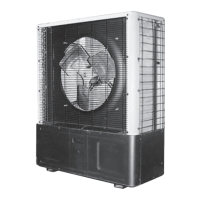
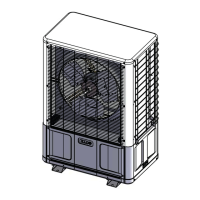
Side Discharge Condensers
20
SINGLE-ZONE AND DUAL-ZONE SEQUENCE OF OPERATION
Note: For remote wall mounted ther-
mostat operation be sure to select EMI
p/n 240004180 or a suitable 24
V, two
sage heating, heat pump thermostat.
Condenser operation: The transform-
er located in the indoor unit provides 24V,
low-
Volt control power to the condenser
(outdoor unit). This can be measured
across low-
Volt terminals “R” and “C”.
Single zone heat pump condensers
utilize a reversing valve to provide re-
verse cycle operation. Therefore the out
-
door unit will act as either a condenser or
an evaporator there-by providing comfort
cooling or heating to the indoor space.
The reversing valve is energized in cool
-
ing. Should the valve fail to actuate, the
system will default to the heating mode of
operation.
Cooling operation, single-zone and
dual-zone: Cooling operation requires that
the control (either unit mount or remote
wall mount thermostat) make a connec
-
tion between low-
Volt terminals “R” and
“Y” along with “R” and “O” (heat pumps
only). When the indoor control is placed
in cooling mode, with the set point tem
-
perature below the room temperature, the
reversing valve will energize (R & O heat
pumps only) along with the compressor
and outdoor fan (R & Y). When the indoor
control is satisfied and the room tempera-
ture falls below the set temperature, the
compressor and fan will de-energize. The
anti-short cycle timer (ASCT) will prevent
the compressor from re-starting for three
minutes.
Heating operation (heat pumps only):
Heating operation requires that the con
-
trol (either unit mount or remote wall
mount, heat pump thermostat) make a
connection between low-Volt terminals
“R” and “Y” only. When the indoor control
is placed in heating mode, with the set
point temperature above room tempera-
ture, the compressor and outdoor fan
(R & Y) will energize. When the indoor
control is satisfied and the room temper
-
ature rises above the set temperature,
the compressor and fan will de-energize.
The anti-short cycle timer (ASCT) will
prevent the compressor from re-starting
for three minutes.
Defrost controls with short cycle
protection (heat pumps only): The unit
is equipped with a logic control circuit de-
signed to keep system operating at peek
efficiency. The 24
V circuit provides control
to the indoor and outdoor systems includ-
ing a three minute, anti-short cycle timer
(ASCT) compressor protection.
The defrost control circuit is designed
to keep the condenser coil free from frost
and ice during heating mode. This is ac
-
complished through the precise switching
sequence of the outdoor fan, reversing
valve and indoor auxiliary heater.
Defrost initiation: The defrost-sensor
is located on either the end plate or the re-
turn bend of the condenser coil. A defrost
cycle will initiate after the sensor closes
(approx. 30° F) and remains closed for
the length of time selected on the control
board (either 30, 60 or 90 minutes)*.
At the start of the defrost cycle, the re
-
versing valve will change from heating to
cooling mode. The condenser fan will also
switch off there-by allowing pressure and
temperature to rise within the condenser
coil to melting off any ice build-up. At the
same time the unit will switch on the in-
door electric strip heater to temper the
cold air being discharged from the evapo
-
rator unit. This will continue until either
the defrost-sensor opens (approx. 60° F)
or a 10-minute maximum cycle time has
elapsed. Defrost times will vary depend-
ing on outdoor temperature and moisture
conditions. When the defrost cycle is com-
plete the unit will return to normal heating
operation.
*Factory settings 9-30k Btu = 90 min
-
utes, 36k Btu = 60 minutes


 To Next Page
 Loading...