3.1 Rotor blades
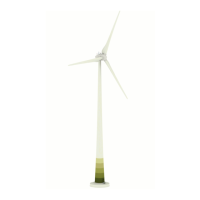
The rotor blades made of glass-fibre reinforced plastic (glass fibre + epoxy resin) have a major in‐
fluence on the wind energy converter’s yield and its noise emission. The shape and profile of the
E-82 E4 rotor blades were designed with the following criteria in mind:
■ High power coefficient
■ Long service life
■ Low noise emissions
■ Low mechanical strain
■ Efficient use of material
One special feature to be pointed out is the new rotor blade profile, which extends down to the na‐
celle. This design eliminates the loss of the inner air flow experienced with conventional rotor
blades. In combination with the streamlined nacelle, utilisation of the wind supply is considerably
optimised.
The rotor blades of the E-82 E4 were specially designed to operate with variable pitch control and
at variable speeds. The PU-based surface coating protects the rotor blades from environmental im‐
pacts such as UV radiation and erosion. This coating is highly resistant to abrasion and visco-hard.
Microprocessor-controlled pitch units that are independent of one another adjust each of the three
rotor blades. An angle encoder in each rotor blade constantly monitors the set blade angle and en‐
sures blade angle synchronisation across all three blades. This provides for quick, accurate adjust‐
ment of blade angles according to the prevailing wind conditions.
3.2
Nacelle
3.2.1 Annular generator
ENERCON wind energy converters (WECs) are equipped with a multi-polar, separately excited
synchronous generator (annular generator). The WEC operates at variable speeds so as to opti‐
mally utilise the wind energy potential. The annular generator therefore produces alternating cur‐
rent with varying voltage, frequency and amplitude.
The windings in the stator of the annular generator form two three-phase alternating current sys‐
tems that are independent of each other. Both systems are rectified independently of each other in
the nacelle and combined by the direct-current distribution system. In the tower base the inverters
reconvert the current into three-phase current whose voltage, frequency, and phase position con‐
form to the grid.
Consequently, the annular generator is not directly connected to the receiving power grid of the
utility/power supply company; instead, it is completely decoupled from the grid by the full-scale
converter.
E-82 E4 components
D0376616-2 / DA 4 of 21


 To Next Page