Need help?
Do you have a question about the ENFORCER SK-910RB2Q and is the answer not in the manual?
Details the purpose and capabilities of the two-channel RF receiver for home automation.
Provides essential guidance for mounting and antenna placement for optimal performance.
Step-by-step guide for programming transmitter buttons to the receiver channels.
Instructions on how to erase all learned transmitter codes from a specific channel.
Method to check the number of transmitter codes currently stored in a channel's memory.
Explains the five different output modes (timed, toggle, latch, validity) for each channel.
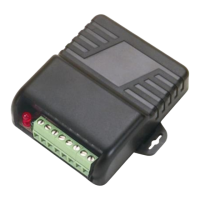
Provides a visual diagram of the receiver and identifies key components like programming buttons.
Identifies the mode buttons for channel 1 (brown) and channel 2 (red) programming.
Details operations like learning mode, clearing memory, resetting latched output, and displaying memory.
Explains the meaning of different LED flash patterns for status and operation.
Information on an optional antenna to extend the receiver's operational range.
Illustrates typical wiring configurations for connecting the receiver to various devices.
Lists key technical parameters including operating frequency, voltage, and relay contact ratings.
Details the types and series of transmitters that are compatible with the RF receiver.
Outlines the product warranty terms, limitations, and conditions for the customer.
Informs users about the manual's currency, SECO-LARM's policy on changes, and responsibility for errors.
 General
| Frequency | 315MHz |
|---|---|
| Channels | 2 |
| Modulation | ASK |
| Sensitivity | -95dBm |
| Type | Super-Heterodyne Receiver |
| Power Supply | 12VDC or 24VDC |
| Operating Voltage | 12-24V DC |
| Current Consumption | ≤25 mA |
| Operating Temperature | -4°~167° F (-20°~75° C) |
| Antenna Connector | SMA |
| Current Draw | 25mA@12VDC |
| Relay Output | Form C relay |

 To Next Page