Environnement S.A MP101M Duplication prohibited
SEPTEMBER 2013
2–10
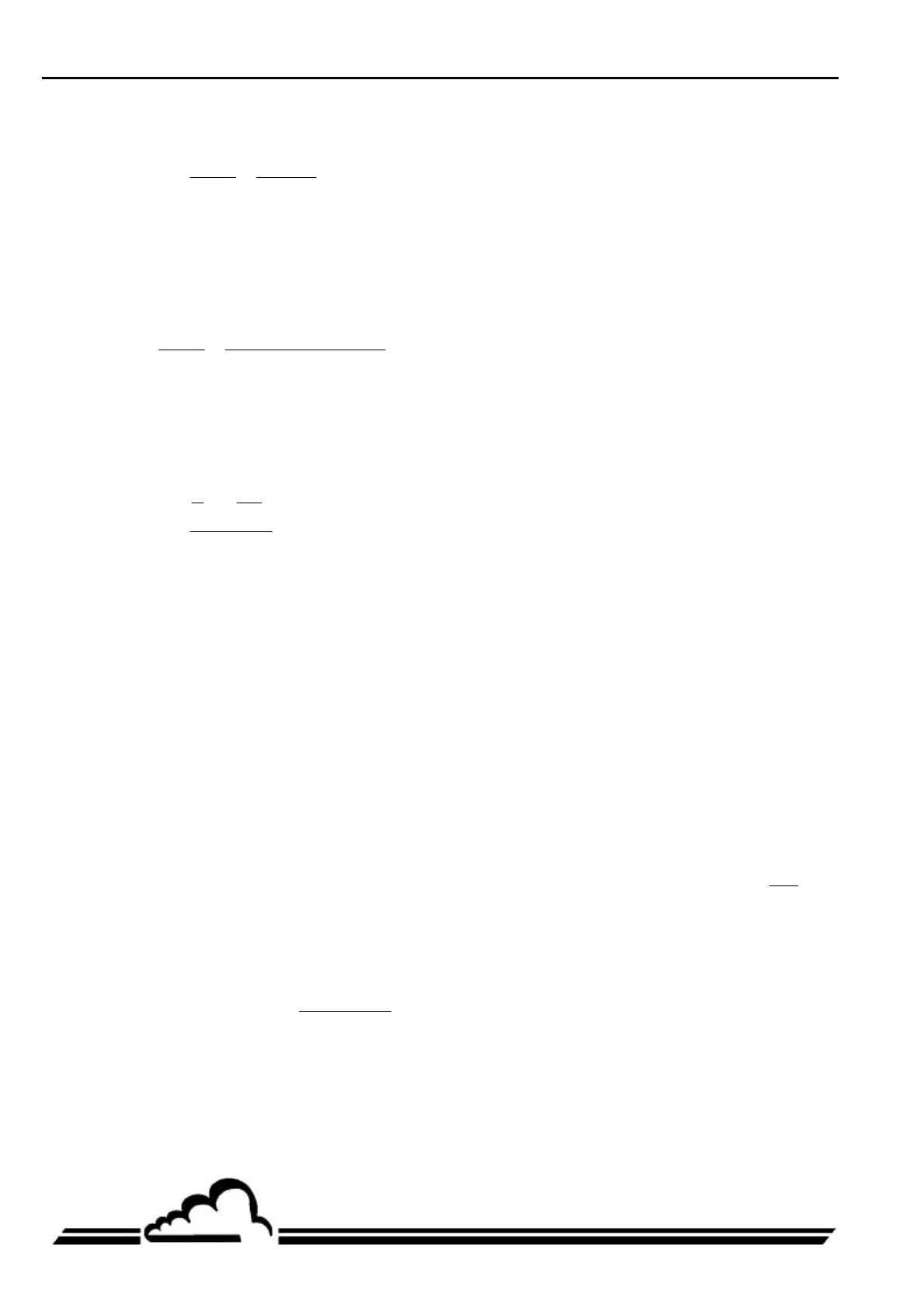
at the end of the next period, the cumulated concentration is given by :
21
21
2
2
VV
CC
V
C
n
n
n
n
at the end of the cycle, the cumulated concentration is given by :
nn
nn
n
n
n
n
VVVV
CCCC
V
C
121
121
...
...
ATTENTION
The analyzer always calculates the cyclic concentration at the cycle end as an
unique measurement :
c
c
V
N
N
Ln
k
0
1
Where N
0
are the blank countings at the beginning of the cycle, N
c
the final countings and V
c
the
whole sampled volume.
This concentration value represents a unique cyclical measurement, it is recorded in the Stored data
and printed at the end of each cycle.
The value of the cumulated concentration is an additional information that can only be
displayed and instantaneously removed via a « data logger », if the analyzer was correctly
configured.
f) Dew point
The dew point or dew temperature is a thermodynamic data specific of gas humidity. The dew
point
of air is the temperature to which the partial pressure of vapour is equal to its pressure of saturated
vapour. If the humid air is gradually cooled, the dew temperature corresponds to the generation of
water under liquid phase. This phenomenon is the measurement principle used in the condensation
hygrometers, which is also called dew point hygrometers.
It is the phenomenon of condensation
, which occurs when the dew point is reached and the nucleation
sites are available, which generates clouds, fog and dew in meteorology. Condensation is generated,
in the same manner on the walls of the buildings.
When the temperature is lower than the freezing point, the air can become saturated with water and
generate superfused droplets, or saturated with ice and give white frost. In this second case, the
saturation temperature is named icing point. This icing point is warmer than the dew point at these
temperatures because the pressure of saturating vapour compared to the ice is lower than compared
to liquid water. It is the reason why the vapour more generally settles into solid form than liquid form
under the condensation point.


 To Next Page