RECOMMENDED TESTING FLOW PRESSURE IS
30 psi (+.5 psi -.0 psi)
Safety equipment shall be accessible within 10 seconds of
hazard. (Sec 4.5.2, 5.4.2, 6.4.2, 7.4.2)
Safety station shall be located on the same level as the
hazard and the path of travel shall be free of obstructions.
(Sec 4.5.2, 5.4.2, 6.4.2, 7.4.2)
All employees subject to exposure to hazardous material
should be instructed in the location and proper use of
emergency equipment. (Sec 4.6.4, 5.5.4, 6.5.4, 7.5.4)
Emergency equipment shall be activated weekly.
(Sec. 4.6.2, 5.5.2, 6.5.2, 7.5.2) All shower units shall be
inspected annually to assure conformance with ANSI Z358.1.
(Sec. 4.6.5, 5.5.5, 6.5.5, 7.5.5)
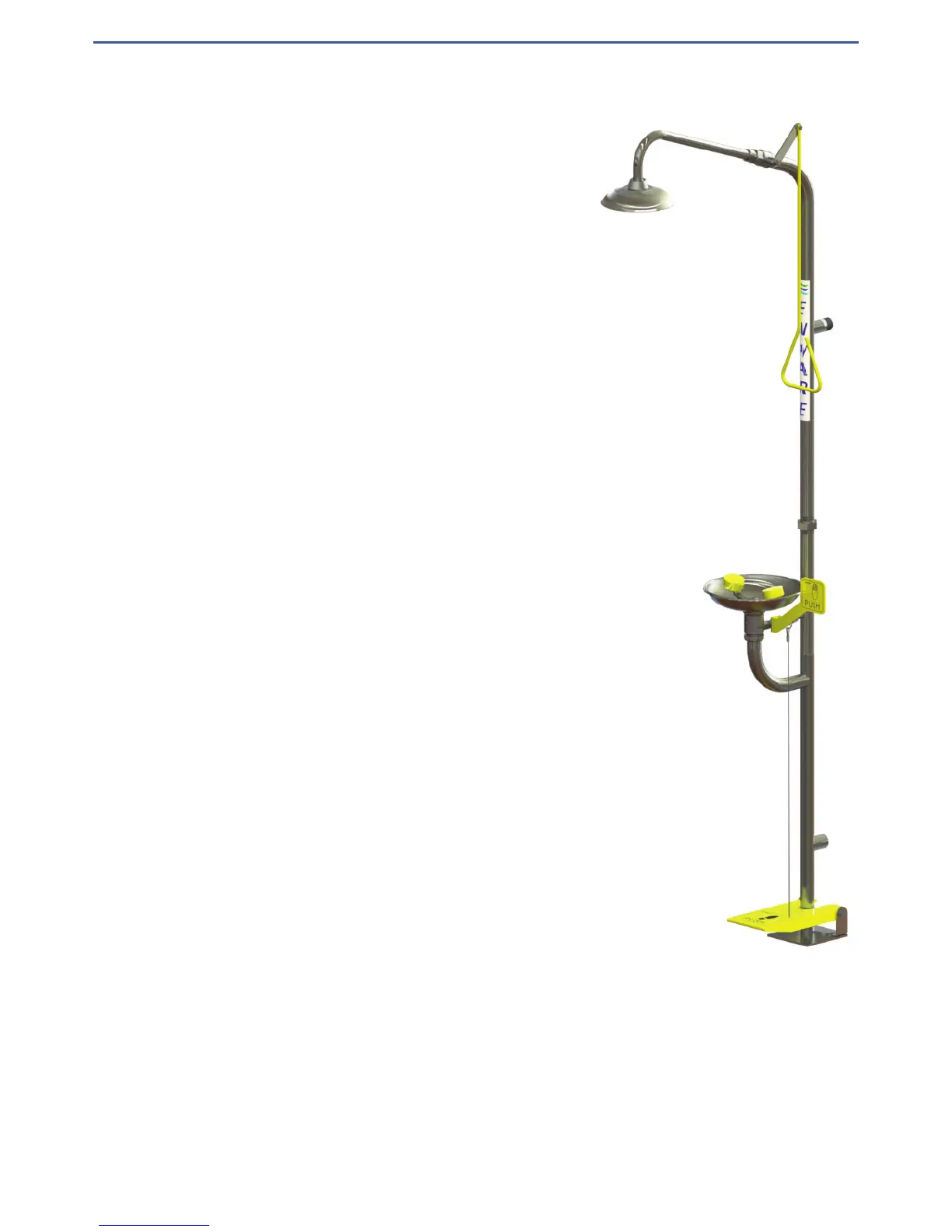
Combination unit components shall be capable of operating
simultaneously and shall be positioned so that components
may be used simultaneously by the same user. (Sec. 7.3,
7.4.4)
All plumbed emergency equipment shall be connected to
a continuous source of ushing uid supply which may be
drinking water, preserved water, preserved buffered saline
solution or other medically acceptable solution manufactured
and labelled in accordance with applicable government
regulations.
Drench hose must deliver a controlled ow of ushing uid
at a velocity low enough to be non-injurious. (Sec. 8.2.1)
A drench hose can only be considered an eyewash –
eye/face wash if it meets performance requirements in
Sec. 5 and/or 6.
Delivery of tepid ushing uid.* (Sec. 4.5.6, 5.4.6, 6.4.6,
7.4.5). *Suggested temperature range – above 60°F (16°C)
and below 100°F (38°C)
Showerhead must be 82 to 96 inches (208.3cm – 243.8cm)
above surface oor of user (Sec. 4.1.3, 7.1)
Shower must deliver minimum of 20 gallons (75.7L) per
minute and provide a column of water 20 inches (50.5cm)
wide at 60 inches (152.4cm) above the surface oor of the
user. (Sec. 4.1.2, 4.1.4, 7.1)
Valve shall be designed so that the ushing ow remains on
without the use of the operator’s hands. The valve shall be
simple to operate and go from “off” to “on” in one second or
less and actuator can not be more than 69 inches (173.3cm)
from surface oor of user. (Sec. 4.2, 7.1)
Emergency equipment location shall be well lit and identied
with a highly visible sign. (Sec. 4.5.3, 5.4.3, 6.4.3, 7.4.3)
Must provide a means of controlled ow to both eyes
simultaneously at a velocity low enough to be non-injurious.
(Sec. 5.1.1, 6.1.1, 7.1)
Eye/face wash equipment must deliver minimum of 3 gallons
(11.4L) per minute of water for 15 minutes. (Sec. 6.1.6, 7.1)
Eyewash only must deliver minimum of 0.4 gallon (1.5L) per
minute for 15 minutes. (Sec. 5.1.6, 7.1)
The ushing uid of an eyewash – eye/face wash shall cover
the areas between the interior and exterior lines of a gauge at
some point less than 8 inches (20.3cm) above the eyewash
nozzle. (Sec. 5.1.8, 6.1.8, 7.1)
Outlets shall be protected from airborne contaminants.
(Sec. 5.1.3, 6.1.3, 7.1)
Flushing uid nozzles should be 33 to 45 inches
(83.8cm – 114.3cm) from oor and minimum of 6
inches (15.3cm) from wall. (Sec. 5.4.4, 6.4.4, 7.1)
Valve shall be designed so that the ushing ow
remains on without the use of the operator’s
hands. The valve shall be simple to operate and
go from “off” to “on” in one second or less. (Sec.
5.2, 6.2, 7.2)
ANSI Z358.1-2009 Safety Equipment Minimum Performance Checklist


 To Next Page
 Loading...