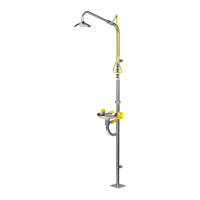
technical information
installation compliance
Inlet Connecon 25mm (1” BSP)
Water Supply Line Size Supply piping shall be adequately sized to meet ow requirements
Minimum Requirements to achieve
ANSI Z358.1-2009 and AS/NZS 4775
2007 compliance
Min Working Pressure: 210 kPa (30 psi)
Cauon should be taken when pressure exceeds 550 kPa (80 psi)
Shower Minimum Flow 75.7 lpm (20 US gpm)
Eye Wash Minimum Flow 1.5 lpm (0.4 US gpm)
Eye/Face Wash Minimum Flow 11.4 lpm (3 US gpm)
Enware Performance
At Working Pressure: 210 kPa (30 psi)
Shower Flow 76 lpm (20 US gpm)
Eye Wash Flow 17 lpm (4.5 US gpm)
Eye/Face Wash Flow 26 lpm (6.9 US gpm)
Waste Water Outlet Size 38.1 mm (1½”) OD
Mounng Base Plate Size 150 x 150 mm (5 9/10 “ x 5 9/10”) with 4 bolts 11 mm (7/16”)
Shipping
Approximate Weight: 9.5 - 13.5 kilograms
Dimensions: 1150 x 287.5 x 200 mm
Supply Lines
Installaon procedures shall be in accordance with proper
plumbing pracces. Supply piping shall be adequately sized
to meet ow requirements. If shut o valves are installed
for maintenance purposes, provisions shall be made to
prevent unauthorised shut o.
Placement of Emergency Equipment
Emergency eyewash and shower equipment shall be
available for immediate use. It shall take no longer than
10 seconds for an individual to reach the nearest facility.
Factors that inuence the locaon of emergency facilies
include workplace lighng, obstrucons to the path of
travel and the work environment. It should be noted that
some situaons may warrant the placement of equipment
signicantly closer to the hazard. In these situaons, such
as exposure to highly corrosive chemicals, the proper
distances should be selected based on the advice from
appropriate consultants. For situaons such as exposure to
strong acids or alkalis, due consideraon needs to be given
to possible reacon between the ushing uid and the
chemical if the ushing uid enters a bulk container of the
chemical.
Flushing Fluid Temperature
Connuous and mely irrigaon of aected ssues for
the recommended irrigaon period are the principal factors
in providing rst aid treatment. Providing ushing uid
at temperatures conducive to use for the recommended
irrigaon period is considered an integral part of providing
suitable facilies. Medical recommendaons suggest a
ushing uid at tepid temperature be delivered to aected
chemically-injured ssue. Temperatures in excess of 38ºC
have proven to be harmful to the eyes and can enhance
chemical interacon with the eyes and skin. During design
and installaon, the eects of exposure of pipe to sun,
radiant heat or other heat sources should be considered,
and suitable control measures should be introduced
to avoid any risk of scalding. While cold ushing uid
temperature provide immediate cooling aer chemical
contact, prolonged exposure to cold uids aects the ability
to maintain adequate body temperature and can result
in the premature cessaon of rst aid treatment. Before
emergency eyewash and shower equipment is selected,
a risk assessment shall be carried out to determine the
most appropriate delivery temperature for the applicaon.
Means to ensure a constantly suitable delivery temperature
shall also be idened during selecon, so that equipment
can perform as desired once installed.
Installaon of emergency showers, eye and eye/face wash equipment shall be in accordance with AS/NZS4775-2007
or ANSI Standard Z358.1-2009 - whichever is applicable to the installaon. REFER to checksheet on pages 10 and 11.


 To Next Page
 Loading...