Need help?
Do you have a question about the Epcom S04 S Series and is the answer not in the manual?
Details FCC compliance and conditions for digital devices operation and interference.
Product compliance with EU directives and recycling symbols for waste electrical equipment.
Lists general device features like H.264 compression, dual-stream, and resolution support.
Features for live view, motion detection, privacy mask, and display settings.
HDD capacity, quota management, status checks, and error handling.
Recording modes, schedules, file search, playback controls, and tagging.
Video backup methods, alarm triggers, and exception handling.
Network interface, protocols, remote management, and CMS features.
Information on SDK, source code, and development support for applications.
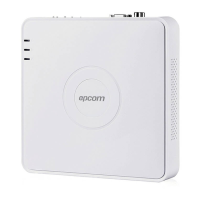
Description of indicators and layout of the device's front panel.
How to use a USB mouse with the device and its control functions.
Explanation of the soft keyboard input method and its icons.
Description of connectors and ports on the device's rear panel.
Procedures for powering the device on and off safely.
Step-by-step guide to the setup wizard for initial configuration.
How to navigate and use the device's main menu bar and icons.
Overview of the live view function and its status icons.
Using the mouse for navigation and controls in live view mode.
Using a secondary monitor for viewing live video feeds.
Switching between main and auxiliary video output modes.
Customizing live view display, output interfaces, and dwell times.
Reducing bandwidth for remote viewing without affecting image quality.
Procedure for logging out of the device interface.
Defining stream types, resolutions, bitrates, and frame rates for recording.
Setting up schedules for automatic recording based on time.
Setting up motion detection areas and response actions for recording.
Configuring different recording schedules for holidays.
Protecting recorded files from being overwritten by locking them.
Accessing and viewing recorded video files by channel or time.
Playing back recorded video based on specified start and end times.
Searching and playing back files by restricting type and time.
Searching and playing back files based on event types like motion or alarm.
Searching and playing back files using custom tags for specific moments.
Playing back video files associated with system log entries.
Frame-by-frame playback, smart search, and digital zoom.
Procedures for backing up recorded video files to various devices.
Managing connected backup devices like USB flash drives and HDDs.
Configuring motion detection areas, sensitivity, and triggers.
Setting up alarms for video loss and configuring response actions.
Configuring alarms for video tampering and response actions.
Configuring how the system handles various exceptions like HDD errors.
Defining actions like full screen monitoring or email alerts for alarms.
Manually triggering or clearing alarm outputs.
Setting up basic network parameters like IP address and NIC type.
Configuring PPPoE, DDNS, NTP, UPnP, and other network features.
Monitoring real-time network traffic information like status and rates.
Checking network connectivity status, delay, and packet loss.
Steps to initialize a newly installed hard disk drive.
Allocating storage quotas for each camera on the HDD.
Monitoring the status of installed HDDs for potential failures.
Checking HDD reliability indicators using S.M.A.R.T. technology.
Detecting and addressing bad sectors on the HDD.
Setting up alarms for HDD errors or abnormal status.
Customizing on-screen display settings like date, time, and camera name.
Setting up privacy mask zones to obscure sensitive areas in video feeds.
Adjusting image parameters like brightness, contrast, and sharpness for cameras.
Accessing device, camera, record, alarm, network, and HDD status.
Finding, viewing, and exporting device operation and alarm logs.
Backing up and restoring device configuration settings.
Updating device firmware via local backup or FTP server.
Resetting device settings to factory defaults.
Setting general parameters like language, video standards, and mouse speed.
Configuring Daylight Saving Time settings.
Configuring device name, timeouts, and output modes.
Adding, editing, deleting users, and managing permissions.
Procedures for logging out, shutting down, or rebooting the device.
Definitions of technical terms used in the manual.
Frequently asked questions and troubleshooting tips for common issues.
 General
| Video Input | 4 channels |
|---|---|
| Audio Output | 1 channel |
| Recording Resolution | 720p |
| Hard Drive Support | 1 SATA |
| Compression | H.264 |

 To Next Page