Care Of Your
Instrument
We recommend that you always keep your
instrument in a case when transporting or storing
it. This reduces the possibility of damage due to
nicks and jams, and sudden changes in climate or
atmosphere.
Carry the case with the lid towards your body.
In the event that you have not properly fastened
the latches and the case opens, the lid will fall
against your leg and prevent the instrument from
falling on the ground. Never put your instrument
in the trunk of your car or place anything on top
of it.
Perspiration can damage the finish of your
instrument so always wipe down your guitar after
playing or before storing with a clean soft cloth.
Polishing it with some high gloss guitar polish or a
good quality carnauba wax polish will prolong the
durability of the finish.
Tuning Your Instrument
The above chart shows how different instru-
ments are tuned. The first string, for this purpose,
is considered to be the smallest diameter. Tune
the two outside strings first, then tune towards
the center. This equalizes the pressure on the
bridge and allows rapid tuning.
Many individuals have their own method of
tuning their instrument. We recommend the
following method. An Epiphone guitar is tuned to
A-440; utilizing a tuning fork, electronic tuner or
pitch pipe.
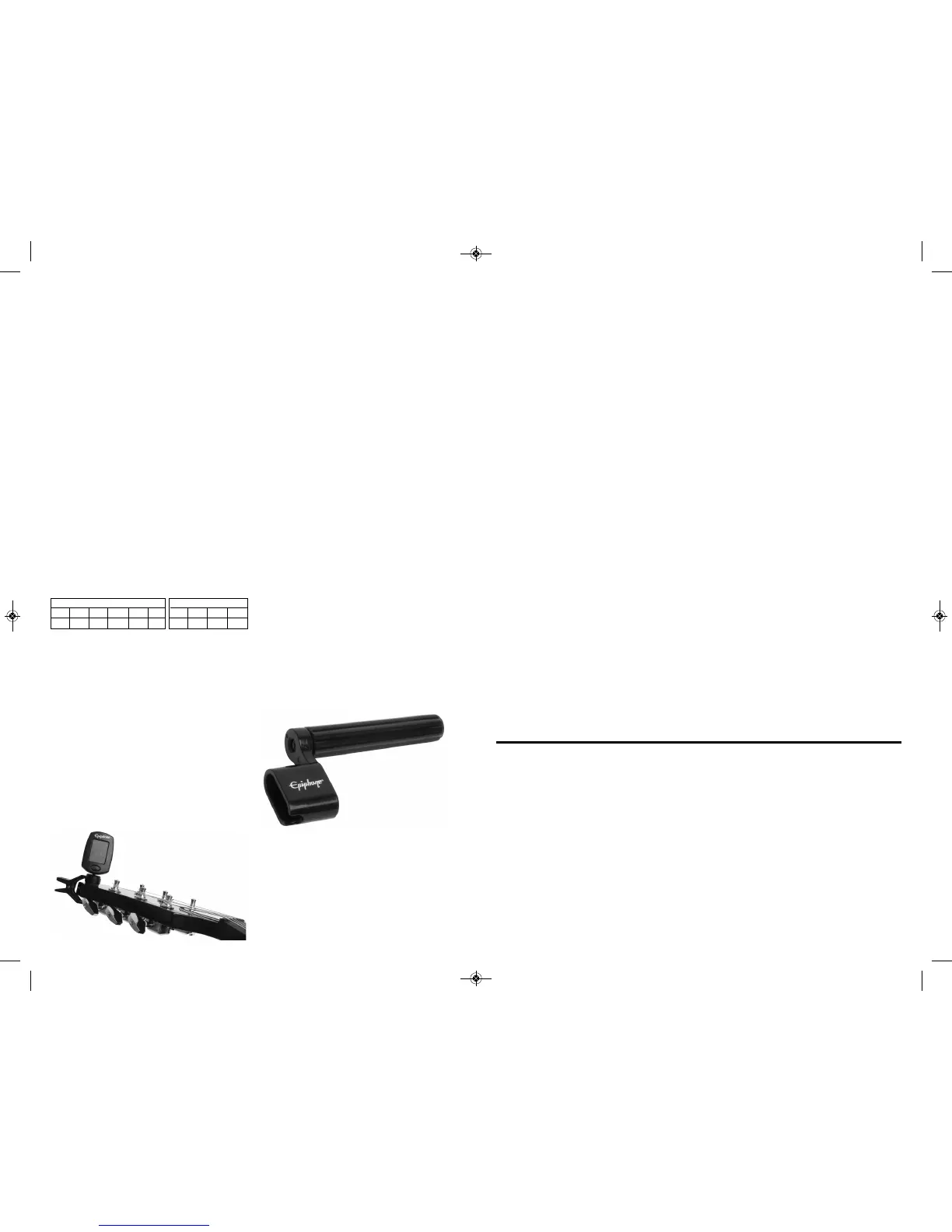
All tuners work alike: a microphone or other
sensor “listens” to your guitar. When you play a
string, the tuner analyzes the pitch and shows
whether it’s flat (too low), sharp (too high), or on
pitch. If needed, you rotate the guitar’s machine
head as appropriate to correct the pitch.
Bass
4th 3rd 2nd 1st
E A D G
Guitar
6th 5th 4th 3rd 2nd 1st
E A D G B E
Follow these tips for more accurate tuning.
• Strings retain correct pitch longer if you tune up
to pitch. If a string is sharp, tune it somewhat flat,
then tune it up to pitch.
• Old strings are hard to keep in tune. Keep fresh
strings on your guitar.
• With a headstock tuner, try clamping in differ-
ent places. Some parts of the headstock may give
more consistent readings.
• Tuning strings below standard pitch decreases
tension, so they’re easier to play. Example: If you fret
a string’s first fret and tune to that reference
instead of the open string, the tuning will be a semi-
tone flat. However, don’t tune down too far - with
insufficient tension, the strings might buzz against
the frets as you play.
• After tuning your guitar, check the string
pitches again. You may need to tune a couple times
before the tuning “settles in.”
Changing Strings
Changing strings becomes easier with experi-
ence. If you have difficulty, your Authorized
Epiphone Dealer can give you tips on how to
change strings.
A string winder can help you turn the tuning
heads faster than turning them by hand.
Note that a string’s end is sharp and
can puncture your skin—be careful.
Here are some tips on how to change
strings.
1. To help maintain consistent neck tension,
replace strings one at a time and tune each
before proceeding to the next string.
2. Tune down the string you’re replacing so it’s
loose enough to remove (a string winder
speeds up this process).
3. The bridge end is always strung first.
Consult your string package to be sure you’re
choosing the correct string.
GUITAR OWNERS MANUAL
REGISTER YOUR NEW
EPIPHONE INSTRUMENT NOW!
V
isit www.epiphone.com and select SUPPORT then WARRANTY REGISTRATION.
Important: Warranties are extended to the original retail purchaser only and may not be transferred
or assigned to subsequent owners. In order to validate your warranty, and as a condition precedent to
warranty coverage, you must complete the on-line registration within fifteen (15) days following the original
date of purchase. Visit www.epiphone.com for complete warranty details and further information.
Warranty Instrument: Your new Epiphone instrument carries a Limited Lifetime Warranty*.
For details and limitations visit www.epiphone.com.
Warranty Amplifier: Your new Epiphone amplifier carries a Limited 3-Year Warranty*.
For details and limitations visit www.epiphone.com.
Returns: All Epiphone products are guaranteed and backed by Gibson Musical Instruments legendary
24 hours, 7 days a week, 365 days a year Customer Service. All returns must be issued a Return
Authorization Number by Customer Service BEFORE shipment. If for any reason, you have questions,
need help or think you need to return your product please contact Gibson Customer Service.
You may contact us by email at:
• USA Email: Service@gibson.com
• Europe Email: Service.Europe@gibson.com
• Japan Email: Service.Japan@gibson.com
• China Email: Service.China@gibson.com
You may also reach us by phone at:
• USA Phone: 1-800-4GIBSON (1-800-444-2766)
• Europe Phone: 00+8004GIBSON1 (00+800-444-2766-1)
• China Phone: 1-800-820-8841
You may also instant message us at:
AOL Instant Messenger, Yahoo! Messenger, & MSN Messenger users can IM Gibson
Customer Service at customer.service1@gibson.com
Don’t Forget to Join Us On-Line!
Please join us on the Gibson Forums at http://forums.gibson.com. The Gibson Forums are provided
for Gibson Fans to share opinions and information about all of the brands in the Gibson family.
* Void where prohibited by law.
For Your Records
Congratulations on owning your new Epiphone product. For your own records, should you ever need to identify your product
for warranty or insurance purposes, please fill in the following:
Model Name._________________________________________________________Serial No.________________________________
Date of Purchase:______________________ Dealer's Name___________________________________________________________
Dealer Address______________________________________________________________________________________________
_____________________________________________________________________________________________
_____________________________________________________________________________________________



 To Next Page
 Loading...