
 Need help?
Do you have a question about the Epson WF-C5310 and is the answer not in the manual?
This document provides a comprehensive guide for setting up and maintaining the WF-C5310, WF-C5390, WF-C5810, and WF-C5890 series of Epson printers. It covers everything from initial unpacking and ink pack installation to software setup, paper loading, and troubleshooting common issues.
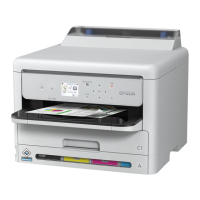
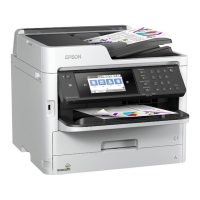
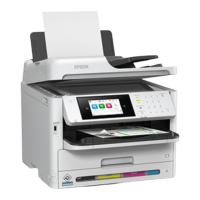
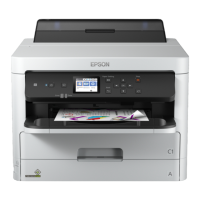
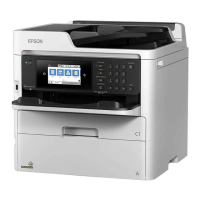
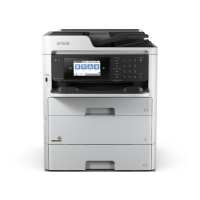
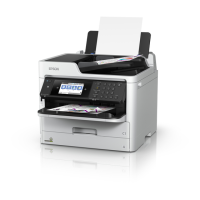
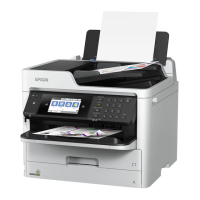
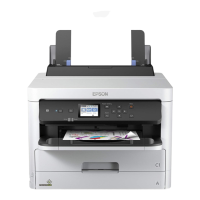
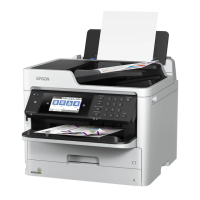
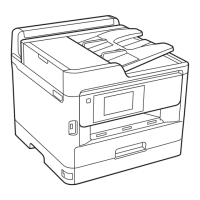
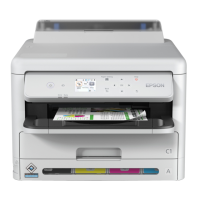
The Epson WF-C5310, WF-C5390, WF-C5810, and WF-C5890 are multi-function printers designed for various printing needs, from standard documents to more specialized tasks. These devices are engineered to work exclusively with genuine Epson ink packs, ensuring optimal performance and print quality. The WF-C5810 and WF-C5890 models offer additional functionalities such as scanning and an Automatic Document Feeder (ADF), expanding their utility for office and home environments. The printers support both wired and wireless network connections, allowing for flexible placement and access within a network. They also offer mobile and voice-activated printing capabilities, enhancing convenience for users who prefer to print from their smartphones, tablets, or through smart assistants. The inclusion of PCL or PostScript drivers for specific models (WF-C5390/WF-C5890) indicates their suitability for professional environments that require advanced printing language support.
The setup process begins with unpacking the printer and removing all protective materials. It is crucial to lift and move the product with two people due to its weight. After unpacking, the output tray needs to be inserted gently. The next step involves connecting the power cord to an electrical outlet and turning on the product. It is explicitly stated not to connect the printer to a computer yet. Users are guided to select their language, date, and time on the control panel or LCD screen, settings that can be adjusted later if needed.
Ink pack installation is a critical part of the setup. Users must unlock and open the ink pack tray cover, press to release and pull out the tray, then remove and discard a protective piece. Before inserting, each ink pack must be shaken 10 times and then removed from its packaging. It's important not to touch the green chip on the ink pack. The handle on the ink pack tray is moved forward, the ink pack is placed into the tray, and the handle is moved back to secure it. The ink packs are keyed to fit into specific color slots, preventing incorrect insertion. Once all ink packs are in place, the tray cover is closed and locked. The printer then initiates an ink charging process, which takes approximately 9 minutes. During this time, it is vital not to unplug or turn off the product, raise the printer cover or scanner unit, or open the ink tray cover to avoid wasting ink. After charging, users are prompted to adjust print quality, which requires paper to be loaded first.
Paper loading involves pulling out the paper cassette, sliding the side edge guides all the way out, and setting the front edge guide to the desired paper size. Paper should be inserted with the glossy or printable side down, ensuring it is under the arrow mark for the specific paper type and loaded against the front edge of the cassette. The edge guides are then slid against the paper, but not too tightly. After inserting the cassette, the output tray extension is pulled out. Finally, paper settings are selected on the control panel.
For the WF-C5810/WF-C5890 models, fax setup is also detailed. This involves connecting a phone cord to a telephone wall jack and to the LINE port on the product. Users can choose to set up the fax immediately or later.
Software installation is a crucial step for full functionality. Users are instructed to ensure the product is NOT CONNECTED to their computer during this phase. Windows users should cancel any "Found New Hardware" screens and disconnect the USB cable if prompted. The software package needs to be downloaded from the official Epson support website. The setup program guides users through selecting a connection type: wireless, direct USB, or wired network. For wireless connections, the installer attempts automatic setup, but users might need to manually enter their network name (SSID) and password. A USB cable (not included) is required for direct USB connections, and an Ethernet cable (not included) for wired network connections. PCL or PostScript drivers for specific models can also be downloaded from the support page.
The printers support mobile and voice-activated printing. Android users (v4.4 or later) can print directly by connecting their device and printer to the same network. The Epson Smart Panel app allows mobile devices to act as a control center for printing and scanning (for WF-C5810/WF-C5890). Remote printing is possible through Epson Connect, and voice-activated assistants can be linked to an Epson Connect account for printing various items.
The document emphasizes the importance of using genuine Epson ink packs for reliable performance. It also provides guidance on troubleshooting common issues. If lines or incorrect colors appear in printouts, users are advised to run a nozzle check to identify gaps and then clean the print head if necessary. These procedures are detailed in the online User's Guide.
For network setup issues, the document suggests printing a network connection report to identify problems and solutions, ensuring the correct network name (SSID) is selected, and restarting the router (turning it off and on) before attempting to connect again.
The document also includes a "Firmware Update Notice," informing users that the printer is designed to work only with genuine Epson ink packs. Firmware updates are periodically provided to address security, performance, and bug fixes, and these updates may affect the functionality of third-party ink. Non-Epson branded or altered Epson packs that functioned prior to an update may cease to work afterward. This highlights the importance of using genuine consumables for continued optimal performance and compatibility with firmware updates.
The online User's Guide is frequently referenced throughout the document for detailed instructions on various topics, including optional paper cassette installation, transportation instructions for the product, advanced paper loading information (capacity, types, sizes, envelopes, rear paper feed slot, ADF), and comprehensive troubleshooting. Technical support is available through the Epson website, offering drivers, manuals, FAQs, and contact information. Phone numbers for service technicians are also provided for various countries in Latin America.
The document also includes information on replacement ink packs, specifying standard and high-capacity options for black, cyan, magenta, and yellow inks, ensuring users can easily identify and purchase the correct consumables. It also promotes Epson specialty and plain papers, which are engineered for optimal results with Epson printers.
 General
| Printer Type | Inkjet |
|---|---|
| Functions | Print, Copy, Scan, Fax |
| Maximum Print Resolution | 4800 x 1200 dpi |
| Monthly Duty Cycle | 30, 000 pages |
| Connectivity | USB, Ethernet, Wi-Fi, Wi-Fi Direct |
| Paper Capacity | 250 sheets |
| Duplex Printing | Yes |
| Print Speed (Black) | 25 ppm |
| Print Speed (Color) | 25 ppm |
| Display | 2.4" Color LCD |
| Mobile Printing | Apple AirPrint |
| Paper Sizes | A4, A5, A6, B5 |
| Ink Type | DURABrite Ultra Pigment Ink |


 To Next Page