This document outlines the operation, assembly, and maintenance of the TT-WBC520 Wheeled Grass Trimmer, a robust tool designed for efficient grass and weed cutting. It emphasizes safety, proper handling, and regular upkeep to ensure optimal performance and longevity.
Function Description
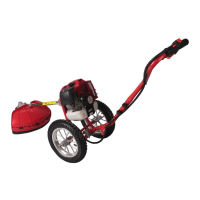
The TT-WBC520 is a wheeled grass trimmer powered by a single-cylinder, air-forced cool, 2-stroke engine. Its primary function is to cut grass and weeds using a flexible nylon line cutter. The wheeled design provides stability and ease of maneuverability, making it suitable for various trimming tasks. The engine is equipped with a centrifugal clutch mechanism, meaning the cutting attachment begins to rotate as soon as the engine starts and the throttle is engaged.
Usage Features
The trimmer is designed for user comfort and control. It features an upper and lower handle, allowing for a firm, two-handed grip. Users are advised to place their feet slightly apart, distributing weight evenly to maintain a steady posture while working. The cutting attachment should be kept below waist level for optimal control and safety.
When trimming, users should remember that only the tip of the line does the cutting. It's recommended to allow the unit to trim at its own pace rather than crowding the line into the cutting area. A slow, deliberate action is advised for heavy growth, while lighter growth may permit faster action. Sweeping from right to left can help avoid thrown debris.
The trimmer is equipped with a bump feed type nylon line head, which allows the operator to advance the line without stopping the engine. When the line becomes short, a light tap of the head on the ground while the engine is running at full throttle will advance the line by approximately 1 inch (25.4 mm). For best results, tapping the head on bare ground or hard soil is recommended, avoiding thick, tall grass that could stall the engine.
Starting the engine involves a series of steps: resting the unit on a flat, firm surface with the cutting head clear of obstructions, setting the choke lever to the closed position, setting the ignition switch to "start," pushing the primer bulb pump five or six times, and then engaging the throttle lock button and throttle lever to the "Start position." After moving the choke lever to the open position, the starter rope should be pulled quickly. Once the engine starts, the choke should be closed, and the engine run for 10-20 seconds before releasing the throttle lock button. It's important to allow the engine to warm up for several minutes before starting operation. For restarting immediately after stopping, the choke should be left open, and the primer pump pushed several times. Overchoking can make the engine hard to start, in which case the choke should be opened, and the rope pulled again, or the spark plug removed and dried.
To stop the engine, the throttle lever should be released, allowing the engine to run for half a minute, then the ignition switch shifted to the "STOP" position. Adjusting the idling speed can be done if the engine frequently stops at idling mode (turn clockwise) or if the cutting head keeps rotating after releasing the trigger (turn anticlockwise). It's important to warm up the engine before adjusting the idling speed.
Maintenance Features
Regular maintenance is crucial for the product's proper working order. Before performing any maintenance or checking procedures, the engine must be turned off. Users are warned against taking apart or altering the product, as this could lead to damage or improper operation.
Fuel handling requires careful attention due to its flammability. Mixed fuel, containing highly flammable petrol, is required. Fuel should never be stored or refilled near heat sources or open flames. Smoking while operating or refilling the unit is prohibited. When refilling, the engine must be off and cool, with no sparks or open flames nearby. Any spilled fuel should be wiped completely with a dry rag, and the fuel cap screwed back tightly. After refuelling, the unit should be moved at least 10 feet (3m) away from the refuelling spot before starting the engine. Mixed fuels left unused for a month or more can clog the carburetor or cause engine failure. For storage, the fuel tank should be emptied, and the engine run until all fuel in the line and carburetor is consumed.
The air filter should be checked monthly and cleaned in warm, soapy water. It must be dried completely before reinstallation. If the element is broken or shrunk, it should be replaced. The fuel filter should be checked for blockage if the engine runs short of fuel supply. The spark plug should be periodically cleaned, and its gap checked. When removing the spark plug, twist and pull off the cap.
The muffler should be inspected periodically for loose fasteners, damage, or corrosion. Any sign of exhaust leakage requires immediate repair to prevent fire. The intake air cooling vent and cylinder cooling fins should be checked after every 25 hours of use for blockages, removing any accumulated waste. This prevents engine overheating and potential mechanical failure.
After every 10 hours of use, the muffler should be removed, and any carbon buildup wiped away from the vent and exhaust vent. All screws, bolts, and fittings should be tightened. Any oil or grease between the clutch lining and drum should be wiped away with oil-free, lead-free gasoline.
For replacement trimming line, a diameter of 3.0mm is recommended, with the spool capable of holding up to 4m. Using a larger line may reduce trimming performance. For safety, metal-reinforced line should not be used.
When transporting the product, the cutting part should be covered if necessary, and care taken with the blade. For long-distance transport by vehicle, all fuel should be removed from the tank to prevent leakage.


 To Next Page
 General