Need help?
Do you have a question about the Erbauer ERH750 and is the answer not in the manual?
Detailed breakdown of the tool's parts and their functions.
General safety guidelines for operating power tools.
Precautions related to electrical connections and usage.
Guidelines for operator's safety, including PPE and alertness.
Best practices for using and maintaining the power tool safely.
Specific safety advice for hammer drill operations.
Warnings and advice regarding dust exposure during construction.
Information and precautions related to tool vibration.
Guidance on health monitoring and torque limiter function.
Explanation of symbols and initial safety steps before assembly.
Procedures for unpacking and preparing the tool for assembly.
Step-by-step instructions for assembling the rotary hammer.
Explains the tool's intended applications and function modes.
Details on using the switch, speed dial, and rotation control.
Instructions on how to clean the tool.
Routine checks and maintenance for tool longevity.
Guidance on power cord care and plug replacement.
Advice on storing, moving, and disposing of the tool.
Details of the 2-year guarantee and its terms.
Formal declaration of compliance with EU directives and standards.
This document provides comprehensive instructions for the Erbauer ERH750 rotary hammer, covering its functions, usage, and maintenance. It emphasizes safety precautions and proper handling to ensure efficient and safe operation of the tool.
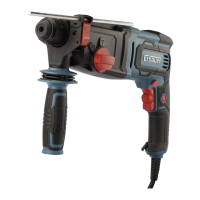
The Erbauer ERH750 is a versatile power tool designed for a range of tasks, primarily hammer drilling in concrete, brick, and stone. Its robust design also makes it suitable for light chiseling work. Beyond impact-based applications, the tool can be used for drilling without impact in various materials such as wood, metal, ceramic, and plastic, making it a multi-functional addition to any toolkit. The tool features an auxiliary handle for enhanced control and safety during operation, which is crucial for resisting rotational forces, especially when the drill bit jams. A depth stop mechanism allows for precise drilling to a predetermined depth, ensuring consistency in repetitive tasks.
The ERH750 incorporates a variable speed control, allowing users to adjust the drilling or hammering speed based on the material and application. This feature is managed via an on/off switch with variable speed control and a dedicated speed dial. For continuous operation, a switch lock-on button is provided, reducing user fatigue during prolonged use. The tool also includes a forward and reverse rotation control, which is essential for both drilling and extracting drill bits from materials. A key safety feature is the function mode selection switch, which allows users to switch between different operating modes: hammer drilling, rotary drilling (without impact), and chiseling. This switch must be depressed and rotated to select the desired mode, ensuring that the tool is set correctly for the task at hand.
Safety is a paramount concern, and the manual details numerous warnings and instructions. Users are advised to read all safety warnings carefully before operating the tool to prevent electric shock, fire, or serious injury. Personal protective equipment, including eye protection, dust masks, non-skid safety shoes, hard hats, and hearing protection, is strongly recommended. The importance of maintaining a clean and well-lit work area is highlighted, along with precautions against operating power tools in explosive atmospheres. Electrical safety guidelines, such as matching power tool plugs to outlets and avoiding body contact with earthed surfaces, are also provided. For outdoor use, an extension cord suitable for outdoor conditions is required, and for damp locations, a residual current device (RCD) protected supply is recommended to reduce the risk of electric shock.
The manual also addresses specific hammer safety warnings, such as wearing ear protectors to prevent hearing loss and using auxiliary handles to maintain control. Users are instructed to hold the power tool by insulated gripping surfaces when there is a risk of contacting hidden wiring. The importance of wearing a dust mask is emphasized, particularly when dealing with construction dust, which can contain harmful crystalline silica. The manual provides detailed information on how to reduce exposure to construction dust, including using appropriate building product sizes, alternative work methods, and approved safety equipment like dust masks and dust extraction facilities. It also warns against operating the tool above shoulder height or below knee height, as this can compromise secure handling.
A critical safety mechanism in the ERH750 is the torque limiter. This clutch system actuates when a certain torque level is reached, disengaging the motor from the output shaft and stopping the drill bit from turning. This feature is designed to prevent the drill from rotating violently if the bit jams, protecting both the user and the tool from damage. Users are instructed to immediately switch off the tool and remove the drill bit if the torque limiter actuates, to prevent premature wear.
Maintenance instructions are straightforward, focusing on keeping the product clean and inspecting it for worn or damaged parts. Users are advised to clean the tool after each use, removing debris and dust, particularly from air vents. Stubborn dirt can be removed with high-pressure air. Chemical, alkaline, abrasive, or aggressive detergents are explicitly warned against, as they can harm the tool's surfaces. Regular inspection and replacement of worn parts are crucial for safe and prolonged operation. The manual also covers power cord and plug replacement, providing clear instructions for connecting wires to the correct terminals and emphasizing the importance of using approved fuses.
The document also touches upon vibration exposure, explaining the European Physical Agents (Vibration) Directive and its aim to reduce hand-arm vibration syndrome injuries. It advises users to adopt correct working practices, use sharp chisels, drills, and blades, and maintain the tool properly to minimize vibration risk. Planning work schedules to spread high-vibration tool use across several days and avoiding use in temperatures below 10°C are also recommended. The manual highlights the importance of health surveillance for employees to identify vibration-related diseases early.
Finally, the manual includes information on recycling and disposal of waste electrical products, encouraging users to recycle where facilities exist. It clarifies that the product does not contain consumer-repairable parts and advises contacting a qualified specialist for repairs. Storage guidelines suggest keeping the tool and accessories in a dry, frost-free place, inaccessible to children, and preferably in its original packaging. Transportation instructions emphasize switching off and disconnecting the tool from the power supply, attaching transportation guards, and securing the product to prevent movement or damage during transit.
 General
| Power | 750 W |
|---|---|
| Chuck Size | 13 mm |
| Weight | 2.5 kg |
| Power Source | Corded Electric |
| Chuck Type | Keyless |
| Drill Type | Hammer Drill |
| Voltage | 230 V |
| Drill function | Hammer, Drill |

 To Next Page