EasyManua.ls Logo

EST SIGA-CT1 - User Manual

EST SIGA-CT1
4 pages
Print Icon
To Next Page IconTo Next Page
Loading...
© 2013 UTC Fire & Security Americas Corporation, Inc. 1 / 4 P/N 387021P-EN • REV 12 • ISS 23JUL13
SIGA-CT1 Single Input Module Installation Sheet
Description
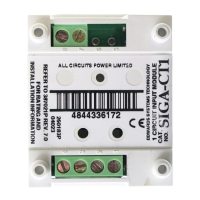
The SIGA-CT1 Single Input Module is an addressable device
used to connect a Class B initiating device circuit (IDC) to a
Signature loop controller.
The module requires one address on the signaling line circuit
(SLC). Addresses are assigned electronically. There are no
address switches.
Diagnostic LEDs provide visible indication of the state of the
module:
Normal: green LED flashes
Alarm/active: red LED flashes
Personality codes
The module requires the loop controller to download a
personality code that determines how the module operates.
Personality codes determine the operation of the circuit and
whether the activation is latched or not. Table 1 lists the
personality codes available for this module.
Table 1: Personality codes
Code
Description UL/ULC EN 54-18
1
Alarm NO latching (Class B) (default) P
2
Alarm – NO delayed latching (Class B) P
3
Active - NO nonlatching (Class B) P P
4
Active - NO latching (Class B) P P
18
Alarm - soft short latching, European
Style C (Class B)
P
Installation
Install this device in accordance with applicable requirements
of the latest editions of the local codes and standards and the
local authority having jurisdiction.
Notes
The module is shipped from the factory as an assembled
unit; it contains no user-serviceable parts and should not
be disassembled.
This module does not operate without electrical power. As
fires frequently cause power interruption, discuss further
safeguards with the local fire protection specialist.
This module does not support conventional smoke
detectors.
To install the module:
1. Write the address assigned to the module on the label
provided, and then apply the label to the module. Remove
the serial number label from the detector, and then attach
it to the project documentation.
2. Wire the module as shown inWiringon page 2.
3. Using the self-tapping screw provided, mount the wall
plate to the module. Refer to Figure 1.
4. Using the two machine screws provided, mount the wall
plate (with the module attached) to one of the compatible
electrical boxes listed in Specificationson page 2.
Question and Answer IconNeed help?

Do you have a question about the EST SIGA-CT1 and is the answer not in the manual?

Summary

Description

Personality Codes

Explains personality codes that determine module operation, circuit behavior, and latching status. Table 1 lists available codes.

Installation

Installation Notes

Module is pre-assembled, requires power, and does not support conventional smoke detectors. Discuss safeguards for power interruptions with specialists.

Wiring

Wiring Notes

Details wiring requirements, including power-limited/supervised nature, and the use of EOL resistors for unused circuits during installation.

Regulatory Information

Summary

Description

Personality Codes

Explains personality codes that determine module operation, circuit behavior, and latching status. Table 1 lists available codes.

Installation

Installation Notes

Module is pre-assembled, requires power, and does not support conventional smoke detectors. Discuss safeguards for power interruptions with specialists.

Wiring

Wiring Notes

Details wiring requirements, including power-limited/supervised nature, and the use of EOL resistors for unused circuits during installation.

Regulatory Information

Overview

The SIGA-CT1 Single Input Module is an addressable device designed for use with Signature loop controllers, enabling the connection of a Class B initiating device circuit (IDC) to the fire alarm system. This module occupies one address on the signaling line circuit (SLC), with addresses assigned electronically, eliminating the need for physical address switches.

Function Description:

The primary function of the SIGA-CT1 is to monitor a Class B initiating device circuit (IDC) and report its status to the Signature loop controller. It acts as an interface between conventional initiating devices (such as pull stations or contact-type sensors) and the intelligent addressable fire alarm system. The module's operation is determined by a downloaded personality code from the loop controller, which defines how the circuit operates and whether activations are latched.

Important Technical Specifications:

  • Operating Voltage: 15.20 to 19.95 VDC.
  • Current Consumption:
    • Standby: 300 µA
    • Activated: 450 µA
  • Ground Fault Impedance: 10 kΩ.
  • Initiating Device Circuit (IDC):
    • EOL Resistor Value: 47 kΩ, UL/ULC Listed.
    • Circuit Resistance: 50 Ω (25 Ω per wire), maximum.
    • Circuit Capacitance: 0.1 µF maximum.
  • Circuit Designation:
    • Signaling Line Circuit: Class A, Style 6 or Class B, Style 4.
    • Notification Line Circuit: Class B, Style B.
  • Wire Sizes: 12 to 18 AWG wire (0.75 to 2.5 mm²).
  • Compatible Electrical Boxes:
    • 2-1/2 in. (64 mm) deep single-gang box.
    • 4-in. square box 1-1/2 in. (38 mm) deep with single-gang cover.
  • LPCB/CPD Electrical Box Requirements: Plastic box with cover plate, no gaps or unused holes.
  • Minimum Dimensions (W × H × D): 2.4 x 3.5 x 1.5 in. (60 × 85 × 38 mm).
  • Operating Environment:
    • Temperature: 32 to 120°F (0 to 49°C).
    • Relative Humidity: 0 to 93%, noncondensing.
  • Storage Temperature Range: -4 to 140°F (-20 to 60°C).
  • Regulatory Compliance: CAN/ULC-S527, UL 864, UL 1638, CE; FCC Part 15, Subpart J, Class B; DOCClass/MDC class B; EN 54-18: 2005 Input/output devices.
  • WEEE Directive: Complies with 2002/96/EC (WEEE directive) for proper recycling.

Usage Features:

  • Addressable Technology: Utilizes addressable technology, allowing for precise identification of the module's location and status within the fire alarm system. Addresses are assigned electronically by the loop controller, simplifying installation and configuration.
  • Personality Codes: The module's operational behavior is highly customizable through personality codes downloaded from the loop controller. These codes define:
    • Alarm - NO latching (Class B) (default): Standard normally open alarm, non-latching.
    • Alarm - NO delayed latching (Class B): Normally open alarm with a delay before latching.
    • Active - NO nonlatching (Class B): Active state, normally open, non-latching.
    • Active - NO latching (Class B): Active state, normally open, latching.
    • Alarm - soft short latching, European Style C (Class B): Specific alarm behavior for European Style C Class B circuits.
  • Diagnostic LEDs: Provides clear visual status indications:
    • Green LED (Normal): Flashes during normal operation, indicating proper communication and standby status.
    • Red LED (Alarm/Active): Illuminates when the module is in an alarm or active state, providing immediate local indication of an event.
  • Wiring Flexibility: Designed for Class B initiating device circuits and compatible with various electrical boxes, including single-gang and 4-inch square boxes with single-gang covers. All wiring is power-limited and supervised, ensuring system integrity.
  • Installation Simplicity: The module is shipped as an assembled unit, requiring no user-serviceable parts or disassembly. Installation involves mounting the wall plate to the module and then securing the assembly to a compatible electrical box using provided screws.
  • Test Resistor: A test resistor is supplied with the SIGA-CT1 to prevent trouble signals on unused circuits during installation. This helps ensure a smooth commissioning process. For permanent installation, a UL/ULC Listed 47 kΩ EOLR must be installed at the end of the circuit.

Maintenance Features:

  • No User-Serviceable Parts: The module is designed as a sealed unit, eliminating the need for internal maintenance or part replacement by the user. This reduces potential for tampering and ensures consistent performance.
  • Electronic Addressing: The absence of physical address switches means there are no mechanical parts to wear out or misconfigure, reducing maintenance needs related to addressing.
  • Diagnostic LEDs: The integrated diagnostic LEDs provide quick visual checks of the module's operational status, aiding in troubleshooting and verification during maintenance routines.
  • Robust Construction: The module is designed for durability and reliability within specified operating environments, minimizing the need for frequent repairs or replacements.
  • Regulatory Compliance: Adherence to various national and international standards (UL, ULC, CE, FCC, EN 54-18) ensures the device meets stringent quality and safety requirements, contributing to long-term reliability and reduced maintenance burden.
  • WEEE Directive Compliance: Facilitates environmentally responsible disposal at the end of its life cycle, aligning with modern sustainability practices.

EST SIGA-CT1 Specifications

General IconGeneral
BrandEST
ModelSIGA-CT1
CategoryI/O Systems
LanguageEnglish