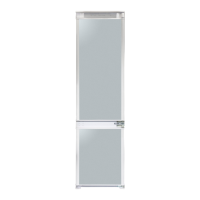
This document describes the eta 275690000E and 275690010E refrigerator-freezer, a household appliance designed for storing fresh and frozen food.
Function Description
The appliance operates as a combined refrigerator and freezer unit. The refrigerator compartment is located at the top, and the freezer compartment is at the bottom. It utilizes NO FROST technology to prevent frost build-up, ensuring maintenance-free operation in terms of defrosting. Excess moisture is automatically removed from both compartments.
The internal temperature of the refrigerator is controlled by a thermostat with four settings: COLD (warmest), COLDER (normal/recommended), COLDEST (coldest), and OFF (appliance off). The freezer temperature is adjusted via a slider in the fridge compartment, allowing for higher or lower temperatures depending on the setting.
The appliance is intended for household use and similar applications, such as staff kitchen areas, farmhouses, hotels, motels, bed and breakfast establishments, and catering. It is not designed for use at altitudes exceeding 2000 meters.
Important Technical Specifications
- Model Names: eta 275690000E, eta 275690010E
- Dimensions (approximate):
- Width (A): 600 mm
- Depth (B): 600 mm
- Height (C): 1850 mm
- Door opening clearance (D, E, F): 50 mm
- Door opening width (G): 1200 mm
- Door opening height (H): 1200 mm
- Door opening angle (I): 135°
- Climate Class: N, ST (suitable for ambient temperatures of 16°C to 38°C). Extended temperate (SN) for 10°C to 32°C and tropical (T) for 16°C to 43°C are also mentioned as general climate classes for refrigerating appliances, but the specific models are N, ST.
- Refrigerant: Isobutane (R600a), a natural gas with high environmental compatibility, but flammable.
- Electrical Components: Plug, power cord, compressor, etc., must be replaced by a certified service agent or qualified service personnel.
- Light Bulb: Special use LED lamp, not suitable for domestic lighting.
- Maximum Freezing Capacity: Specified on the rating plate (not provided in the excerpt).
- Storage Time in Case of Power Interruption: Specified in the technical characteristics chart (not provided in the excerpt).
Usage Features
- Initial Use: Before first use, wash the interior and accessories with lukewarm water and neutral soap, then dry thoroughly.
- Temperature Control:
- Refrigerator: Thermostat knob with COLD, COLDER (recommended), COLDEST, and OFF settings.
- Freezer: Slider in the fridge compartment to adjust temperature; moving it to
* makes it higher, and to ** makes it lower. The center position is recommended.
- Food Storage Guidelines:
- Do not place hot food or evaporating liquids directly on plastic parts or against the rear wall.
- Wrap or cover food, especially those with strong odors.
- Do not refreeze thawed food.
- Store pre-packed frozen food according to manufacturer's instructions.
- Avoid storing carbonated drinks in the freezer to prevent container rupture.
- Ice lollies can cause frostbite if consumed directly from the freezer.
- Raw meat and fish should be stored in suitable containers to prevent contact with other foods.
- Two-star freezer compartments are for pre-frozen food, ice cream, and ice cubes. One-, two-, and three-star compartments are not for freezing fresh food.
- If the appliance is left empty for long periods, switch it off, defrost, clean, dry, and leave the door open to prevent mold.
- Door Balconies: Removable and adjustable to accommodate different package sizes.
- Shelves: Movable, allowing flexible positioning.
- Ice Cubes: The appliance may be equipped with trays for ice cube production.
- Energy Saving Tips: Avoid putting hot food in, do not pack food too closely, ensure food doesn't touch the back wall, keep doors closed during power outages, avoid frequent or prolonged door openings, do not set the thermostat to excessively cold temperatures, and ensure all drawers, shelves, and door compartments are in their correct positions for optimal energy efficiency.
Maintenance Features
- Cleaning:
- Always disconnect the appliance from the mains before cleaning to avoid electric shock.
- Do not use metal objects, abrasive cleaners, or sharp objects to remove frost (use a plastic scraper for freezer compartments, if applicable).
- Clean the interior and accessories with a cloth and lukewarm water, then wipe with fresh water and dry thoroughly.
- Regularly check and clean the drain for defrosted water in the refrigerator compartment.
- Do not use steam cleaners.
- Avoid contact with ethereal oils, organic solvents, or acidic cleaners (e.g., lemon juice, orange peel juice, butyric acid, acetic acid) as they can damage plastic parts.
- Light Bulb Replacement: The LED light should be replaced by a qualified technician.
- Defrosting: The NO FROST technology means manual defrosting is not required.
- Troubleshooting: Before attempting any troubleshooting, disconnect the appliance from the power supply. Only qualified electricians or competent persons should address problems not covered in the manual. Normal operating sounds (compressor, refrigerant circulation) are not considered defects.
- Service: Use only original spare parts. When contacting authorized service, provide the model name (product number) and serial number (SN) found on the rating plate. The manufacturer provides a standard legal warranty of 24 months. Spare parts for selected components are available for at least 7 to 10 years from the launch of the last product piece.
- Disposal: The appliance contains gases that could damage the ozone layer and flammable insulation foam. It must not be disposed of with household waste. Follow local regulations for disposal and recycling. Disconnect the mains plug, cut the power cable, and remove the door before discarding to prevent accidents, especially with children. The refrigerant circuit contains flammable materials, so keep the appliance away from fire sources during use, service, and disposal. Packaging materials are recyclable.

 Need help?
 General

 To Next Page