22
9.2 Before installing the hob, make sure that
• The work surface is square and level, and no structural members interfere with space requirements.
• The work surface is made of a heat-resistant material.
• If the hob is installed above an oven, the oven has a built-in cooling fan.
• The installation will comply with all clearance requirements and applicable standards and regulations.
• A suitable isolating switch providing full disconnection from the mains power supply is incorporated
in the permanent wiring, mounted and positioned to comply with the local wiring rules and
regulations.
• The isolating switch must be of an approved type and provide a 3 mm air gap contact separation in
all poles (or in all active [phase] conductors if the local wiring rules allow for this variation of the
requirements).
• The isolating switch will be easily accessible to the customer with the hob installed.
• You consult local building authorities and by-laws if in doubt regarding installation.
• You use heat-resistant and easy-to-clean finishes (such as ceramic tiles) for the wall surfaces
surrounding the hob.
9.3 After installing the hob, make sure that
• The power supply cable is not accessible through cupboard doors or drawers.
• There is adequate flow of fresh air from outside the cabinetry to the base of the hob.
• If the hob is installed above a drawer or cupboard space, a thermal protection barrier is installed
below the base of the hob.
• The isolating switch is easily accessible by the customer.
9.4 Before locating the fixing brackets
The unit should be placed on a stable, smooth surface (use the packaging). Do not apply force onto the
controls protruding from the hob.
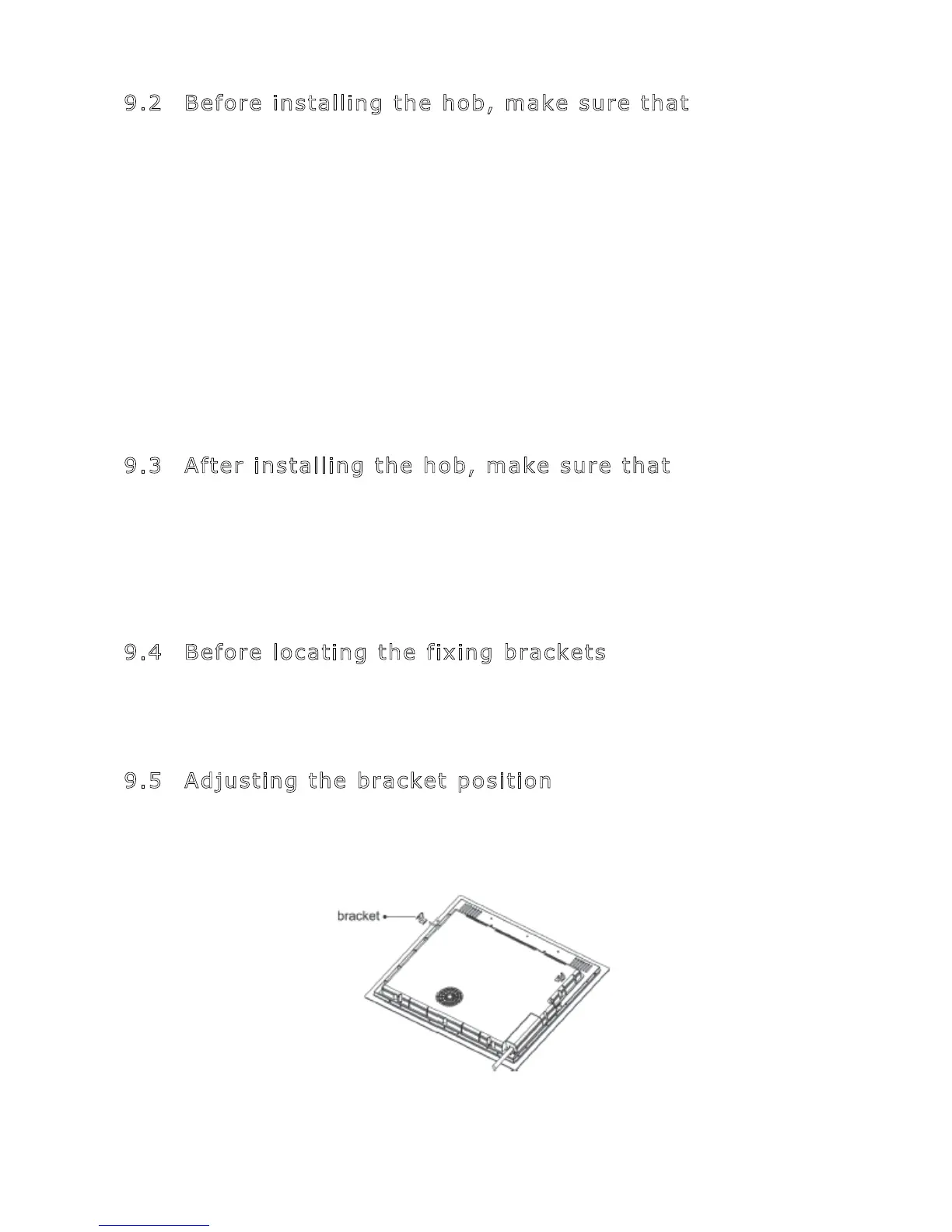
9.5 Adjusting the bracket position
Fix the hob on the work surface by screw 2 brackets on the bottom of hob (see picture) after installation.
Adjust the bracket position to suit for different table top thickness.


 To Next Page