This document provides an instruction and maintenance manual for the Everlasting Seasoning Cabinet, specifically the "Lo Stagionatore All-In-One LCD" model. The cabinet is designed for the cooling, preservation, and storage of food products in a commercial setting, with a particular focus on the maturation of salamis, cheese, or meat.
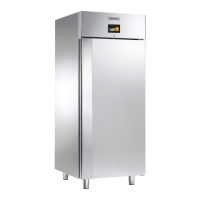
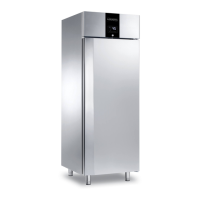
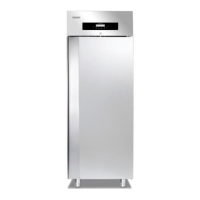
The Seasoning Cabinet is a modular monocoque structure, insulated with polyurethane foam (42 kg/m³) and covered with various materials. The control panel, located on the front, houses the condenser unit and electrical wiring. Internally, the cabinet features structures for supporting wire shelves (grids) and other accessories. The doors are equipped with an automatic return device and magnetic gaskets. Safety features include rounded internal corners, funnels for draining condensation liquids to the exterior, smooth surfaces, and fixed guards on moving or dangerous components.
Technical Specifications:
- Dimensions: The manual provides a table (Table 1) with dimensions for packaged units (cardboard, wooden crate, wooden box). For example, the 700 INOX model has packaged dimensions of 770mm (L-W) x 2240mm (H) x 895mm (P-D), a net weight of 137 kg, and a packaged weight of 149 kg.
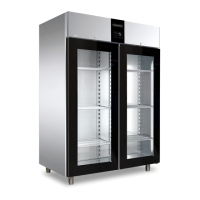
- Capacity: The 700 series models have a storage volume of 100 kg, while the 1500 series models have a storage volume of 200 kg.
- Power: The refrigerating power for 700 series models is 565 watts (1.8-1.82 Kw absorption), and for 1500 series models, it is 922 watts (2.22-2.24 Kw absorption).
- Refrigerant: All models use R404A refrigerant, with quantities ranging from 320g for 700 series to 400g for 1500 series.
- Noise Level: The noise level of the machine is below 70 dB (A).
- Operating Conditions: The cabinet is designed to operate in ambient temperatures between +10°C and +43°C. Performance may be affected outside this range.
- Power Supply: Standard power supply is 230V +/- 10% 50Hz.
Usage Features:
The Seasoning Cabinet allows for customized programming of up to 20 different programs, each divided into 6 phases (F1 to F6). For each phase, users can set temperature, relative humidity, duration, and rest pauses. Phases can be canceled depending on the product type and program.
The seasoning cycle is typically divided into four main steps:
- Cooling: Lasts several hours to prevent the formation of microorganisms and contaminant bacteria after meat processing.
- Stewing/Dripping: A few hours during which aroma diffuses into the meat, activating natural fermentation.
- Drying: Takes about six days. During this phase, the product loses a significant amount of water. This loss should be as uniform as possible, alternating between work and rest periods to maintain gut elasticity and draw water from the inside out.
- Seasoning: The duration depends on the product type. Proper humidity regulation promotes the proliferation of "Good mould," which aids in complete maturation, preservation, and healthiness.
Electronic Control Panel Description:
The control panel features several buttons for operation and programming:
- ON/OFF Button: Turns the cabinet on or off. A single press turns it on, while a 3-second press turns it off, displaying "OFF."
- Enter Button: Confirms values or accesses submenus. A 3-second press activates/deactivates the extractor fan for air recycling.
- Menu Button: Accesses the main menu and submenus. A 3-second press blocks the keyboard (displaying a white 'S' on a black background) and can deactivate the buzzer during an alarm. Pressing again unblocks the keyboard.
- Up/Down Buttons: Used for scrolling through menus and adjusting parameter values. A 3-second press of the Down button resets the current cycle to Phase 1. Pressing the Up button displays the ending date and time of the running program.
- Aux Button: Turns on the internal light. A 3-second press activates a rest period (if selected) manually during pre-set phases.
Programming Features:
Users can customize programs by setting parameters for each phase:
- Set Point (Temperature): Adjusts the desired temperature for each phase.
- Humidity: Sets the relative humidity for each phase.
- Duration: Defines the length of each phase. Setting duration to 0H inhibits a phase.
- Extractor: Controls air exchange within the cabinet. Default is 10 minutes every 10 hours. Users can modify the cyclic activation frequency. Two air exchanges per day (morning and evening) are recommended for optimal oxygenation.
- Rest: Configures cyclic product rehydration pauses. Users can choose between MANUAL or AUTOMATIC rest types. MANUAL only requires setting the duration, while AUTOMATIC requires setting delay, duration, interval, and days. The rest cycle is crucial during drying to prevent excessive surface drying of the casing, which can hinder internal moisture absorption. The casing should remain elastic and soft, not dry and rough.
- Fan Speed: Sets the evaporator fan speed (High/Low) for each phase. This is only modifiable if a dual-speed fan is installed.
- Defrost: The defrost cycle is automatic. Manual activation is possible.
- Germicidal Lamp: Can be used in some phases to limit bacterial proliferation. It activates only when evaporator ventilation is on and turns off automatically if the door is opened or defrost is running.
- Programs: Allows selection from 20 available programs.
Alarms and Diagnostics:
The system provides alarms for various issues, including:
- High/Low Room Temperature: Temperature inside the cabinet is above/below the alarm mark.
- Black Out: Lack of power. The cabinet resumes the cycle once power is restored.
- Probe Alarms: Broken room, evaporator, condenser, or humidity probes.
- Open Door: Door left open for too long (20 minutes).
- Compressor Use: Compressor running for too long in a day.
The manual includes a "Diagnostics" section (Section 7) with a table of possible causes and remedies for common problems.
Maintenance Features:
- Routine Maintenance: Performed by qualified technicians, as described in Chapter 5.
- Extraordinary Maintenance: Performed by qualified technicians authorized by the manufacturer, as described in Chapter 6.
- Cleaning: The machine is designed with materials that can be cleaned before each use.
- Cleaning the Interior and Exterior: Use a neutral detergent, not abrasive or corrosive. Clean with a cloth or sponge soaked in suitable cleaning product. Do not use water jets.
- Cleaning the Condenser: The condenser should be cleaned monthly. Access the condenser by removing the front panel. Use a brush or vacuum cleaner to remove dust and dirt.
- Periodic Checks: Monthly checks are recommended for door seals, electrical connections, and moving parts.
- Preventive Maintenance: After a prolonged period of disuse, perform preventive maintenance as described in the manual.
- Service Menu: A password-protected service menu allows authorized technicians to control working parameters, view compressor working hours, defrost durations, door openings, and save/reset parameters.
- Timer: Records compressor working hours (average on/off time, daily/hourly percentage of operation, total days/hours of operation).
- Defrost: Records duration of the last 16 defrost operations.
- Open Door: Records door openings and their duration.
- Parameters: Allows modification of various system parameters (alarms, display, defrost, configuration, adjustments, fans).
- Reset Memory: Deletes all saved data.
- Restore: Resets all parameters to original factory settings. This will block the control unit until factory parameters are re-entered.
- Input/Output: Displays the status of inputs and output relays, and temperatures of the cell, evaporator, condenser, and humidity.
Safety Regulations:
- Read the manual carefully and adhere to all instructions.
- Do not touch the unit with wet hands or bare feet.
- Do not insert screwdrivers or other objects into guards or moving parts.
- Do not pull the power cord to disconnect the appliance.
- Ensure the appliance is not used by children or unqualified persons.
- Disconnect from the electrical mains before any cleaning or maintenance.
- In case of faults, switch off the appliance and contact qualified technicians; do not attempt repairs yourself.
- The manufacturer declines responsibility for improper use or operations not following the manual.
- The manual must be kept accessible to all operators.
Client's Responsibilities:
- Electrical connection of the appliance.
- Preparation of the installation site.
- Provision of cleaning materials.
- Performance of routine maintenance.
- Preparation and mounting of the condenser unit (for Split refrigerated cabinets) or functional and electrical connections to a suitable condenser unit (for Spm cabinets).
- Adequate protection for external pipes and cables.
- In case of power failures or malfunctions, do not open doors/drawers to maintain temperature. If the problem persists, move food contents to a suitable place.
- For technical problems or service requests, contact the local dealer.
- Order spare parts by consulting the spare parts catalog, providing the correct description, reference code, and serial number.

 Need help?
 General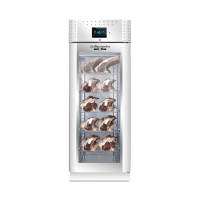


 To Next Page