Need help?
Do you have a question about the evertz 7814UDX-4K Series and is the answer not in the manual?
Details the various product variations and ordering options available for the series.
Lists and describes the different multiframe enclosures compatible with the modules.
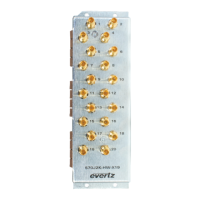
Describes the various input and output connectors, including video and reference signals.
Details the Ethernet connection requirements and cabling standards for the modules.
Explains the pin-out and functionality of the 15-pin DB GPIO connector.
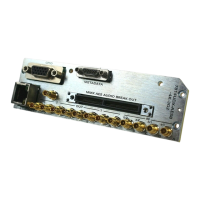
Describes the 8x AES outputs, interfacing via MMX breakout connectors.
Details the 8x AES inputs, interfacing via MMX breakout connectors.
Details the standard, number of inputs, connector, signal level, and equalization for serial digital video input.
Details the standard, number of outputs, connector, signal level, and rise/fall times for serial digital video output.
Describes the types of reference video signals accepted, connector, and termination.
Details the number, type, connector, signal level, and function of GPIO ports.
Specifies the number, standard, connector, impedance, signal level, and sampling rate for AES inputs.
Specifies the number, standard, connector, impedance, signal level, and sampling rate for AES outputs.
Covers voltage, power consumption, and compliance with FCC and EU EMC directives.
Details the number of slots required in different Evertz frames for the module.
Depicts and explains the status LEDs for both AES8 and non-AES8 versions of the module.
Provides detailed descriptions for each status LED, including Module Status, Local Fault, and input presence.
Explains how to access and use the WebEASY® interface for module configuration.
Outlines the different menu categories available within the WebEASY® interface.
Covers controls for input/output video standards, phase offsets, and video monitoring.
Details parameters for video gain, DC offsets, hue, and gamma levels for image enhancement.
Explains HDR capabilities, dynamic range selection, advanced HDR controls, and color space conversion.
Describes the controls for the 12G IO option, including frame rate, source, and delay settings.
Details the controls for video noise reduction processing using Temporal Noise Reduction.
Covers controls for adjusting horizontal and vertical filter cutoff frequencies for scaling.
Explains how to manage reference signals, including selection, monitoring, and fail-over.
Details audio controls for sample rate converters, delay, embedders, and C-Bit processing.
Describes controls for audio input gain, inversion, and delay for embedded and AES channels.
Explains the 2-channel audio mixer for inversion, gain adjustment, and mono mixing of output channels.
Covers extracting and translating closed captioning, including CDP output and CEA708 service mapping.
Details modes for passing Ancillary (ANC) data, including mapped and direct pass-through.
Explains how to configure GPIO direction, force output, and monitor GPI status.
Describes how to set the IP address, subnet mask, and default gateway for network control.
Covers configuring, storing, and recalling user presets for card settings.
Provides information on firmware revision, build number, serial number, and board details.
Allows the user to change the product string, including checksum verification.
Illustrates the locations of jumpers and LEDs on the main module boards.
Explains how the FRAME STATUS jumper monitors local faults via the global frame status indicator.
Details the purpose and installation of the slot blocker for proper module operation in frames.
Guides the user through the process of upgrading the module firmware using the WebEASY interface.
 General
| Brand | evertz |
|---|---|
| Model | 7814UDX-4K Series |
| Category | Media Converter |
| Language | English |

 To Next Page