Need help?
Do you have a question about the evertz EQT Series and is the answer not in the manual?
Safety guidelines for handling fiber optic devices and their outputs.
Precautions for handling electrostatic-sensitive devices to prevent damage.
Details on EQT router configurations, including frame sizes and source/destination counts.
Explains various methods for controlling the EQT router, like remote panels and serial.
Covers bandwidth, signal support, equalization, and fiber capabilities of the EQT router.
Highlights specific features available only for the EQT Clean Switch (-CS) versions.
Defines technical terms and abbreviations used in the manual for clarity.
Procedures for unpacking equipment, checking for transit damage, and mounting in racks.
Details on rear panel connections for video, reference, serial, Ethernet, and fiber interfaces.
Guidelines for handling fiber optic modules, including SFP installation and removal procedures.
Details Q-Link connections for control panels and serial port pinouts (RS422/RS232).
Explains Ethernet port usage for monitoring and control, including network connection guidelines.
Covers alarm connector functionality and video reference signal connections and indicators.
Details power supply operation, grounding, and NEBS compliance requirements for installation.
Specifies router configurations, input/output counts, and redundant protection options.
Details supported video signal standards, levels, impedance, and fiber optic I/O parameters.
Covers reference timing, control interfaces (Q-Link, Serial, Ethernet), and physical dimensions/weight.
Information on input voltage range, power consumption, and cooling methods for the EQT router.
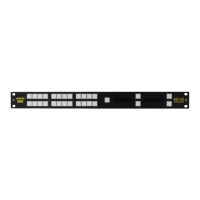
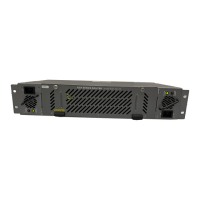
Describes the EQT router architecture and illustrates front/rear panel connections and indicators.
Guide to front panel menus for system configuration, IP addressing, and network settings.
Details SNMP configuration and monitoring of system status, crosspoint, and reclockers.
Covers engineering/debug options, frame configuration, and video signal parameter adjustments.
Explains signal monitoring, system status, and control options via Ethernet, Q-Link, and Serial.
Explains VistaLINK as Evertz' remote monitoring and configuration platform using SNMP.
Details the 'General' tab in VistaLINK, covering video input standard, Q-Link address, and PSU status.
Covers the 'Input Monitor' tab for viewing the presence or absence of video signals on each input.
Details the 'Output Control' tab for enabling or disabling video outputs on the output BNC connectors.
Manages clean/quiet paths and relays on specific outputs via the 'Clean Switch Output Control' tab.
Explains the 'Reclocker Control' tab for enabling or disabling reclockers on output BNCs.
Sets input routing to output BNCs via a matrix interface using the 'Crosspoint Control' tab.
Details the 'General Faults' tab for monitoring temperature warnings and power supply failures.
Adjusts video parameters like phase, level, and standard for clean switch routers via 'Module Control'.
Manages embedded audio and SoftSwitching on AES pairs for clean switch routers via 'Audio Control'.
Configures gain, phase, and source selection for audio outputs using the 'Audio Mixer' tab.
Monitors video loss and audio missing on inputs via the 'Clean Switch Output Faults' tab.
Introduces WinSetup and details communication port setup for Ethernet, Q-Link, and serial interfaces.
Configures the Ethernet interface for control panel connectivity using the RouterLink protocol.
Sets up the Q-Link interface for control panel connection using the Qlink (Hosted Panels) protocol.
Defines serial (COM1) and Ethernet interface settings for external automation control.
Steps to upgrade firmware on standard EQT routers using a web browser interface.
Process for upgrading EQT Clean Switch versions, including router and control panel components.
Procedure for upgrading EQTs with firmware prior to 1.0 build 001 using FTP and Telnet.
 General
| Category | Network Router |
|---|---|
| Series | EQT |
| Model | EQT |
| Ports | Varies by model |
| Protocols | Varies by model |
| Power Supply | Varies by model |
| Dimensions | Varies by model |

 To Next Page