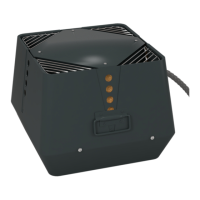
The Exodraft RS chimney fan is designed for horizontal discharge and is intended for installation on top of a chimney to create negative pressure (suction) along the full length of the flue. It is suitable for use with all types of fuel-burning appliances, particularly wood-burning fireplaces, stoves, and biomass or solid-fuel boilers. The fan is part of an Exodraft system and should be connected to an Exodraft controller for optimal performance.
The RS chimney fan is available in six sizes. Its body and casing are constructed from cast aluminium, and it is equipped with either a stainless steel axial vane or a cast aluminium impeller. All models can be opened for service and cleaning. The fan is designed to tolerate flue gas temperatures up to 250°C. For temperatures up to 300°C, the mineral wool mat should be removed and replaced with optional dilution bolts (type RSD) or vibration dampers (type SVD-RS) at the flange to create additional cooling air under the fan. All RS models, except for the RS009-41, include a motor capacitor, which is a wear part that will need replacement over time.
Scope of Supply:
Each Exodraft RS chimney fan package includes:
- Exodraft RS chimney fan
- Mineral wool mat for vibration-free mounting
- Packet with location brackets, safety wire, bolts, and nuts (including wing screws for applicable uses)
- Armoured hose
- Installation manual and user instructions
Accessories and Spare Parts:
Available accessories include flanges (for steel chimneys), cover plates (for steel and brick chimneys), RSD dilution bolts (for brick chimneys), and a rainshield. Spare parts include motors, impellers and axial vanes, mineral wool mats, SVD-RS vibration dampers (for flanges on steel chimneys), and capacitors.
Technical Specifications:
- Models: RS009-41, RS012-41, RS014-41, RS016-41, RS255-41, RS285-41
- RPM: 1400 for all models
- Voltage: 1 x 230 V for all models
- Amperage: Ranges from 0.30 A (RS009-41) to 1.20 A (RS016-41)
- Power Consumption (kW*): Ranges from 0.05 kW (RS009-41) to 0.29 kW (RS016-41) at ambient temperature of 20 °C
- Weight: Ranges from 9 kg (RS009-41) to 25 kg (RS016-41)
- Dimensions (mm): Vary by model, with A (height) from 250-405 mm, B (width) from 300-480 mm, C (diameter) from 285-450 mm, D (spigot height) from 35-100 mm, and E (spigot diameter) from 200-380 mm.
- Axial Vane/Impeller: Stainless steel axial vane for RS009-41, RS012-41, RS014-41, RS016-41; Cast aluminium impeller for RS255-41, RS285-41.
- RPM Adjustability: Infinitely adjustable
- Motor Protection IP Rating: IP54
- Insulation Class: F
- Special Models: RS009-41 and RS012-41 can also be supplied with an octagonal bottom section for circular chimneys.
- Sound Level: Below 67 dB (measured at a distance greater than one metre away from the fan) when installed correctly.
Usage Features:
- Installation: Can be mounted horizontally or vertically on both steel and brick chimneys using approved Exodraft accessories.
- Minimum Distance: Must maintain a minimum distance of 500 mm to flammable materials, adhering to national legislation.
- System Operation: For optimal use, speed adjustments and air intake adjustments are required based on external weather conditions and the stage of the firing process.
- Startup Procedure: Before lighting a fire, turn the fan on at full speed and open the air intake completely. If the control has a boost function, activate it. Once the fire has caught, reduce the fan speed to a point where flue gases are safely removed without quenching the flames. This setting should be remembered or will be automatically saved by controls with a temperature sensor.
- Refueling: To avoid smoke spillage during refueling, temporarily increase the fan speed for about 3 minutes.
- Shutdown: Leave the fan on until the heat in the flue has dissipated completely. Controls with a temperature sensor will automatically turn off the fan after a post-purge period.
- Multiple Fans: If multiple fans are required for sufficient draft, they should be of the same model and size, and controlled in tandem by one motor speed control. Special adapter plates (for brick chimneys) or plenum boxes (for steel chimneys) may be required, along with a partition between fans.
Maintenance Features:
- Cleaning: The fan's top section is hinged and can be opened for easy cleaning. Cleaning intervals depend on usage; regular use (2-3 times a week) may require semi-annual cleaning of the chimney and fan. Daily use may necessitate shorter intervals. The fan must be inspected and cleaned at least once a year, preferably by a trained professional chimney sweep.
- Cleaning Procedure:
- Switch off power to the fan using the isolation switch and ensure it is not rotating.
- Loosen the screw and open the top section, allowing it to hang on its hinges and safety wire.
- Clean the axial vane/impeller with a scraper or brush.
- Check for soot deposits in the smoke path through the fan's top and bottom sections and clean as needed.
- While the fan is open, the chimney sweep can clean the chimney.
- Ensure no weights are removed from the centrifugal impeller, as this could impair its balance.
- Motor Bearings: The motor has sealed, lifetime-lubricated, and maintenance-free ball bearings. Replacement, if needed, should be carried out by qualified personnel.
- Capacitor Replacement: The motor capacitor is a wear part and will eventually need replacement if the motor has difficulty starting. This task should be performed by a qualified electrician.
- Sealing: To prevent rainwater entry, slots and holes in the chimney fan must be sealed with silicone.
Safety Precautions:
- Always read the manual and use the product according to manufacturer's instructions.
- All installations must be carried out by properly qualified personnel in accordance with national legislation and regulations.
- The product must be earthed.
- The chimney fan must always remain switched on when the fireplace is in use.
- Ensure the chimney has been swept before mounting the fan to prevent chimney fires.
- Disconnect power before servicing the product.
- Exodraft recommends using a smoke alarm with solid fuel fireplaces.
- For solid fuel/multi-fuel installations, ensure design meets BS EN15287-1 requirements; otherwise, install a smoke alarm in the same room as the appliance.
- Fans serving biomass boilers require more frequent cleaning due to soot buildup.
- The isolation switch must be easily accessible.
- Do not overfire the fireplace/stove to avoid chimney fires caused by creosote ignition.

 Need help?

 To Next Page
 General