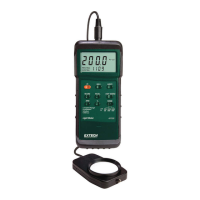
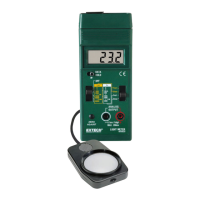
The Extech Model 401025 Digital Light Meter is a handheld instrument designed for measuring illuminance in both Lux and Foot-candles (Fc). This device is suitable for a wide range of applications, from general recreational activities and home use to industrial settings, offices, stores, and hospitals, providing accurate light level readings.
Function Description:
The primary function of the Extech 401025 is to measure the intensity of light. It utilizes an exclusive photo diode and color correction filter, with its spectrum designed to meet C.I.E. (International Commission on Illumination) standards, ensuring reliable and accurate measurements. The meter offers multiple measurement ranges for both Lux and Foot-candles, allowing users to select the most appropriate range for their specific lighting conditions. It also includes a response time selection (Fast/Slow) to adapt to different measurement scenarios. The device features a data hold function to freeze readings on the display, an analog output terminal for recording or datalogging, and a manual zero adjustment for calibration.
Important Technical Specifications:
- Display: 13mm (0.5") LCD (Liquid Crystal Display)
- Measurement Types: Lux, Foot-candles (Fc)
- Lux Ranges:
- 0 to 50,000 Lux in 3 ranges:
- 2,000 Lux: 0-1,999 Lux (Resolution: 1 Lux, Accuracy: ± (5% + 2 digits))
- 20,000 Lux: 2,000-19,990 Lux (Resolution: 10 Lux, Accuracy: ± (5% + 2 digits))
- 50,000 Lux: 20,000-50,000 Lux (Resolution: 100 Lux, Accuracy: ± (5% + 2 digits))
- Foot-candle Ranges:
- 0 to 5,000 Fc in 3 ranges:
- 200 Fc: 0-199.9 Fc (Resolution: 0.1 Fc, Accuracy: ± (5% + 2 digits))
- 2,000 Fc: 200-1,999 Fc (Resolution: 1 Fc, Accuracy: ± (5% + 2 digits))
- 5,000 Fc: 2,000-5,000 Fc (Resolution: 10 Fc, Accuracy: ± (5% + 2 digits))
- Sensor: Exclusive photo diode & color correction filter, spectrum designed to meet C.I.E.
- Zero Adjust: Manual adjustment
- Sampling Time: Approximately 0.4 seconds
- Response Time: Fast: 0.4 seconds; Slow: 2 seconds
- Over Input Indication: "1"
- Analog Output: 0.1 mV/1 digit (maximum output: 200mV)
- Operating Temperature: 0°C to 50°C (32°F to 122°F)
- Operating Humidity: Less than 80% RH
- Power Supply: 9V DC battery
- Power Current: Approximately 2 mA DC
- Weight: 220 g (0.52 lbs.)
- Dimensions:
- Main instrument: 163 x 70 x 30 mm (6.4 x 2.8 x 1.2")
- Sensor Probe: 85 x 55 x 12 mm (3.2 x 2.2 x 0.5")
- Optional Accessories: Vinyl pouch carrying case (Part Number 409996)
Usage Features:
- Unit and Response Time Selection: Users can select between Lux or Foot-candle units and choose a Fast or Slow response time using a slide switch. The typical selection for general use is Slow and Fc, indicated by gray lettering.
- Range Selection: The meter offers multiple ranges for both Lux and Fc. Users should select the maximum range that best suits the expected light level to ensure the most accurate reading. For instance, a reading of 1456 Fc should be taken on the 0-2000 Fc range, not the 0-5000 Fc range, to maximize digit count without exceeding the range.
- Measurement Procedure: To take a measurement, the light sensor should be held facing the light source. The LCD will display the measured value.
- Display Multipliers: For certain ranges (Lux 20,000, Lux 50,000, and Fc 5,000), the displayed reading must be multiplied by a factor (x10 or x100) to obtain the actual value. For example, a reading of 350 on the 5000 Fc range means the actual value is 350 x 10 = 3500 Fc.
- Data Hold: A slide switch allows users to freeze the current measurement on the display, which remains held until the switch is released.
- Over Range Indication: If the display shows "1", it indicates an over-range condition, and the user should switch to a higher measurement range.
- Analog Output: The front panel features analog output jacks that provide a 0.1mV DC per digit signal. This feature is useful for connecting the meter to recording devices or dataloggers for continuous monitoring or data collection.
- Lighting Type Correction Factors: The meter is calibrated under a standard tungsten light source (2856°K). For measurements taken under different light sources (e.g., Mercury Lamp, Fluorescent Lamp, Sodium), specific correction factors must be applied to the readings to ensure accuracy. For example, a Mercury Lamp reading requires a x1.14 correction, while a Sodium lamp requires a x1.22 correction. Daylight and Metal Halide sources typically use a x1.00 factor. Fluorescent lamps have a range of x0.92 to 1.12.
Maintenance Features:
- Zero Adjustment: The meter's zero point may drift over time. To maintain accuracy, occasional zero adjustment is required. This involves completely covering the light sensor to block all light, setting the range switch to the lowest Lux or Fc range, and then using a small screwdriver to adjust the Zero control until the display reads zero. Minor fluctuations in the last digit are normal and do not affect accuracy.
- Battery Replacement: The LCD display will show "LO BAT" when the battery output falls below the design limit, indicating that the 9V battery needs to be replaced. While the meter may continue to function for a few hours, replacing the battery promptly ensures reliable measurements. The battery compartment is located at the rear of the device.
- Disposal: The manual emphasizes responsible disposal of both used batteries and the instrument itself. Batteries should be taken to appropriate collection sites, and the instrument, being an end-of-life electrical and electronic device, must be disposed of at a designated collection point, not in household waste.

 Need help?
 General



 To Next Page